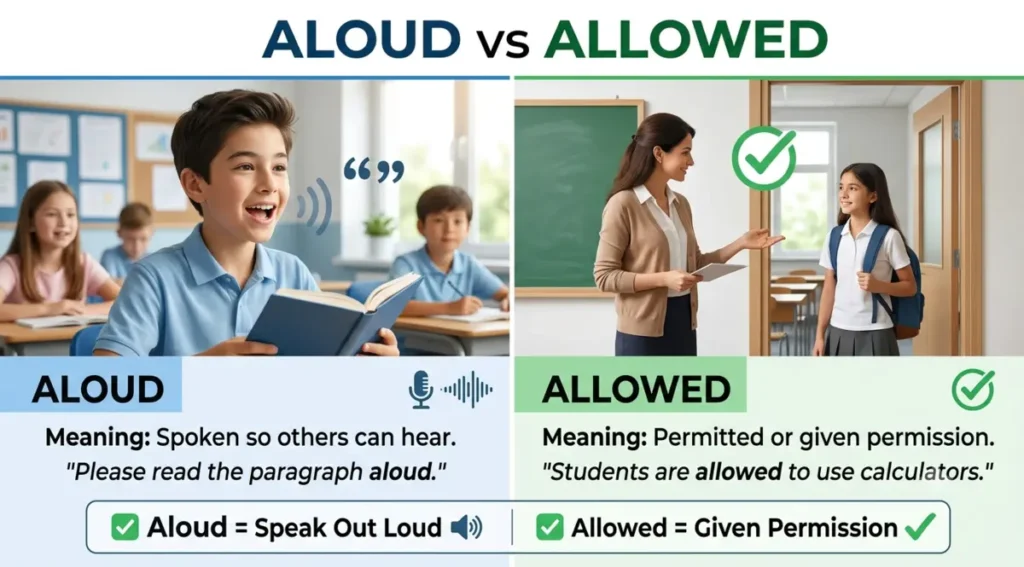
Ever thought of writing “read aloud” or “read allowed“? Or wondered if they can speak or wanted to speak loudly? You’re not alone. The pronunciation of these two words is very similar and are among the most frequently confused pairs of words in English.
Well, aloud and allowed sound alike but have very different meanings and are used differently in the grammar. If you use the wrong one, it can alter the meaning of a sentence and affect the quality of your writing, particularly in emails, schoolwork, business documents and communication with your peers and colleagues.
You will find here when to use aloud and allowed, tips on remembering the difference, common errors to watch out for, useful real-life examples of each, grammar information and answers to common questions. At the end you’ll be able to pick the right word every time.
Aloud Allowed Quick Answer
Aloud out loud, meaning that it is spoken out loud.
She read the book to them.
Allowed permitted, or given permission.
Students are allowed to use calculators.
Quick Takeaway
- Inaudible = Too quiet for anyone to hear
- Allowed: Permitted/Authorised
Read more:Hanged or Hung: What’s Difference and Which You Use
Each word means:
The word “aloud” means to make a sound, either spoken or sung.
Definition
Aloud: using the voice, not silent.
Pronunciation
/əˈlaʊd/
Part of Speech
Adverb
Read more:Laying or Lying: What’s Difference and Which One You Use
When to Use “Aloud”
Say aloud when someone is talking, reading, laughing, crying or thinking aloud.
Common Contexts
- Reading aloud
- Speaking aloud
- Thinking aloud
- Laughing aloud
- Praying aloud
Memory Trick
Think:
ALOUD = AUDIO
Both are related to sound.
Examples
- Please read the paragraph aloud.
- She burst out laughing and laughed so hard she let out a few sneezes.
- He counted aloud.
- The teacher invited all of the students to respond verbally.
- I shared my thoughts with some of my voice.
What Does “Allowed” Mean?
Definition
Permitted, authorised, or given permission is allowed.
The past tense and past participle of “allow.
Pronunciation
/əˈlaʊd/
Part of Speech
Verb (past tense/past participle)
Use “Allowed” when it is appropriate to use it.
Use when the use of permission is involved.
Common Contexts
- School rules
- Company policies
- Legal permission
- Parents giving permission
- Website access
Memory Trick
All of the words allowed are present in the word.
If there is a permission, it is allowed.
Examples
- No cell phone is permitted in this area.
- We got to leave early.
- After 5pm visitors are welcome.
- She wasn’t allowed to drive.
- Children can have 1 dessert.
Key Differences
| Feature | Aloud | Allowed |
| Meaning | Spoken so that others can hear | Permitted or authorised |
| Part of Speech | Adverb | Verb (past tense/past participle) |
| Related Word | Loud | Allow |
| Used With | Speaking, reading, laughing | Permission, rules, policies |
| Example | Read it aloud. | You are allowed to read it. |
| Memory Trick | Audio = sound | Allow = permission |
Word Origin (Etymology)
Aloud
Aloud is derived from the words “to speak out” or “loud enough to hear. Eventually it became the common term for audible speech.
Allowed
The word allowed is derived from the verb allow, and was brought to English through Old French, from the Latin allaudare, meaning “to approve” or “to praise. The meaning of it slowly evolved to permission.
Why They’re Confused
They’re pronounced the same in most English accents, making them homophones. They are homonymous words, and if written can be misspelled.
British English vs American English.
The good news is that there is no difference in the spelling of British and American English.
| Feature | British English | American English |
| Aloud | Same | Same |
| Allowed | Same | Same |
| Pronunciation | Nearly identical | Nearly identical |
| Usage | Same | Same |
Examples
British:
Please read the poem aloud.
American:
Visitors aren’t allowed beyond this point.
Both forms are acceptable all over the world.
Which one would you choose:
American Readers
For audible speech use aloud and for permission use allowed.
British Readers
The same goes for that.
International Readers
There are no regional variations and these meanings remain unchanged in the English
speaking countries.
Academic Writing
Always select the word for meaning. You should double check because this is likely to be a spell check mistake.
Business Writing
If you use the right word, it demonstrates professionalism.
Example:
✅ Employees are allowed to work remotely.
Not:
❌ No one is allowed to come to work.
Everyday Communication
Ask yourself:
- Is someone speaking?
→ Aloud
- Are there people who are authorized to grant permission?
→ Allowed
Common Mistakes
1
❌ Read the passage allowed.
✅ Read the passage aloud.
Why? You’re talking about speaking.You’re talking about talking.
2
❌ Students are aloud to leave.
✅ Students are allowed to leave.
Permission requires allowed.
3
❌ She laughed allowed.
✅ She laughed aloud.
Laughing is audible.
4
❌ Pets aren’t aloud.
✅ Pets aren’t allowed.
Rules require allowed.
5
❌ Think allowed.
✅ Think aloud.
You’re articulating your thoughts.
6
❌ Cameras are aloud.
✅ Cameras are allowed.
Permission is involved.
7
❌ Read it allowed.
✅ Read it aloud.
Reading aloud is a way of reading by speaking.
8
Talking is not allowed here!
✅ Talking isn’t allowed here.
The sentence refers to rules.
9
She stated that it was allowed by.
✅ She said it aloud.
She spoke audibly.
10
❌ Visitors are aloud after noon.
✅ Visitors are allowed after noon.
The answer is permission.
Everyday Examples
Emails
Staff to work from home on Fridays.
School
Read the first paragraph out loud.
Business
Contractors are allowed to enter with identification.
News
Protesters were allowed to gather peacefully.
Books
He read out the answer which he had written, and he did so softly.
Social Media
I took the liberty of reading that comment.
Daily Conversation
May we park here?
Grammar Tips
Aloud
- Adverbs are used to describe verbs.
- Typically associates verbs with the following nouns:
- read
- speak
- laugh
- cry
- Shout
- Think
Examples:
Read aloud.
Say it aloud.
Allowed
- Common patterns:
- allowed to
- not allowed
- be allowed
Examples:
- Entry is permitted.
- Smoking isn’t allowed.
Easy Memory Tricks
Trick 1
Aloud = Audio
Both involve sound.
Trick 2
Allowed = Allow
First, to get permission, one must use the word allow.
Trick 3
Ask yourself:
Can people hear it?
→ Aloud
Is permission involved?
→ Allowed
Google Trends & Usage
There are a number of common misspellings that are homophones that are likely to be confused in writing, such as aloud or allowed, and this is one such misspelling. Searches are more likely to happen throughout the school year when students are doing tasks such as assignments and when professionals are proofreading documents.
Typical questions that users ask are:
- Which is the right spelling:
- The difference between the words
- Grammar rules
- Example sentences
- Some easy-to-remember differences:
Related Words
Accept vs Except
Accept: to take in. Except is a word that means “excluding.”
Affect vs Effect
Affect is typically a verb. Effect typically is a noun.
Principal vs Principle
The word principal means “head teacher” or “primary importance. Principle is a rule or belief.
Complement vs Compliment
Complement completes something. Compliment is praise.
There vs Their vs They’re
An old fashioned shot with position, possession and a contraction.
Frequently Asked Questions
1.Is it “read aloud” or “read allowed”?
The proper word is spoken out loud, that is, read using the voice, so that people can hear it. Allowed means permitted and therefore doesn’t have this meaning.
2. Do aloud and allowed rhyme?
Yes. They are homophones, meaning that they have a very similar pronunciation, but different meaning and spelling, in most English accents.
3. Is aloud a verb?
Aloud means in a loud voice, and is an adverb.
4. Is always allowed about permission?
Yes. Always is used in reference to permission, approval or authorisation.
5. May I say “think aloud”?
Yes. The phrase “think aloud” is frequently used to indicate verbally describing what you are thinking.
6. why is this error sometimes not caught by the spellchecker?
Spell-check is not a great tool for finding misspelled homophones.
7. What is the fastest way to remember the difference?
Remember:
- Audio → Aloud
- Allow → Allowed
This is a simple association that will work in almost all scenarios.
8. Which word is more common?
Both are very common, but they can be used in different contexts. Allowed is used more often when talking about rules, permissions; aloud is used when talking about speaking or reading out loud.
Key Takeaways
- Aloud – to speak out loud so that others can hear.
- Allowed means permitted.
- Aloud is an adverb.
- The past tense and past participle of allow is allowed.
- Aloud is associated with the sound.
- The word allowed means to be given permission; to have authorization.
- Check if the sentence is based on hearing or permission.
- Be careful about proof-reading as your spell-check might not pick up the error.
Conclusion
The difference in the meanings of aloud and allowed is easy to remember once you understand it; they sound the same. When you’re using aloud, you’re talking to the point where others can hear you, when you’re using allowed, you’re talking about permission, rules and what you can be allowed to do. Knowing this difference will assist you in communicating with greater accuracy in school assignments, workplace emails and social media posts and in common conversation.
As long as you’re in doubt, ask yourself one simple question: Is this sentence about sound or permission? If it’s the voice that is the problem, select aloud. If it is a matter of permission or rules, select allowed. This is one easy way to avoid a common homophone error in English.
Continue to practice with real-life scenarios and remember, it’s okay if you make a mistake here and there. Fluently speaking English, these words are sometimes mixed up. The memory tricks and examples provided in this guide will help you use aloud and allowed confidently at all times.

I am Bahadar Ali, a professional content writer and the author behind GrammarDrive.com. I am passionate about making grammar simple and accessible for everyone. Through my writing, I aim to help learners and professionals communicate with clarity and confidence.