You put out a message to a friend, or stop. Grateful or Great? Your fingers are on the keyboard, your mind is working to recall the meaning behind the word.
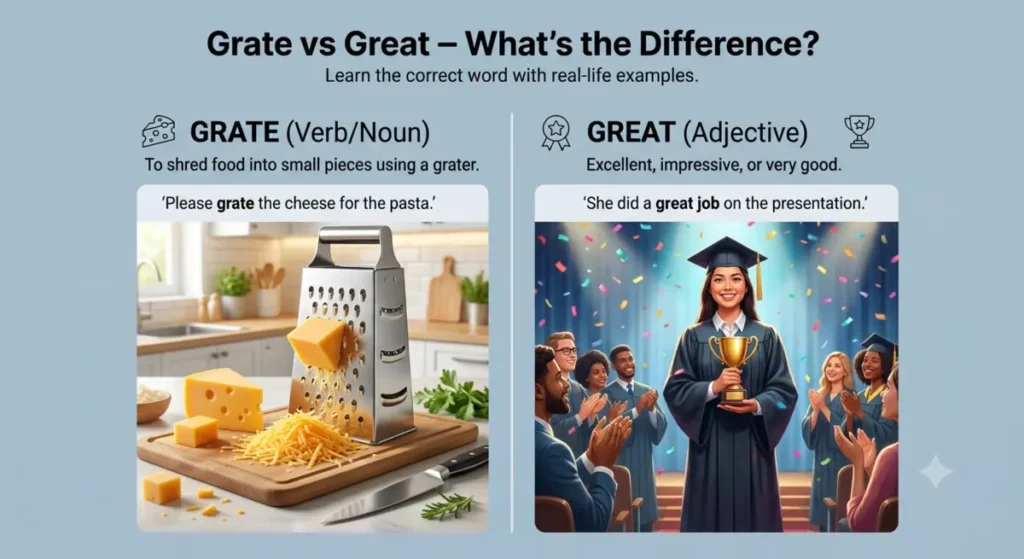
You’re not alone. Grate‘ is a homophone with the word ‘great‘, meaning they sound exactly the same when spoken aloud but have entirely different meanings. One is the process of shredding cheese. The other is related to excellence. They may be fun to play with in a text message but not in a resume, work email or a school essay.
This book tells you all you need to know about grate vs. great. You will understand the meaning of each word, you will see examples of words you will learn, learn simple tricks to help you remember words, and learn what are the most common mistakes people make. At the end of course, you will no longer need to second-guess yourself.
Grate or Great – Answer to the Question
In case you aren’t in the mood for a long story, here it is:
- Grate is the verb (and sometimes the noun) for shavings made with a rough tool, such as grating cheese. It also can refer to making a bothersome sound, or to bother someone (“that habit is a real nuisance”).
- The word great is an adjective with the meaning excellent, large or impressive. It is used to refer to a thing that you admire or something of great size or importance.
Read more:Hear vs Here: What’s the Difference? (+ Easy Examples)
Quick example:
- Is it possible to grate the cheese for the pasta?
- This was a terrific pasta!
Grate: Use for shredding or when you are describing an irritating sound. Use great when you’re commending something or explaining how big or important it is.
Read more:What’s the Difference? Aloud and Allowed
Meaning of each word
Grate
Definition:Grind, crush, or slice into small pieces with a rough, sharp surface: grate (usually food): It also implies to make a rough, grating noise or to make rough.
Part of speech: Verb (most common use); also a noun, a metal frame, e.g. a fireplace grate or a drainage grate.
Pronunciation: Rhymes with “gate” — /greɪt/
When to use it:
- However, they are typically used for cooking instructions, such as grating cheese, vegetables or spices.
- To give a description of a sound that is disagreeable: the sound of metal rubbing on metal
- Satisfying one’s annoyance: to “satisfy someone’s itch”
- Referring to a physical grate, like a drain cover or fireplace grate
Common contexts: Recipes, cooking shows, complaints about annoying habits, home repair / plumbing
Memory: Remember that R stands for rough, like a grater roughs food.
Examples:
- She sprinkled some fresh parmesan on top of the salad.
- The grated chalk made everyone cringe in the face of the black board’s surface.
- He keeps tapping on the desk, it is really irritating me.
- The water was running through the metal grate in the street.
Great
Definition:Greatness: excellence, wonder, admiration, impressiveness. It is also used for something that is large in size, extent or degree or important in significance.
Pronunciation: ADJECTIVE (mainly); also as an interjection (informal) ‘Great!’
Gender: Also spelt gate, it is a masculine word.
When to use it:
- Praising others, locations, ideas or experiences.
- To say how big or large something is, or how much of something there is (a great distance, a great amount)
- Demonstrating enthusiasm/agreement.
- Historical or Formal names (“Alexander the Great,” “the Great Depression”)
Uses: Reviews, conversation, compliments, history, business communication
Memory trick: Great has an A for ” Awesome” – great things are awesome, admirable, and impressive.
Examples:
- It’s a good film — would watch again.
- The Great Wall of China is many thousands of miles long.
- Our concert last night was wonderful!
- Do you need any help with moving this weekend? “See you Saturday! Great!
Key Differences
| Feature | Grate | Great |
| Meaning | To grind (food) or to make a harsh noise; to cause irritation (of food). | Excellent, impressive, large, or important |
| Part of Speech | The word verb, which is used mainly and is also a noun. | Adjective |
| Common Usage | Describing annoyance, cooking, plumbing. | Compliments, praise, describing scale |
| Example | Grind the cheese. | This is a fine idea! |
| Easy Memory Trick | Rough surface, R – rough. | A for “awesome” |
Word Origin (Etymology)
The word grate is derived from the Old French verb grater, meaning “to scrape or scratch”, from a Germanic root related to scraping. In the late Middle Ages, the word came into English, and maintained its basic meaning of “to scrape into small pieces” or “to make a scraping noise”.
On the contrary, the Old English word great means “big, coarse, or thick. Its meaning, however, evolved over the centuries from physical size to significance, quality and excellence. Hence our use of both “great” and “big” for size, e.g. “a great mountain”, and for quality, e.g. “a great performance”.
Both words are derived from completely different origins but due to the phonetic changes within English, the words became indistinguishable. That’s why people often mix them up these days: the ear can’t tell them apart, the context and the spelling can
.
British English/American English.
Bad news: The meaning, spelling and pronunciation of the words grate and great is the same in British English and American English. In the two dialects the same word is both written and said the same.
| Feature | American English | British English |
| Spelling | grate / great | grate / great |
| Pronunciation | /greɪt/ | /greɪt/ |
| Preference | No difference | No difference |
| Example | Grate the cheese; that’s a great recipe. | Cheese Flakes are a great recipe for grating. |
This is a homophonic confusion, meaning it affects American, British, Australian and Canadian English speakers alike, as the confusion is due to how the word is pronounced, rather than the actual spelling of the word.
Which One Should You Use?
American English: grate = for cooking or irritation, great = excellent or big. There is no regional variation to be concerned with.
British readers: as per above. These words are used the same way in British English as in American English.
International readers (ESL): These words are homophones, so it is not enough to listen to them to distinguish them. If it is a food, sound or annoyance, it probably means “grate”: When it comes to praise or size, it’s “great.
Academic writing: Make sure to proofread spelling errors in essays. Spell-check programs will not pick up this misspelling because the words are spelled right, but used wrong.
Business writing, such as “That’s a grate proposal!,” can make you look like you didn’t pay attention to the details and undermine your credibility. Proofread carefully.
Everyday communication: The error occurs in writing and in everyday speech, and generally does not matter much but should be corrected to make the text clearer.
Common Mistakes
Here are some of the most common grate vs. great mix-ups and corrections.
1.❌ Wow it was an awful film! ✅ Ooh wow, this was a good film! Why: You’re not going to compliment the quality of the movie, you’re not going to tear it up.
2.❌ Can you give the tacos some cheese? ✅ Can you give the tacos some grated cheese? Why: This is a cooking instruction you will need a verb for “grate.”
3.❌ He has a grate sense of humor. ✅ He has a great sense of humor. Why: Admirable quality is described here as ‘Great’.
4.❌ The noise from the construction site was really great on my nerves. ✅ The noise from the construction site was really grating on my nerves. Why: The term ‘grating’ comes from ‘grate’, meaning something that is irritating.
5.❌ We had a grate time at the beach. ✅ We had a great time at the beach. Why is it you want to write about it?
6.❌ Please great the carrots into thin strips. ✅ Please grate the carrots into thin strips. Why: This is not a compliment, it is cooking action.
7.❌ That’s grate news! ✅ That’s great news! Why: “Great” means excited/approving.
8.❌ The metal fence has corroded over time.✅ The metal fence rusted over time. (Or: The wind made the metal fence rattle when it blew.). Why: “Grate” means a scraping sound or action not general wear.
9.❌ She’s a really great cheese enthusiast — always grating new flavor. ✅ She’s a really great cheese enthusiast — always grating new cheeses. Why: because you “grate cheese” you don’t “grate flavors.
10.❌ It was an honour to meet you. ✅ It was a great honour to meet you. Why: “Great” is used to describe the level of importance or admiration.
Everyday Examples
Telephones: “Thank you for your efforts on the quarterly report — the numbers were very well presented.
School writing:The correct answer to the question in school writing is “Alexander the Great established one of the greatest empires in ancient history.
Business communication: “Thank you for all the positive feedback in today’s meeting.
News:The Great Barrier Reef is confronted with additional environmental issues this year, according to news.
Books: It was the best of times, it was the worst of times – a wonderful beginning quote from Dickens.
Social media:“Just tried this new zucchini recipe — you grate it first, then add the parmesan. Great weeknight dinner!”
Everyday talk: “Would you like to grate some ginger for the tea? It’s going to be delicious when served with honey.
Grammar Tips
Position of the sentence: The word “great” usually comes before a noun (a great idea) or after a linking verb (this is great). The most common usage of the verb “grate” is as the principal verb in a sentence (I grate the cheese) or as a noun with the definite article (the grate, a grate).
Common collocations:
- With great: great idea, great job, great time, great deal, great distance, great importance
- With grate: to crush between plates, cheeses, etc., with a knife with a sharp edge.Grating on someone’s nerves: to grieve or be grieved by.
Verb forms ofGrate:Grated forms of the verb: grated, has grated, grating, grate. The word great is an adjective and doesn’t have any forms of the verb.
Punctuation:No special rules of punctuation are used for either word; however, take care in using exclamation points with the interjection Great! as too many will make it less effective to use in professional writing.
Easy Memory Tricks
- Grate = Rough. Imagine a metal grater with rough edges, used to grate cheese. The “R” in grate is to remind you of the word rough and the word rasp.
- Great = Awesome. Use the words ‘that’s great’ as a mini celebration. You might also remember the “A” in “great” by thinking of “Amazing.
- Sound test: If you can find a word that could be replaced by “shred” or “annoying,” then grate. Use great if it can be replaced with excellent or huge.
- Visual Trick: The holes of a grater are jagged and sharp, similar to the sharp angle of the letter “R”. Great has letters that curve round, as smooth as a compliment.
Google Trends & Usage
The overall use of the two words is very different: great is far more frequent, as it is a highly frequented adjective, appearing in review, conversation and writing on any topic. “Grate” is a more niche term, associated primarily with culinary purposes and certain sounds and/or sensations of irritation, so it has a relatively limited search volume.
People also seem to find themselves stumbling over the two, as evidenced by the increased level of “how to grate cheese without a grater” and “grate or great in a sentence” searches around the cooking time and the proofreading period, respectively. It is a common error among both native speakers of English and ELLs because spell-check programs do not always identify it as an error. The search intent for “grate or great” is almost always disambiguation: the intention is to have a fast and clear answer to close down uncertainty before completion of the sentence.
Related Words
English has all sorts of confusing homophones and near-homophones. Here are some more you may encounter:
- Affect vs. Effect: The word affect is typically a verb that indicates to have an effect on something. Typically, the word “effect” is a noun that describes a result of a change.
- Accept vs. Except: Accept means to receive or agree to something. Except means to exclude.
- Principal vs. Principle: Principal – someone in charge, the most important thing (as in principal of a school) Principle is defined as a fundamental rule or belief.
- Straight vs. Strait: The word “straight” refers to not curved. “Strait” is used to describe a narrow passage of water or a difficult situation.
Frequently Asked Questions
1.Has it holes in it or is it full of holes? It’s “grate.” A small sharp hole covered kitchen utensil used to grate foods, such as cheese or vegetables. Great only means something is excellent and not holes.
2.What is the spelling of “great job”? It is spelled, “great job”, where “great” is the adjective meaning “excellent” or “impressive”. The correct term for the job is “praise” as “grate” means to tear, make rough or irritated.
3.Why is it that grate and great sound the same? They are homophones – words that say the same thing but have different meanings and origins. The Old French word grate means “to scrape” and the Old English word great means “big. They were just pronunced the same thing over time.
4.Does “grate” ever come in as an expression of praise? NO. “Grate” is always related to shredding, scraping sounds or irritation. When you’re praising someone or something, you always go with “great.
5.What does great mean to shred? No 1: ‘Great’ is an adjective meaning ‘good’, ‘large’ or ‘important’. It is not ever used as a verb to refer to cutting or shredding.
6.How can you easily keep the distinction while writing at speed? Use the substitution technique: substitute “excellent” for the word in your head. If it still makes sense, then use “great”. If it does not, and the word is shredding or sound, use “grate.
Key Takeaways
- Grate primarily means to cut into pieces, make a rough noise or rub down, as in “grate with your teeth” and “grate against someone’s teeth”, it can also mean for a metal grating.
- Great is an adjective (describing word) that means excellent, impressive, large or important.
- Both words sound the same and that’s why they are often confused in writing.
- American and British English are spelled and used exactly the same.
- Swap in the words “excellent” or “shred” for a fast check of which word is the proper one.
- Read emails, essays, and writing for work carefully; spell-check will not find this error.
Conclusion
This may seem like a double meaning, but grate and great are two very different words. Grate in the kitchen, when referring to a rough sound, and when you’re irritated. The word “great” can be used anywhere you want to convey a sense of excellence, admiration or scale.
The bad news is that the confusion seems to dissipate quickly once you know the origins of each word (grate comes from the word to scrape, great comes from the word big! If in any doubt, always perform the quick substitution test and watch out for the common pitfalls above, then use the memory tricks in this guide.
You will no longer have to pause and guess when you come to write the text, the e-mail or your essay. You’re sure to know when it’s time to press the grater or extend the compliment.

I am Bahadar Ali, a professional content writer and the author behind GrammarDrive.com. I am passionate about making grammar simple and accessible for everyone. Through my writing, I aim to help learners and professionals communicate with clarity and confidence.