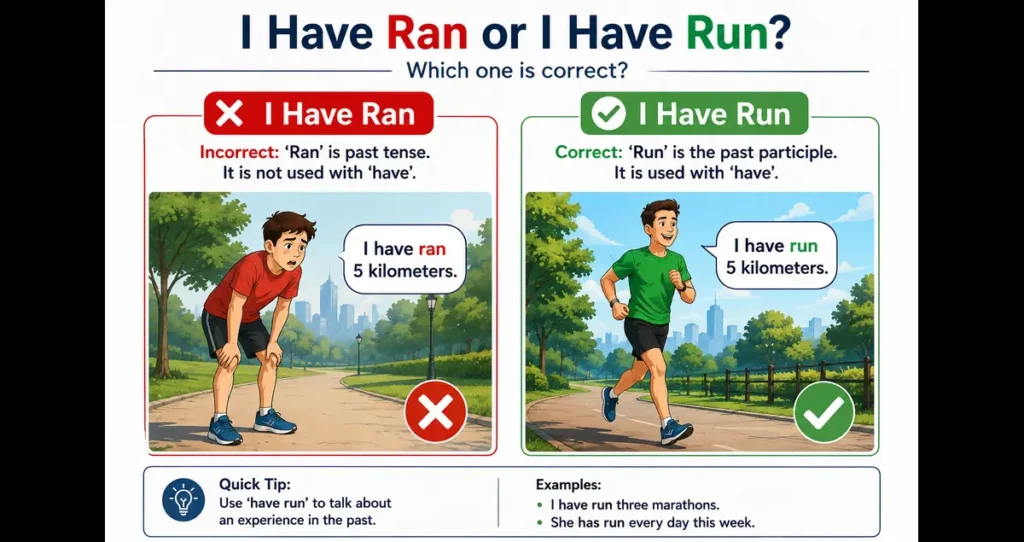
Many English learners and even native speakers ask the same question: “I have ran or I have run?” The confusion happens because both words come from the verb run, and both are used when talking about past actions. At first glance, they seem similar, but only one is grammatically correct in the present perfect tense.
People search for this keyword because they want to write correct English in emails, school assignments, business communication, and social media posts. Using the wrong form can make writing look less professional and may confuse readers.
The good news is that the rule is simple. Once you understand the difference between ran and run, you can avoid common mistakes and use the correct form every time.
In this guide, you will learn the quick answer, the history behind the words, differences in English usage, common mistakes, examples, trends, and expert advice on when to use each form.
I Have Ran or I Have Run? – Quick Answer
Correct: I have run ✅
Incorrect: I have ran ❌
The phrase “I have run” uses the present perfect tense. After have, has, or had, English requires the past participle form of the verb.
Examples:
- I have run five miles today. ✅
- I have run this race before. ✅
- I have ran five miles today. ❌
- I have ran this race before. ❌
Read more:A MBA or an MBA? Which One Is Correct?
Remember:
| Verb Form | Example |
| Base Verb | run |
| Past Tense | ran |
| Past Participle | run |
The Origin of I Have Ran or I Have Run
The verb run comes from Old English rinnan and irnan, which meant “to move quickly on foot.”
English inherited many irregular verbs from its Germanic roots. Unlike regular verbs that simply add -ed, irregular verbs change form over time.
For the verb run:
- Present: run
- Past: ran
- Past Participle: run
Because the past tense and past participle are different, many people mistakenly use ran where run should be used.
The confusion has existed for centuries because the forms sound similar and are often heard in casual speech.
Read more:Check In or Check In: Which Spelling Is Correct?
British English vs American English Spelling
Unlike many English words, run and ran are spelled the same in both British and American English.
The grammar rule is also identical.
British English Examples
- I have run a marathon.
- She has run the company for years.
American English Examples
- I have run a marathon.
- She has run the company for years.
Comparison Table
| Usage | British English | American English |
| Present Tense | I run | I run |
| Past Tense | I ran | I ran |
| Present Perfect | I have run | I have run |
| Past Perfect | I had run | I had run |
| Correct Grammar Rule | Same | Same |
There is no spelling difference between the two varieties of English for this verb.
Which Spelling Should You Use?
The answer depends on grammar, not location.
If You Are Writing for a US Audience
Use:
- I have run
- She has run
- They have run
If You Are Writing for a UK or Commonwealth Audience
Use:
- I have run
- She has run
- They have run
If You Are Writing for a Global Audience
The same rule applies worldwide.
Use “run” after have, has, or had.
Examples:
- I have run three businesses.
- She has run the event successfully.
- They had run out of time.
Common Mistakes with I Have Ran or I Have Run
Many learners mix up the past tense and past participle forms.
Mistake 1
❌ I have ran to the store.
✅ I have run to the store.
Mistake 2
❌ She has ran every day this week.
✅ She has run every day this week.
Mistake 3
❌ They had ran out of money.
✅ They had run out of money.
Mistake 4
❌ We have ran many campaigns.
✅ We have run many campaigns.
Easy Rule
If you see have, has, or had, use run, not ran.
I Have Ran or I Have Run in Everyday Examples
Emails
✅ I have run the final report and attached it.
✅ I have run the numbers again for accuracy.
News Writing
✅ The athlete has run faster than expected.
✅ The company has run successful projects worldwide.
Social Media
✅ I have run my first marathon today!
✅ I have run 10 kilometers this morning.
Formal Writing
✅ The organization has run educational programs since 2010.
✅ Researchers have run several experiments.
I Have Ran or I Have Run – Google Trends & Usage Data
Search interest for “I have ran or I have run” remains steady because many learners struggle with irregular verbs.
The query is common in:
- United States
- United Kingdom
- Canada
- Australia
- India
The phrase is usually searched by:
- English learners
- Students
- Job seekers
- Business professionals
- Content writers
In modern English, “I have run” is overwhelmingly accepted in grammar guides, dictionaries, schools, and professional writing.
Comparison Table: Keyword Variations
| Phrase | Correct? | Explanation |
| I have run | ✅ Yes | Present perfect form |
| I have ran | ❌ No | Incorrect grammar |
| I ran | ✅ Yes | Simple past tense |
| I had run | ✅ Yes | Past perfect tense |
| She has run | ✅ Yes | Present perfect tense |
| She has ran | ❌ No | Incorrect grammar |
| They have run | ✅ Yes | Present perfect tense |
Frequently Asked Questions
1. Is “I have ran” ever correct?
No. Standard English grammar requires “I have run.”
2. Why do people say “I have ran”?
Many speakers confuse the past tense (ran) with the past participle (run).
3. Is “I ran” correct?
Yes. I ran is the simple past tense.
Example:
- I ran yesterday.
4. Is “I have run” present or past tense?
It is the present perfect tense.
5. What is the past participle of run?
The past participle is run.
6. What comes after have, has, and had?
Use the past participle form of the verb.
Examples:
- have run
- has run
- had run
7. Do British and American English use different forms?
No. Both use I have run as the correct form.
Conclusion
If you are wondering whether “I have ran or I have run” is correct, the answer is simple: “I have run” is the correct phrase. The reason is that run is the past participle of the verb, and English grammar requires a past participle after have, has, and had.
The confusion happens because the simple past tense is ran, while the past participle is run. Many irregular verbs follow similar patterns, which is why learners often mix them up. However, once you remember the basic rule, choosing the correct form becomes easy.
Whether you are writing an email, creating content, posting on social media, or preparing professional documents, using “I have run” will keep your English accurate and natural. The rule is the same in American English, British English, and other English-speaking countries.
A simple memory tip is this: After have, has, or had, always use run—not ran. Following this rule will help you communicate clearly and confidently in every situation.

I am Bahadar Ali, a professional content writer and the author behind GrammarDrive.com. I am passionate about making grammar simple and accessible for everyone. Through my writing, I aim to help learners and professionals communicate with clarity and confidence.