Have you ever stopped while writing and wondered, “Should I say ‘if I was’ or ‘if I were’?” You are not alone. This is one of the most searched grammar questions in English. Many native speakers use both phrases, which makes the rule seem confusing.
People search for if I was or if I were because they want to sound correct in emails, school assignments, business writing, and everyday conversations. The confusion comes from the fact that both forms appear in books, movies, songs, and spoken English.
The good news is that the difference is simple once you understand the purpose of each phrase. One form talks about a real possibility in the past, while the other talks about an imaginary or unreal situation.
In this guide, you will learn the correct usage, the history behind the phrase, differences between British and American English, common mistakes, and practical examples. By the end, you will know exactly when to use if I was and when to use if I were.
If I Was or If I Were – Quick Answer
Short Answer
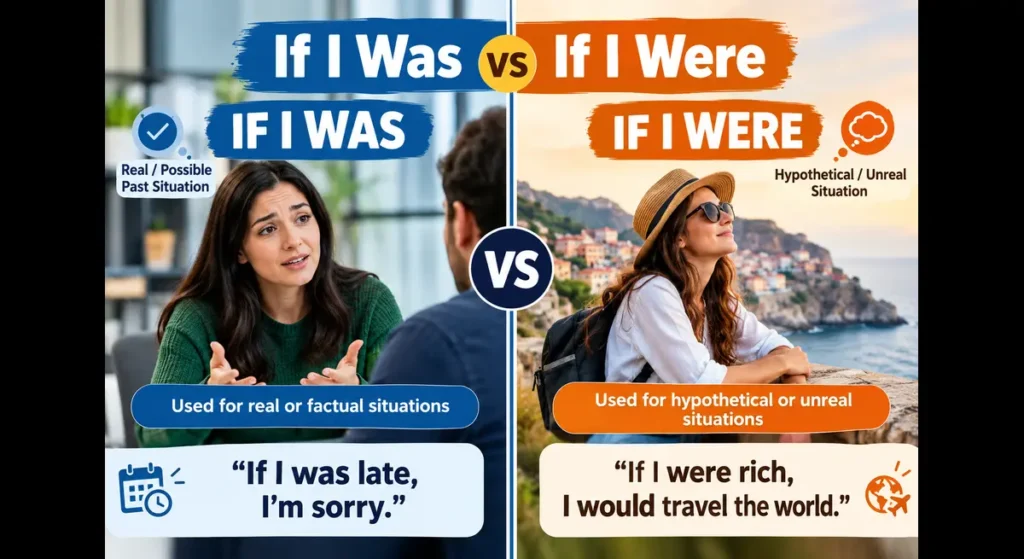
Use if I were for imaginary, unlikely, or unreal situations.
Examples:
- If I were rich, I would travel the world.
- If I were you, I would apologize.
Use if I was when referring to a real past possibility or uncertainty.
Examples:
- If I was rude yesterday, I am sorry.
- If I was at the meeting, I do not remember it.
Read more:Comma Before Or: When Should You Use a Comma Before “Or”?
Simple Rule
| Phrase | Use |
| If I were | Imaginary or unreal situations |
| If I was | Real past events or uncertainty |
The Origin of If I Was or If I Were
The difference comes from an old English grammar feature called the subjunctive mood.
The subjunctive mood is used to talk about:
- Wishes
- Hypothetical situations
- Imaginary events
- Things that are not true
In older English, the verb to be had special forms for these situations. The word were became the standard choice for unreal conditions.
For example:
- If I were king, I would change the law.
Over time, everyday speech became less strict. Many people started using was in places where traditional grammar preferred were.
Today, both forms are heard in conversation, but if I were remains the standard choice in formal English.
Read more:Computer Engineering or Electrical Engineering: Which is Better?
British English vs American English Spelling
Unlike words such as “colour” and “color,” the difference between if I was and if I were is mainly grammatical rather than spelling-related.
Both British and American English generally follow the same rule.
British English
British grammar guides strongly favor if I were for hypothetical situations.
Example:
- If I were the manager, I would hire more staff.
American English
American English also teaches if I were for hypothetical situations. However, conversational American English is often used if I was.
Example:
- If I was wrong, I apologize.
- If I were wrong, I would apologize.
Comparison Table
| Situation | British English | American English |
| Hypothetical situation | If I were | If I were |
| Casual speech | Sometimes if I was | Often if I was |
| Formal writing | If I were | If I were |
| Academic writing | If I were | If I were |
Which Spelling Should You Use?
For US Audiences
Use if I were in professional, academic, and formal writing.
Use if I was only when referring to a real past possibility.
For UK Audiences
Use if I were for hypothetical situations. It is considered the standard form.
For Global Audiences
Choose if I were when discussing imaginary situations. It is widely accepted and understood around the world.
Best Practice
If you are unsure, use:
- If I were = imaginary
- If I was = real past uncertainty
Common Mistakes with If I Was or If I Were
Mistake 1: Using “Was” for an Unreal Situation
❌ If I was a millionaire, I would buy a yacht.
✅ If I were a millionaire, I would buy a yacht.
Mistake 2: Using “Were” for a Real Past Event
❌ If I were late yesterday, I am sorry.
✅ If I was late yesterday, I am sorry.
Mistake 3: Copying Informal Speech into Formal Writing
Many people say:
❌ If I was you…
Formal English prefers:
✅ If I were you…
Mistake 4: Assuming Both Always Mean the Same Thing
The meaning changes depending on whether the situation is real or imaginary.
If I Was or If I Were in Everyday Examples
Email Example
- If I was unclear in my last email, please let me know.
- If I were available tomorrow, I would attend the meeting.
News Example
- If I was mistaken, the report will be corrected.
- If I were president, taxes would be lower.
Social Media Example
- If I were a celebrity, I would travel every week.
- If I was online earlier, I would have missed your message.
Formal Writing Example
- If I were responsible for the project, I would recommend a different strategy.
- If I was involved in the discussion, my name was not recorded.
If I Was or If I Were – Google Trends & Usage Data
Search interest for if I was or if I were remains strong because learners frequently encounter both forms.
Popular Countries
The topic is commonly searched in:
- United States
- United Kingdom
- Canada
- Australia
- India
Common Search Intent
Users often want to know:
- Which phrase is grammatically correct
- Whether both forms are acceptable
- Which form should be used in professional writing
- How native speakers use each phrase
Usage Trends
| Form | Common Context |
| If I were | Formal writing, education, grammar guides |
| If I was | Casual conversation, everyday speech |
| If I were you | Extremely common fixed expression |
| If I was there | Real past possibility |
Comparison Table: If I Was vs If I Were
| Feature | If I Was | If I Were |
| Meaning | Real past possibility | Imaginary situation |
| Formality | Neutral | More formal |
| Grammar Rule | Indicative mood | Subjunctive mood |
| Academic Writing | Sometimes | Preferred |
| Professional Writing | Sometimes | Preferred |
| Everyday Speech | Very common | Common |
Frequently Asked Questions
1. Is “if I was” grammatically correct?
Yes. It is correct when referring to a real past possibility or uncertainty.
2. Is “if I were” grammatically correct?
Yes. It is the standard form for hypothetical or imaginary situations.
3. Why do people say “if I was you”?
Many native speakers use it in casual conversation, even though traditional grammar prefers “if I were you.”
4. Which form should I use in formal writing?
Use if I were for hypothetical situations and if I was for real past situations.
5. Is “if I were you” always correct?
Yes. It is the standard expression because you cannot literally become another person.
6. Do British and American English use different rules?
Not significantly. Both generally prefer if I were in formal grammar.
7. Will people understand me if I use “if I was”?
Yes. It is very common in everyday speech, especially in informal conversation.
Conclusion
The debate over if I was or if I were becomes simple when you focus on meaning. Use if I were when discussing imaginary, hypothetical, or unreal situations. Use if I was when referring to a real past event, possibility, or uncertainty.
Traditional grammar strongly supports if I were for hypothetical statements. This form remains the preferred choice in academic, professional, and formal writing. Meanwhile, if I was is common in everyday conversation and is widely accepted when discussing real past situations.
Remember this easy rule: if the situation is not real, choose were. If the situation could have happened in the past, choose was.
By understanding this distinction, you can write with greater confidence and avoid one of the most common grammar mistakes in English. Whether you are writing an email, a report, a social media post, or a school assignment, choosing the correct form will make your English sound clearer and more professional.
Meta Description: Learn the difference between if I was or if I were, with grammar rules, examples, comparisons, FAQs, and writing tips.

I am Bahadar Ali, a professional content writer and the author behind GrammarDrive.com. I am passionate about making grammar simple and accessible for everyone. Through my writing, I aim to help learners and professionals communicate with clarity and confidence.