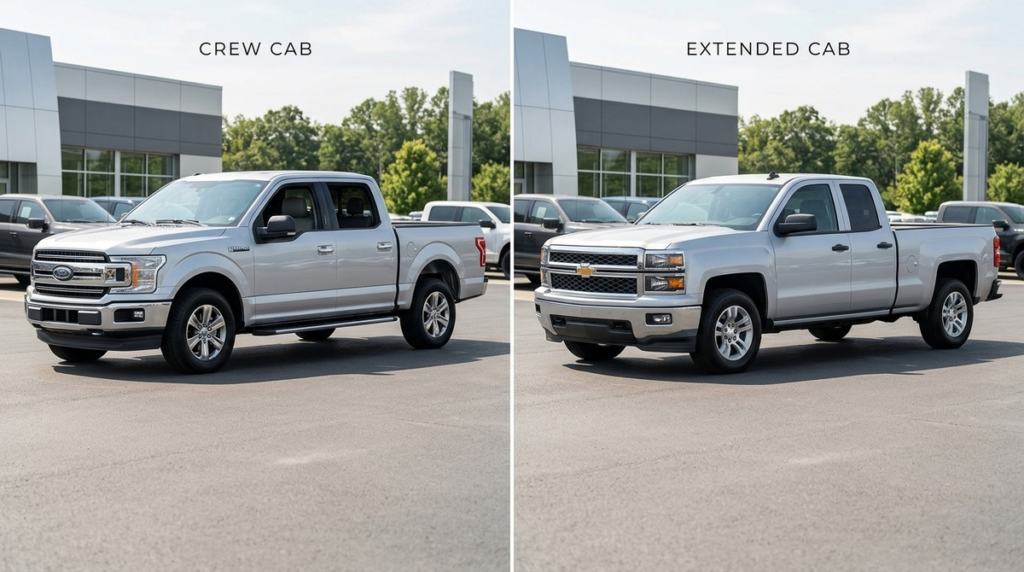
Choosing a pickup truck involves more than engine power, bed size, and towing capacity. The cab also matters. If you are searching for a crew cab or extended cab, you likely want to know which design gives you more room, comfort, and useful space. Both cab styles can carry passengers, but they serve different needs.
A crew cab usually offers four full-size doors and a roomy back seat. An extended cab usually has a smaller rear seating area and less rear legroom. Some extended cabs use smaller rear doors, while others use rear-hinged doors or a smaller access area.
The right choice depends on how you use your truck. A crew cab can work well for families, regular passengers, and long trips. An extended cab can suit drivers who want extra interior storage while keeping a shorter or more affordable truck.
This guide explains crew cab or extended cab differences in simple terms. You will learn about space, doors, comfort, cargo use, common terminology, and how these terms appear in everyday writing.
Crew Cab or Extended Cab : Quick Answer
A crew cab has a larger passenger area with full-size rear seating. An extended cab has a smaller rear passenger area.
| Feature | Crew Cab | Extended Cab |
| Rear seating | Full-size | Smaller |
| Rear legroom | More | Less |
| Rear doors | Usually full-size | Often smaller |
| Passenger comfort | Higher | More limited |
| Interior storage | Good | Good |
| Family use | Very suitable | Less suitable |
| Work use | Suitable | Suitable |
| Overall rear space | Larger | Smaller |
For example:
- Choose a crew cab if you often carry adults in the back.
- Choose an extended cab if you mainly drive alone or with one or two passengers.
- Choose an extended cab if you want extra cabin space without needing a large rear passenger area.
- Choose a crew cab if rear-seat comfort matters most.
The names can vary by truck maker. Some manufacturers use terms such as Double Cab, SuperCrew, or Quad Cab for designs that may differ slightly from one brand to another.
The Origin of Crew Cab or Extended Cab
The terms crew cab and extended cab come from the development of pickup trucks.
The word cab is short for cabin. In a vehicle, the cab refers to the enclosed section where the driver and passengers sit.
The word crew refers to a group of people working together. A crew cab therefore describes a truck cabin designed to carry a larger crew.
The term extended cab describes a cabin that extends beyond the space found in a traditional regular cab. Manufacturers added this extra space to provide additional storage or occasional rear seating.
Truck makers developed different cab designs as buyers wanted more flexibility. Some drivers needed a truck for work but also wanted to carry passengers. Others wanted a larger cabin without choosing a full-size crew cab.
These terms describe vehicle design rather than spelling differences. Unlike words such as color/colour or catalog/catalogue, crew cab and extended cab do not represent British and American spellings of the same word.
British English vs American English Spelling
Crew cab and extended cab use the same basic spelling in both British and American English.
The main difference comes from vehicle terminology and market usage.
| Term | American English | British English | Meaning |
| Crew cab | Crew cab | Crew cab | Larger passenger cabin |
| Extended cab | Extended cab | Extended cab | Cabin with additional space |
| Cab | Cab | Cab | Enclosed driver/passenger area |
| Pickup truck | Common | Pickup truck/pick-up truck | Truck with an open cargo bed |
| Pickup | Common | Common | Short form of pickup truck |
American truck advertising uses crew cab very often. British English may also use the term, especially in automotive writing, but pickup and other vehicle terms can appear more frequently depending on the publication.
The phrase pick-up can also appear in British English. However, this does not change the spelling of crew cab or extended cab.
Which Spelling Should You Use?
Use crew cab and extended cab when you describe these truck body styles.
Your audience should guide the rest of your vehicle terminology:
- US audience: Use “pickup truck,” “crew cab,” and “extended cab.”
- UK audience: “Pickup” or “pick-up” may appear, while “crew cab” and “extended cab” remain understandable.
- Canadian audience: Both cab terms are common in automotive contexts.
- Global audience: Use the standard cab terms and explain them briefly when needed.
If you are writing an automotive article for a US audience, crew cab or extended cab is a clear and familiar phrase.
If you are writing product descriptions, use the manufacturer’s official terminology. Truck brands do not always use the same names for similar cab configurations.
Common Mistakes with Crew Cab or Extended Cab
1. Treating Them as Different Spellings
Incorrect idea: Crew cab and extended cab are two spellings of the same term.
Correct: They describe two different cab configurations.
2. Assuming Every Extended Cab Has the Same Design
Truck manufacturers use different designs. Some extended cabs have small rear doors, while others have different rear access systems.
Always check the specific truck model.
3. Assuming Crew Cab Means a Larger Truck Bed
A crew cab mainly describes the cab, not the bed.
A truck can have a large crew cab with a shorter bed or a smaller cab with a longer bed.
4. Confusing Cab Size With Truck Size
A crew cab does not automatically tell you the truck’s engine size, towing capacity, or overall length.
These are separate specifications.
5. Writing “Crewcab”
The standard form is usually crew cab, as two words.
Correct: The truck has a crew cab.
Less standard: The truck has a crew cab.
6. Assuming Extended Cab Means No Rear Seats
Many extended-cab trucks provide rear seating. The rear area simply tends to offer less space than a crew cab.
Crew Cab or Extended Cab in Everyday Examples
In an Email
I’m looking for a crew cab because I need comfortable rear seating for my family.
In a News Article
The automaker introduced a new pickup with crew cab and extended cab configurations.
On Social Media
Should I get a crew cab or extended cab for weekend trips and daily driving?
In Formal Writing
Buyers should compare rear-seat dimensions before selecting a crew cab or extended cab model.
In a Vehicle Listing
4WD pickup, crew cab, four doors, spacious rear seating.
These examples show that crew cab and extended cab work naturally in automotive descriptions, reviews, advertisements, and casual discussions.
Crew Cab or Extended Cab : Comparison Table
| Category | Crew Cab | Extended Cab |
| Cabin size | Larger | Smaller |
| Rear passenger room | Spacious | Limited |
| Rear legroom | More | Less |
| Rear doors | Usually full-size | Usually smaller |
| Adult passengers | Better suited | Less comfortable |
| Child passengers | Comfortable | Suitable depending on model |
| Interior storage | Plenty | Often useful |
| Long-distance passengers | More comfortable | Less comfortable |
| Access to rear seats | Easier | Can be less convenient |
| Best for | Families and frequent passengers | Work use and occasional passengers |
The exact dimensions depend on the truck model and manufacturer. Always compare the specifications for the specific vehicle you plan to buy.
Crew Cab vs Extended Cab: Which Has More Space?
A crew cab generally has more passenger space.
The difference becomes especially noticeable in the rear seat. Crew cabs usually provide enough legroom for adults, while extended cabs often have tighter rear seating.
However, an extended cab can provide a useful balance for people who do not regularly carry adults.
If you rarely use the rear seats, the additional passenger space in a crew cab may not matter as much to you.
Crew Cab vs Extended Cab: Which Is Better for Families?
A crew cab provides more room for families because it normally has a larger rear seating area and full-size rear doors.
Parents may also find full-size rear doors easier when placing children into child seats or helping passengers enter and exit.
An extended cab can still work for families, but its smaller rear area may feel cramped during longer trips.
Your choice should depend on the number of passengers, their size, and how often they use the back seat.
Crew Cab vs Extended Cab: Which Is Better for Work?
Both designs can work well for jobs.
An extended cab may appeal to workers who mainly use the truck for equipment, tools, and occasional passengers.
A crew cab can work better for crews that regularly travel together. It gives several adults more comfortable seating.
The truck bed, payload rating, towing capacity, and storage needs also matter. Cab style alone does not determine a truck’s usefulness for work.
Crew Cab or Extended Cab : Google Trends & Usage Data
Search interest for crew cab or extended cab can change based on vehicle launches, truck-buying trends, seasonal demand, and consumer questions.
In general, crew cab appears frequently in automotive listings, truck reviews, dealership pages, and buyer guides. Extended cab also appears in truck specifications and comparison searches.
Search behavior can differ by country because manufacturers use different names for similar cab configurations. A buyer may search for “crew cab,” while another may search for a brand-specific term such as “Double Cab” or “SuperCrew.”
Google Trends can help writers and marketers study these patterns over time. However, search popularity does not by itself show which cab configuration is more suitable for an individual buyer.
For accurate SEO research, compare the exact phrases crew cab, extended cab, and related manufacturer-specific terms for your target country and date range.
Crew Cab or Extended Cab: Key Differences at a Glance
| Question | Crew Cab | Extended Cab |
| More rear space? | Yes | No |
| Full-size rear doors? | Usually | Usually not |
| Better for adult passengers? | Yes | Less suitable |
| Good for occasional passengers? | Yes | Yes |
| Useful for work? | Yes | Yes |
| Larger cabin? | Yes | No |
| Easier rear access? | Usually | Often less convenient |
| Best for frequent family use? | Often suitable | Depends on needs |
FAQs About Crew Cab or Extended Cab
1. What is the difference between a crew cab and an extended cab?
A crew cab has a larger passenger cabin and usually full-size rear doors. An extended cab has a smaller rear passenger area.
2. Is a crew cab bigger than an extended cab?
The crew cab generally has more interior passenger space, especially in the rear.
3. Does an extended cab have back seats?
Many extended-cab trucks have rear seats, but the space varies by model. Some provide compact rear seats designed for occasional use.
4. Is a crew cab better for families?
A crew cab offers more rear passenger space and easier access in many models, which can make it practical for families.
5. Is “crew cab” one word?
No. Crew cab is normally written as two words.
6. Is “extended cab” two words?
Yes. The standard form is extended cab, written as two words.
7. Which has more legroom, crew cab or extended cab?
A crew cab generally provides more rear legroom.
8. Can an extended cab tow as much as a crew cab?
Towing capacity depends on the specific truck, engine, drivetrain, axle ratio, configuration, and equipment. Cab style alone does not determine towing capacity.
Conclusion
The difference between a crew cab or extended cab mainly comes down to passenger space and rear-seat design. A crew cab normally gives you a larger cabin, more rear legroom, and full-size rear doors. An extended cab provides extra cabin space compared with a regular cab but usually offers less room for rear passengers.
Choose your terminology carefully when writing about trucks. Crew cab and extended cab are standard descriptive terms, not competing British and American spellings. Both terms can appear in automotive writing across English-speaking markets.
If you carry adults or family members often, compare rear-seat dimensions and door access. If you mainly use the truck for work and carry rear passengers only sometimes, an extended cab may meet your needs. Always check the exact specifications because manufacturers use different names and designs.
For SEO content, product listings, or buyer guides, use crew cab or extended cab clearly and explain the difference. That approach helps readers understand the terms without confusing cab size with bed size, towing capacity, or overall truck performance.

I am Bahadar Ali, a professional content writer and the author behind GrammarDrive.com. I am passionate about making grammar simple and accessible for everyone. Through my writing, I aim to help learners and professionals communicate with clarity and confidence.