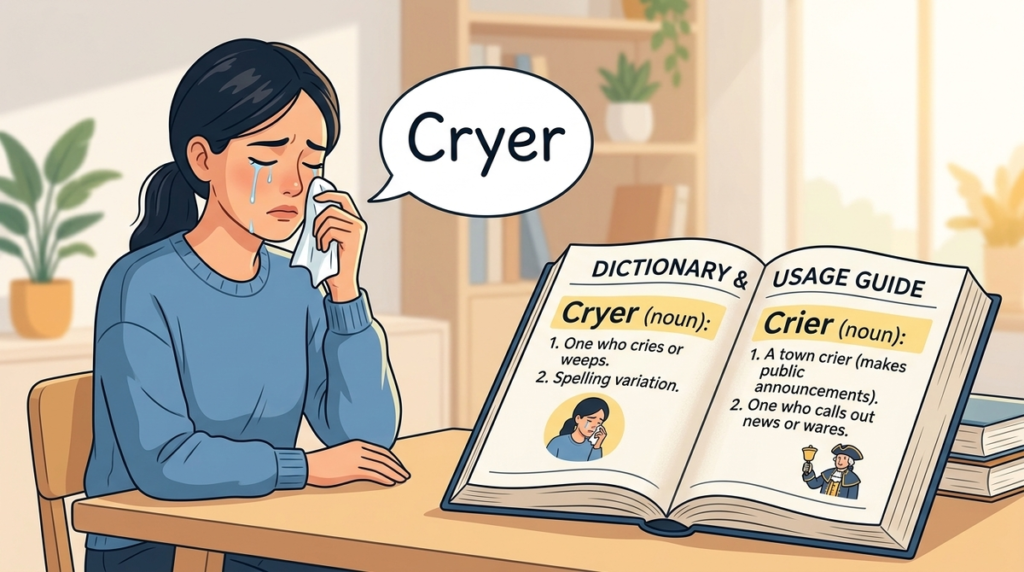
If you have ever typed “cryer or crier” into a search box, you are not alone. These two words look almost the same, sound alike in normal speech, and both seem to come from the verb cry. That makes the spelling easy to question.
The good news is simple: crier is the standard spelling for most modern English writing. It can mean a person who cries, or a person who calls out announcements, such as a town crier. Dictionaries also record cryer as a variant or historical form, so it is not always a simple spelling mistake. (Collins Dictionary)
People often search for “cryer or crier” because the spelling cryer looks natural. After all, the word comes from cry, and English often adds -er to a verb to name the person who performs an action. However, standard English uses crier in ordinary modern writing.
This guide explains the difference, the history behind both spellings, British and American usage, common mistakes, and the best choice for everyday and professional writing.
Cryer or Crier : Quick Answer
Crier is the preferred spelling in modern English.
Use crier when you mean:
- A person who cries easily.
- A person who cries or weeps.
- A person who makes public announcements.
- A traditional town crier.
Examples:
- She is a frequent crier.
- The baby was a loud crier.
- The town crier announced the news.
- He became emotional and started crying.
Cryer also exists. Dictionaries and historical sources record it as a variant or older form of crier. (Wiktionary)
So the practical rule is:
Use “crier” for normal modern writing. Use “cryer” only when the context calls for the variant, historical form, or a proper name.
Crier vs. Cryer at a Glance
| Word | Status | Meaning | Example |
| crier | Standard modern form | A person who cries | She is a crier. |
| crier | Standard modern form | A public announcer | The town crier rang the bell. |
| cryer | Variant/older form | A person who cries or calls out | The old text used “cryer.” |
| Cryer | Proper name | A surname | Jon Cryer is an actor. |
The Origin of Cryer or Crier
The history of crier goes back much further than modern spelling rules.
Middle English used several forms related to the word, including crier, criere, cryar, cryer, and cryour. Historical forms developed from Old French crieor, which referred to someone who shouted or made a proclamation. (Wiktionary)
The modern English word connects with the verb cry, which can mean to weep, shout, call out, or make a public announcement.
Over time, English spelling became more standardized. Crier became the usual modern form, while cryer became much less common. Historical sources still contain the older spelling, and modern dictionaries may list it as a variant. (Wiktionary)
The spelling crier can look surprising because people naturally expect:
cry + er = cryer
But English does not always create words through simple letter-by-letter additions. Historical spelling patterns helped establish crier as the normal form.
Why Does “Cryer” Still Exist?
English keeps many older spellings alive. Some survive in books, family names, historical documents, or dictionary variants.
For example, Cryer also exists as a surname. The surname developed from an occupational name connected with a town crier. (Wiktionary)
Therefore, it would be too broad to say that cryer never exists. The better rule is that crier remains the normal choice for modern common-noun use.
British English vs American English Spelling
Unlike words such as colour/color or centre/center, crier does not have a standard British-versus-American spelling difference.
Both British and American English use crier.
Collins lists crier in both British and American English. The definitions include a person who cries and a person who makes public announcements. (Collins Dictionary)
British English
British English uses:
crier
Example:
- The town crier announced the event.
American English
American English also uses:
crier
Example:
- She is a crier when she watches sad movies.
Comparison Table
| Variety | Preferred spelling | Example |
| British English | crier | The town crier made an announcement. |
| American English | crier | She is an emotional crier. |
| Australian English | crier | The crier announced the news. |
| Canadian English | crier | He is known as a crier. |
| Historical English | crier / cryer | The document uses “cryer.” |
| Proper names | Depends on the name | Jon Cryer |
The key point is that crier vs. cryer is not mainly a US-versus-UK spelling issue. It is a difference between the standard modern form and a less common variant or historical form.
Which Spelling Should You Use?
For most readers, writers, students, and professionals, choose crier.
For American English
Use crier in:
- School assignments
- Emails
- Articles
- Business writing
- News writing
- Social media
- General conversation
Example:
I am a crier when I watch emotional films.
For British English
Use crier as well.
Example:
The town crier announced the royal proclamation.
For Global English
If your audience comes from several English-speaking countries, crier is the clearest choice.
It is familiar across major varieties of modern English.
When Should You Use “Cryer”?
Use cryer when:
- You are reproducing an original historical spelling.
- A source specifically uses that variant.
- Cryer appears as someone’s established surname.
- You are discussing spelling variants themselves.
For example:
The historical document spells the word “cryer.”
Do not change a person’s surname simply because another spelling looks more common.
Common Mistakes with Cryer or Crier
Mistake 1: Using “cryer” in ordinary modern writing
Incorrect for standard modern usage:
She is a cryer.
Better:
She is a crier.
Mistake 2: Assuming “cryer” can never be correct
This goes too far.
Cryer appears as an older or variant form, and Cryer also exists as a surname. (Wiktionary)
Mistake 3: Treating this as a British vs. American issue
It is not like colour/color.
Both British and American English normally use crier.
Mistake 4: Changing a person’s name
If someone’s surname is Cryer, keep that spelling.
For example:
Jon Cryer appeared in the film.
Here, Cryer is a proper name, not a spelling mistake.
Mistake 5: Confusing “crier” with “crying”
These words have different jobs.
- Crier = a person who cries.
- Crying = the act of crying.
- Cry = the verb.
Example:
The child is crying because he is upset.
The child is a frequent crier.
Cryer or Crier in Everyday Examples
The word crier works in many types of writing.
In Emails
She can be a crier when discussions become emotional.
This sounds natural in an informal email.
In News Writing
The town crier announced the news in the main square.
The phrase town crier remains the established form.
On Social Media
I am a total crier during emotional movies.
This casual use clearly means someone who cries easily.
In Formal Writing
The study describes emotional responses among participants who identified themselves as frequent criers.
The standard spelling works well in academic and professional contexts.
In Historical Writing
The document refers to the official as a “cryer.”
Here, keeping cryer may make sense because the writer wants to preserve the original wording.
Cryer or Crier : Google Trends & Usage Data
Search interest for “cryer or crier” mainly reflects a spelling question rather than a difference in meaning between two equally common modern words.
Current dictionary and usage references consistently place crier as the normal modern form, while cryer appears as a variant or historical form. (GRAMMARIST)
Search behavior can also vary by context:
- Crier appears in modern grammar and spelling questions.
- Town crier appears in historical and cultural contexts.
- Cryer appears in discussions of spelling variants.
- Cryer also appears as a surname.
Google Trends can show relative search interest, but it does not provide a complete count of every word used in books, speech, or private writing. Search volume also changes over time and by country.
For SEO content, the most useful distinction is therefore not simply which spelling gets more searches. The key intent is usually: “Which spelling should I use in modern English?”
For that question, crier is the practical answer.
Crier vs. Cryer: Comparison Table
| Feature | Crier | Cryer |
| Modern standard use | Yes | Less common |
| Person who cries | Yes | Variant/historical use |
| Town announcer | Yes | Historical variant |
| British English | Yes | Rare/variant |
| American English | Yes | Rare/variant |
| Historical documents | Yes | Yes |
| Surname | Possible | Yes |
| Best choice for modern writing | Yes | Usually no |
| Pronunciation | Generally the same | Generally the same |
| Common phrase | Town crier | Historical “town cryer” |
FAQs About Cryer or Crier
1. Is “crier” or “cryer” correct?
Crier is the standard spelling for most modern English writing. Cryer exists as a variant and historical form.
2. Is “cryer” a real word?
Yes. Cryer appears in historical English and is recorded as a variant of crier. It can also occur as a surname. (Wiktionary)
3. How do you spell someone who cries a lot?
The standard spelling is crier.
Example:
She is a crier when she watches sad movies.
4. Is “town cryer” correct?
Town crier is the standard modern expression. Historical sources may use town cryer, but modern writers should normally use town crier.
5. Is crier the same in British and American English?
Yes. Both British and American English use crier. The spelling does not normally change between these varieties. (Collins Dictionary)
6. Why does “crier” have an i instead of a y?
English spelling developed over time, and crier became the established modern form. Historical English included several related spellings, including cryer. (Wiktionary)
7. Is “Cryer” a surname?
Yes. Cryer is an established surname. It has an occupational history connected with the word for a public announcer. (Wiktionary)
Conclusion
When you are choosing between cryer or crier, the safest modern choice is crier. Use it for a person who cries and in established expressions such as town crier. Dictionaries and modern usage sources support crier as the normal contemporary form. (GRAMMARIST)
The spelling cryer deserves a little more care. It is not simply an invented word. Historical English used several related spellings, and cryer still appears as a variant or older form. It can also appear as a surname, so you should not automatically change it when you see it in a person’s name. (Wiktionary)
This is also not a British-versus-American spelling difference. Both varieties normally use crier. If you are writing an email, article, essay, report, website, or social media post, crier will usually give readers the clearest and most familiar form.
The simple rule is easy to remember: use “crier” for normal modern English, and keep “cryer” when history, a source, or a proper name requires it.