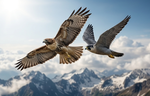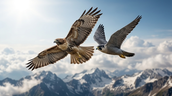
Seeing a bird of prey circle high above you can raise a simple question: Is it a hawk or falcon? These birds look alike, hunt other animals, and have sharp beaks and talons. Yet hawks and falcons are not the same group of birds.
People often search for hawk or falcon because the two names are easy to mix up. Photos can make the problem harder because some hawks have pointed wings, while some falcons look quite broad. Their size, color, and flight style can also vary by species.
The good news is that you can learn a few simple clues. Hawks often have broader, rounded wings and use soaring flight. Falcons usually have long, pointed wings and are known for fast flight and dramatic dives. Cornell Lab of Ornithology notes that falcons and hawks look alike but are not closely related.
This guide explains the difference between a hawk and a falcon, their names and origins, common mistakes, everyday usage, and what search trends can tell us.
Hawk or Falcon : Quick Answer
Hawk and falcon are different types of birds of prey. Neither word is a spelling variation of the other.
A hawk usually has broader wings and a more powerful, steady flight style. Many hawks spend time soaring and searching the ground for prey. The Red-tailed Hawk, for example, often circles over open land and can hover in strong winds.
A falcon usually has long, pointed wings and a streamlined body. Falcons are famous for speed and fast aerial attacks. Cornell Lab describes falcons as having long, pointed wings and a long tail.
| Feature | Hawk | Falcon |
| Main group | Many hawk groups | Falconidae |
| Wing shape | Often broad and rounded | Usually long and pointed |
| Flight | Soaring and controlled | Fast and direct |
| Hunting style | Often attacks from a perch or controlled flight | Often chases prey in the air |
| Famous example | Red-tailed Hawk | Peregrine Falcon |
| Speed reputation | Fast | Extremely fast |
Simple rule: If you see broad wings and a soaring bird, think hawk. If you see pointed wings and very fast flight, think falcon.
The Origin of Hawk or Falcon
The two words have very different histories.
The word hawk comes from Old English hafoc or heafoc. It later developed through Middle English forms such as hauk. Its deeper history connects it with a Proto-Germanic word and an Indo-European root linked with the idea of grasping.
The word falcon entered English around the mid-13th century from Old French faucon. That word came from Late Latin falco. The Latin name may relate to falx, meaning a curved blade or sickle, perhaps because of the shape of the bird’s talons, beak, legs, or wings.
So, hawk and falcon did not develop as British and American spelling differences. They are separate words with different histories.
The word falconry, meaning the practice of hunting with trained birds of prey, comes from French fauconnerie and dates in English to around the 1570s.
British English vs American English Spelling
Unlike words such as colour/color or centre/center, hawk and falcon do not have a major British-versus-American spelling difference.
Both British and American English use:
- hawk
- falcon
- hawks
- falcons
- hawk-like
- falconry
- falconer
The main issue is not spelling. It is correct identification.
Comparison Table
| Meaning | Standard spelling | British English | American English |
| A bird of prey | hawk | hawk | hawk |
| A bird in the falcon family | falcon | falcon | falcon |
| More than one hawk | hawks | hawks | hawks |
| More than one falcon | falcons | falcons | falcons |
| Sport involving trained birds | falconry | falconry | falconry |
| Person who trains or keeps falcons | falconer | falconer | falconer |
Key point: There is no need to choose hawk because you are writing for the US or falcon because you are writing for the UK. Choose the word that matches the bird or meaning.
Which Spelling Should You Use?
If you are writing about the bird, use the word that correctly identifies it.
For US audiences
Use hawk for hawk species and falcon for falcon species.
Examples:
- “A red-tailed hawk flew over the field.”
- “A peregrine falcon crossed the sky.”
For UK and Commonwealth audiences
The same basic rule applies. British English does not normally change hawk into another spelling or falcon into another spelling.
For a global audience
Use the full bird name when possible.
For example, peregrine falcon is clearer than simply saying falcon. Likewise, red-tailed hawk is clearer than simply saying hawk.
This matters because “hawk” covers many different birds, while “falcon” can refer to several species within the falcon family. Cornell Lab lists species such as the American Kestrel, Merlin, Aplomado Falcon, Gyrfalcon, Peregrine Falcon, and Prairie Falcon in Falconidae.
Common Mistakes with Hawk or Falcon
1. Treating hawk and falcon as synonyms
They are both birds of prey, but they are not interchangeable in scientific identification.
Better:
“The peregrine is a falcon.”
2. Assuming every fast raptor is a falcon
Hawks can also fly very fast. Flight speed alone does not identify every bird.
Better: Look at wing shape, body shape, tail, behavior, and habitat.
3. Assuming every large raptor is a hawk
Size does not always solve the mystery. Some falcons are quite large. The Gyrfalcon, for example, is a very large falcon with a powerful body.
4. Using “falcon” for every bird used in falconry
Historically, people have trained different birds of prey. The term falconry is broader than the word falcon itself.
5. Thinking the words are spelling variants
Hawk ≠ British spelling of falcon.
Falcon ≠ American spelling of hawk.
They are different words for different groups of birds.
Hawk or Falcon in Everyday Examples
Knowing when to use each word helps in many types of writing.
In an email
“I saw a hawk near the office this morning.”
This works when you know or reasonably identify the bird as a hawk.
In news writing
“A peregrine falcon was spotted near the city center.”
A news report should use the most specific name available.
On social media
“Look at this beautiful hawk!”
This is common when the exact species is not known.
In formal writing
“Falcons have long, pointed wings and are adapted for fast aerial hunting.”
Formal writing benefits from accurate species terms.
In a bird guide
“The Red-tailed Hawk has broad wings and often soars over open areas.”
Specific names make identification easier.
Hawk or Falcon : Google Trends & Usage Data
Google Trends measures search interest rather than the total number of searches. Its data can be compared by location, time, and search term. Google also provides regional and global Trends tools for exploring search behavior.
For hawk or falcon, search interest can change with context.
People may search hawk when they want:
- Bird identification
- Local wildlife information
- Hawk species
- Hawk symbolism
- Sports team names
- Political uses of “hawk”
The word falcon can attract searches related to:
- Bird identification
- Falconry
- Peregrine falcons
- Fast birds
- Wildlife photography
- Popular culture and names
This makes raw search comparisons harder to interpret. Google Trends itself notes that search data can be explored by location and topic, and its bird-focused projects show that search behavior can reveal interest in bird species.
For SEO, the best approach is to cover the search intent behind the phrase “hawk or falcon” rather than simply repeating the two words. Include clear comparisons, identification tips, species examples, and questions such as “Which is faster?” and “How can you tell them apart?”
Hawk vs Falcon: Side-by-Side Comparison
| Category | Hawk | Falcon |
| Basic meaning | A group of birds of prey commonly called hawks | Birds in the falcon family |
| Wings | Often broad and rounded | Usually long and pointed |
| Flight | Often soaring | Often fast and direct |
| Hunting | Many hunt from perches or controlled flight | Many chase prey in the air |
| Body shape | Varies by species | Often streamlined |
| Famous species | Red-tailed Hawk | Peregrine Falcon |
| Family | Hawks occur across several raptor groups | Falconidae |
| Speed | Fast | Famous for extreme speed |
| Relatedness | Not closely related to falcons | Not closely related to hawks |
Cornell Lab specifically notes that hawks and falcons can look similar while being distantly related.
Which Is Faster: Hawk or Falcon?
In general, falcons are better known for extreme speed.
The peregrine falcon is especially famous for its high-speed hunting dive, called a stoop. Hawks also fly quickly, but many species rely more on soaring, gliding, or controlled attacks.
For example, the Red-tailed Hawk often circles over open land while searching for prey. Its hunting style differs greatly from the rapid aerial attack associated with many falcons.
Still, “falcon is faster” does not mean every falcon always flies faster than every hawk. Bird species differ greatly.
FAQs About Hawk or Falcon
1. Is a hawk the same as a falcon?
No. Hawks and falcons are different groups of birds of prey. They can look similar, but they are not closely related.
2. Which is faster, a hawk or a falcon?
Falcons generally have the stronger reputation for speed, especially during hunting dives. The peregrine falcon is a famous example.
3. How can you tell a hawk from a falcon?
Look at wing shape and flight style. Hawks often have broader wings and may soar. Falcons usually have pointed wings and a streamlined shape.
4. Is a falcon a type of hawk?
No. Falcons belong to the family Falconidae. They are not simply a type of hawk.
5. Are hawks bigger than falcons?
Not always. Size varies greatly among species. Some falcons are small, while the Gyrfalcon can be very large.
6. Do hawks and falcons eat the same food?
Their diets can overlap. Both may eat birds and other vertebrates, but diets vary by species and location.
7. Is “hawk or falcon” a spelling question?
No. Hawk and falcon are separate words, not alternative spellings. British and American English generally use the same spellings.
Conclusion
The choice between hawk or falcon is not really a spelling choice. It is a question about bird identification. Both are birds of prey, but they belong to different groups and often have different shapes, flight styles, and hunting methods.
Hawks often have broader wings and spend a lot of time soaring or watching for prey. Falcons usually have long, pointed wings and a streamlined body built for fast flight. The difference becomes clearer when you look at a specific species. A Red-tailed Hawk and a Peregrine Falcon, for example, have very different flight and hunting styles.
For writing, there is no major British-versus-American spelling issue. Use hawk when you mean a hawk and falcon when you mean a falcon. When possible, use the full species name for greater accuracy.
If you are unsure what bird you saw, do not rely on speed alone. Check its wings, tail, body shape, flight pattern, habitat, and markings. These clues can help you make a much better identification.

I am Arshman Ali a professional English writer and English professor with a passion for language and a commitment to excellence. I bring precision and clarity to my writing, and the same high standards into my classroom. For me, language is not just a profession it is a purpose.