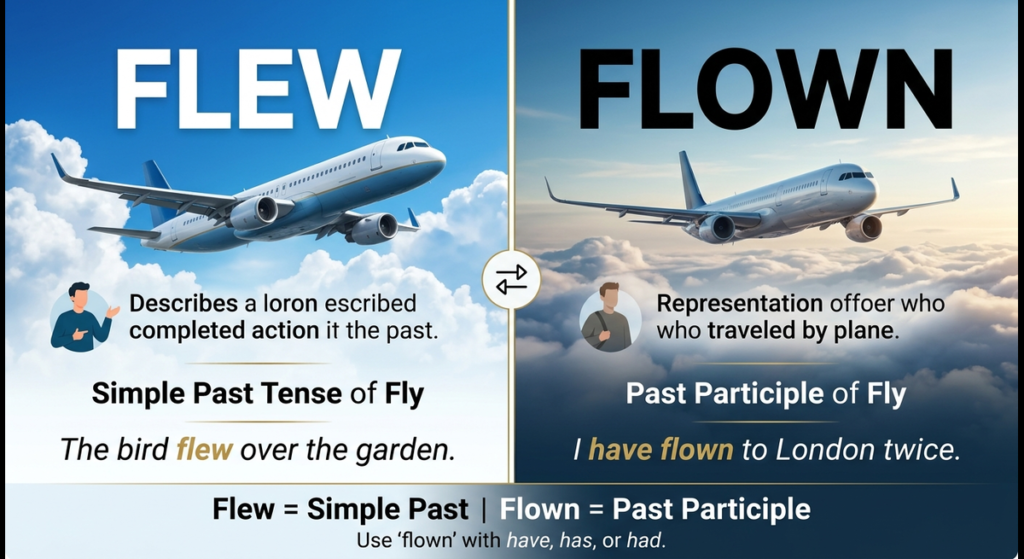
Many English learners and writers get confused about flew or flown. Both words come from the verb “fly,” but they are used in different ways. This mistake is common in emails, school work, social media posts, and even business writing.
People often search for “flew or flown” because they want a quick answer. They may wonder which word is correct in a sentence like, “I have flew to London” or “I have flown to London.” The confusion happens because English verbs change forms depending on tense.
The good news is that the rule is simple once you understand it. “Flew” is the simple past tense. “Flown” is the past participle and needs helping verbs like “has,” “have,” or “had.”
In this guide, you will learn the difference between flew and flown, their history, common mistakes, and how to use them correctly in everyday English.
Flew or Flown – Quick Answer
Flew is the simple past tense of “fly.”
Flown is the past participle of “fly.”
Correct Examples
- I flew to Dubai yesterday.
- She has flown to Paris many times.
- They had flown before the storm started.
Easy Rule
- Use flew for past actions.
- Use flown with helping verbs like:
- has
- have
- had
Wrong Example
❌ I have flew to London.
✅ I have flown to London.
Read more:A University or An University? The Correct Grammar rule
The Origin of Flew or Flown
The words “flew” and “flown” come from the Old English verb flēogan, which meant “to fly through the air.”
Over time, English verbs changed forms. Many old verbs became irregular verbs. That means they do not follow the normal “-ed” pattern.
For example:
| Base Verb | Past Tense | Past Participle |
| fly | flew | flown |
| grow | grew | grown |
| know | knew | known |
The word “flew” developed as the past tense form. “Flown” became the past participle form used with helper verbs.
This pattern stayed in modern English.
Read more:Hawk or Falcon: What’s the Difference and Which Bird Is Faster?
British English vs American English Spelling
There is no spelling difference between British English and American English for flew and flown. Both countries use the same forms.
The difference is mainly in style and sentence structure, not spelling.
Examples
| British English | American English |
| She has flown to Madrid. | She has flown to Madrid. |
| He flew home yesterday. | He flew home yesterday. |
Comparison Table
| Form | Usage | Example |
| flew | Simple past tense | We flew to Canada. |
| flown | Past participle | We have flown to Canada. |
Even though spelling is the same, Americans may use the simple past more often in casual speech.
Example:
- US casual speech: “Did you fly there?”
- UK formal style: “Have you flown there before?”
Which Spelling Should You Use?
You should use both words correctly based on grammar, not location.
Use “Flew” When:
- Talking about a finished past action
- No helping verb is present
Examples:
- I flew to Karachi last week.
- The bird flew away.
Use “Flown” When:
- Using has, have, or had
- Talking about experience or completed action
Examples:
- I have flown many times.
- She had flown before sunset.
Audience-Based Advice
| Audience | Best Usage |
| US readers | Simple and direct sentences |
| UK readers | More present perfect sentences |
| Global audience | Use standard grammar rules |
Common Mistakes with Flew or Flown
Many people mix these words because both refer to past actions.
Common Errors
| Incorrect Sentence | Correct Sentence |
| I have flew to Turkey. | I have flown to Turkey. |
| She had flew home. | She had flown home. |
| They flown yesterday. | They flew yesterday. |
Easy Tip
If you see:
- has
- have
- had
Use flown, not flew.
Flew or Flown in Everyday Examples
Emails
- I flew to Lahore for the meeting.
- Our CEO has flown to Singapore.
News Writing
- The rescue team flew over the flooded area.
- The president has flown abroad for talks.
Social Media
- Just flew to Dubai!
- I’ve flown six times this year.
Formal Writing
- The aircraft had flown safely through the storm.
- Scientists have flown drones for research.
Flew or Flown – Google Trends & Usage Data
Search interest for “flew or flown” is high in countries where English learners are common.
Popular Countries
- India
- Pakistan
- Philippines
- United States
- United Kingdom
People usually search this keyword because:
- They want grammar help
- They are writing emails or essays
- They need correct English for work or study
Usage Context
| Word | Common Context |
| flew | Stories, conversation, news |
| flown | Formal grammar, professional writing |
“Flew” appears more in spoken English. “Flown” appears more in formal writing and grammar lessons.
Flew vs Flown Comparison Table
| Feature | Flew | Flown |
| Verb Type | Past tense | Past participle |
| Needs Helping Verb | No | Yes |
| Example | I flew home. | I have flown home. |
| Common Usage | Casual speech | Formal and correct grammar |
| Grammar Role | Completed action | Perfect tense |
FAQs About Flew or Flown
1. Is it “have flew” or “have flown”?
The correct phrase is have flown.
✅ I have flown to London.
❌ I have flew to London.
2. When should I use “flew”?
Use “flew” for simple past tense.
Example:
- She flew yesterday.
3. When should I use “flown”?
Use “flown” with has, have, or had.
Example:
- They have flown before.
4. Is “flown” a present tense?
No. “Flown” is a past participle.
5. Why is “flew” incorrect after “have”?
Because “have” needs a past participle, and the correct participle is “flown.”
6. Can I say “I had flew”?
No.
✅ I had flown
❌ I had flew
7. Are “flew” and “flown” used the same worldwide?
Yes. Both British and American English use the same forms.
Conclusion
Understanding the difference between flew or flown is easier than many people think. The key is knowing how English verb forms work. “Flew” is the simple past tense, while “flown” is the past participle used with helping verbs like “has,” “have,” and “had.”
A simple way to remember the rule is this: if there is no helping verb, use “flew.” If there is a helping verb, use “flown.” This small grammar rule can make your writing sound much more natural and professional.
Whether you are writing emails, school essays, social media captions, or business documents, using the correct form matters. It improves clarity and helps you avoid common English mistakes.
Both British and American English follow the same grammar rule, so you can use these words confidently anywhere in the world. Practice with simple examples every day, and soon the difference between flew and flown will feel natural.

I am Bahadar Ali, a professional content writer and the author behind GrammarDrive.com. I am passionate about making grammar simple and accessible for everyone. Through my writing, I aim to help learners and professionals communicate with clarity and confidence.