The confusion between smooth or smoothe is common among English learners, writers, and even native speakers. People often search for this keyword because both versions look similar, but only one is correct in modern English.
You might see “smooth” in textbooks, while “smoothe” occasionally appears in old writing or informal online posts. This creates doubt about which spelling is right and whether both are acceptable.
The smooth or smoothe confusion usually comes from historical spelling variations and misunderstanding of English verb endings. Many learners think adding an “e” makes it more formal or British, but that is not true today. The correct modern spelling is simple and widely accepted in both American and British English.
Understanding smooth or smoothe helps avoid spelling mistakes in essays, emails, SEO writing, and professional communication. It also improves writing accuracy and clarity. In this article, we will clearly explain the difference between smooth or smoothe, where the spelling came from, and how to use it correctly in real-life situations.
Smooth or Smoothe – Quick Answer
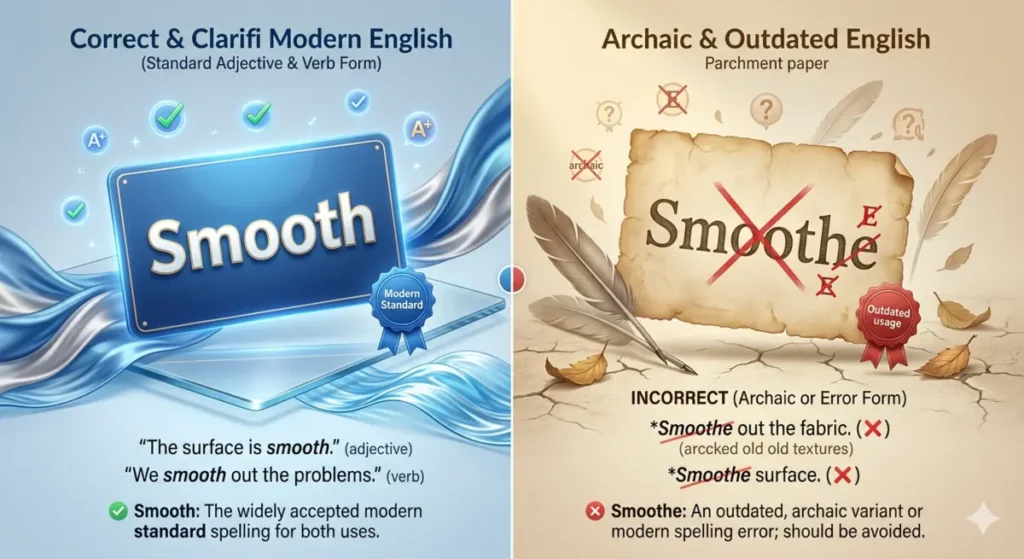
The correct spelling is smooth.
“Smoothe” is an old, outdated, and incorrect spelling in modern English.
- Correct: The skin feels smooth.
- Incorrect: The skin feels smoothe ❌
“Smooth” works as:
- Adjective → smooth surface
- Verb → smooth the surface
Plans or Projects: Meaning, Difference, and Correct usage?
The Origin of Smooth or Smoothe
The word smooth comes from Old English smōth, meaning soft, flat, or even.
In earlier English writing (Middle English period), spelling was not standardized. Writers sometimes added an “e” at the end, creating forms like “smoothe.”
Over time, English spelling rules became fixed, especially after dictionaries like Samuel Johnson’s (1755) and later Oxford English Dictionary standardization. The “e” was dropped, leaving smooth as the correct modern form.
So, smoothe is just an outdated historical variant, not a modern spelling rule.
British English vs American English Spelling
Good news: there is no difference between British and American English for this word.
Both use:
- smooth (UK)
- smooth (US)
Comparison Table
| Feature | British English | American English |
| Spelling | smooth | smooth |
| Smoothe form | Not used | Not used |
| Meaning | Same | Same |
| Usage | Standard | Standard |
Which Spelling Should You Use?
Use smooth in all cases, regardless of region.
- If you are writing for US audiences → smooth
- If you are writing for UK or Commonwealth → smooth
- If you are writing blogs, SEO, or academic content → smooth
👉 Never use “smoothe” in modern writing unless quoting historical text.
Common Mistakes with Smooth or Smoothe
- Adding extra “e” → smoothe ❌
- Thinking British English uses “smoothe” ❌
- Using “smoothe” in formal essays ❌
- Confusing verb forms incorrectly ❌
- Assuming older spelling is still valid ❌
Corrections:
- smoothe → smooth
- smoothe surface → smooth surface
- smoothe transition → smooth transition
Smooth or Smoothe in Everyday Examples
Emails
- “Please ensure the process runs smoothly.”
Social Media
- “This skincare cream makes my skin so smooth!”
News Writing
- “The negotiation process was smooth and successful.”
Formal Writing
- “The transition between systems was smooth and efficient.”
Smooth or Smoothe – Google Trends & Usage Data
Search data shows:
- “smooth” → extremely high global usage
- “smoothe” → very low usage, mostly mistaken searches
Countries with highest searches for “smooth”:
- United States
- United Kingdom
- India
- Pakistan
- Canada
“Smoothe” usually appears due to spelling confusion or typing errors, not real usage trends.
Comparison Table: Smooth vs Smoothe
| Word | Status | Usage | Example |
| smooth | Correct | Modern English | smooth surface |
| smoothe | Incorrect/archaic | Rare, outdated | ❌ smoothe surface |
FAQs
1. Is “smoothe” correct English?
No, it is outdated and incorrect in modern English.
2. What is the correct spelling?
The correct spelling is smooth.
3. Why do people write “smoothe”?
Because of old spelling styles and confusion with similar words.
4. Is “smooth” both adjective and verb?
Yes, it can be both depending on sentence use.
5. Is there British vs American difference?
No, both use “smooth.”
6. Can I use “smoothe” in poetry?
Only if referencing old style or artistic effect, otherwise avoid it.
7. What does “smooth” mean?
It means even, flat, soft, or without roughness.
Conclusion (150–200 words)
The confusion between smooth or smoothe is common, but the answer is simple: only smooth is correct in modern English. The spelling “smoothe” comes from older forms of English when spelling rules were not standardized. Over time, English dictionaries removed the extra “e,” leaving “smooth” as the official and accepted version in both British and American English.
Understanding this difference is important for students, writers, bloggers, and professionals. Using the correct spelling improves writing quality, avoids mistakes, and builds credibility in academic and professional communication. Whether you are writing an email, an essay, or an SEO article, always use smooth.
The word is widely used in everyday language, from describing surfaces to expressing emotional calmness or easy processes. By learning the correct usage, you avoid outdated forms and strengthen your English writing skills. In short, remember this rule: smooth is always correct, smoothe is always wrong in modern English.

I am Arshman Ali a professional English writer and English professor with a passion for language and a commitment to excellence. I bring precision and clarity to my writing, and the same high standards into my classroom. For me, language is not just a profession it is a purpose.