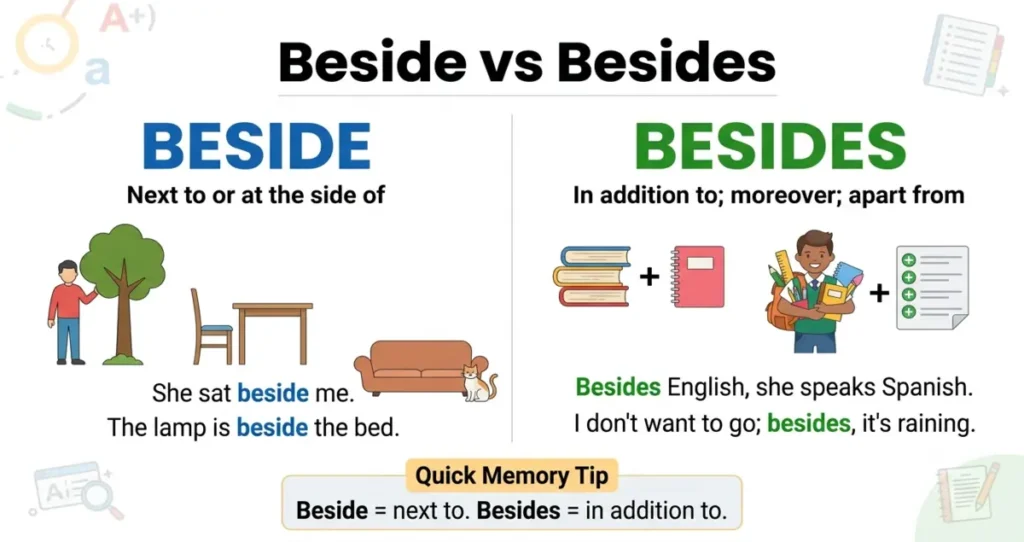
Ever written and not known whether to use beside or besides? You’re not alone. The two words are very similar in appearance, but differ in meaning and function in a sentence. This is because one additional “s” alters everything. This slight distinction, however, can baffle students, writers, professionals and even native English speakers.
“beside or besides?” is asked because people want a fast answer that they can count on. Whether they’re writing an email, a school project, a blog or a social media post, they would like to know which word to use in their sentence. The wrong word can make your writing awkward, or even alter the meaning.
The first good news is the difference is easy to understand once you grasp it. Here you will learn the meaning of beside and besides, their origins, how to use them correctly, common errors to avoid, and lots of examples. At the end, you will be able to select the right word on every occasion.
Beside/Besides – Quick Answer
The difference is quite simple:
- Beside – on the side of, alongside.
- Besides – in addition to, apart from, also.
Examples
Beside (next to)
- The dog was lying near the fireplace.
- She was seated next to her close friend.
- I can see my laptop next to my phone!
Read more:Passed vs Past: What’s Difference and Which One You Use
In addition to (besides)
- Besides English, he speaks Spanish.
- I don’t want pizza. Besides, I’ve already eaten.
- Who besides Sarah knows the answer?
Quick Memory Trick
- Beside = Side
- In addition = Plus one more…
Use beside instead of the word if it can be replaced by the word next to.
Use besides instead of also and in addition.
The meaning of Beside or Besides
Both are derived from Old English and have the same etymology.
The word beside joins be (“by”) and side, and is used to mean by side.
English-speaking people used it for many hundreds of years to refer to physical location.
Later people started to add –s to form besides
. The new form over time took on a new meaning. It initially meant where, but then came to mean along with, separate from, or even.
The spelling is very similar, but English has distributed the two words amongst different functions.
Read more:Desert vs Dessert: What’s the Difference between them
Today:
- Beside describing location.
- Besides in addition, it provides additional information.
Just a little letter “s” makes all the difference.
British English vs American English Spelling
British and American English spell both of the words beside and besides the same.
No difference in spelling of the two versions of English.
It’s not about how the word is spelled, it’s about how the words are used.
Comparison Table
| Feature | Beside | Besides |
| Meaning | Next to | As well as |
| Part of Speech | Preposition | Preposition or adverb |
| British English | Beside | Besides |
| American English | Beside | Besides |
| Example | Sit beside me. | I like science other than math. |
What Spelling to Use?
The decision depends on what you’re trying to say, not who you are saying it to.
For American Englsh
Use:
- Beside location.
- In addition to providing information.
For British English
It goes without saying that the same rule applies.
- Beside = next to
- Besides = also/in addition
For Global English
This rule applies to writing for Americans, Britishers, Canadians, Australians and anyone else.
Always ask yourself:
- Are you talking about position? → __________
- Am I elaborating? → Use in addition to.
Common Errors: Beside or Besides
The following errors are common.
❌ Incorrect:
She sat beside me.
✅ Correct:
She sat beside me.
Reason: She is next to you.
❌ Incorrect:
He enjoys playing tennis in addition to football.
✅ Correct:
Besides football, he enjoys tennis.
Meaning: You are about to add another activity.
❌ Incorrect:
Who else besides John came?
✅ Correct:
Who besides John came?
Other than John: Reason.
❌ Incorrect:
I stayed home. After all, it was the rainy season.
✅ Correct:
I stayed home. Besides, it was raining.
Reason: Also.
Beside/Besides in Everyday Examples
These are examples that you will see everyday.
Emails
Beside
Please put the file files next to the printer.
Besides
We have to finish the report, in addition to today’s meeting.
News Writing
Beside
The bicycle was located by police next to the road.
Besides
Heavy rain was not the only cause of damage, as strong winds did as well.
Social Media
Beside
My best friend is by my side!
Besides
I love nothing more than getting my morning coffee and listening to some music.
Formal Writing
Beside
The monument is located on the side of the river.
Besides
In addition to financial gains, the project also helped to enhance the health of the community.
This is an illustration that illustrates the differences between Beside and Besides
Beside or Besides – Google Trends & Usage Data
Interests in ‘beside‘ and ‘besides‘ remain high all year long, as students often mix them up in English use.
The expression is particularly popular in the countries where English is taught:
- United States
- United Kingdom
- Canada
- Australia
- India
- Pakistan
- Philippines
Many people ask questions, such as:
- Beside vs besides
- When to use beside
- When to use besides
- Beside meaning
- Besides meaning
Their confusion is due to their similar spelling, but different meanings. There is a constant stream of visitors who are interested in this subject on education websites, grammar blogs, and language-learning sites, which is why it still has a lot of visitors.
Beside vs Besides Comparison Table
| Feature | Beside | Besides |
| Main Meaning | Next to | In addition to |
| Shows Location | ✔ Yes | ✖ No |
| Adds Information | ✖ No | ✔ Yes |
| Can Mean “Also” | ✖ No | ✔ Yes |
| Can informally means “apart from. | ✖ No | ✔ Yes |
| Example | She was standing by my side. | All the others concurred except for me. |
| Easy Memory Tip | Side | Plus one more |
FAQs
Is it next to me or next to me?
Use on the side of me when there is someone next to me.
Example:
- She was standing next to me.
Use besides me when you want to say “other than me.
Example:
- Well… who else do I know that knows an answer?
What’s the difference between beside and besides?
Beside shows position.
It is in the form of a beside that adds additional information.
Can you write ‘besides’ grammatically?
Yes.
It is a common English word which is used as also, apart from or in addition.
Or can beside mean also?
No.
Beside (only) is used to indicate physical proximity.
In what ways are British and American English different in spelling?
No.
There’s no difference in the spelling of beside/besides in either country.
What’s the trick for remembering the difference?
Think:
- Beside = Side
- In addition to = Another:
This easy technique is a must do.
May be used at the beginning of a sentence as well as can.
Yes.
Example:
In addition, there is lots of time.
Conclusion
Beside and besides are actually really easy. Beside is used to refer to a location or position. It describes how a thing is related to a thing. Otherwise, it adds additional details. It can also mean, in addition, or apart from.
When you know how to connect words next to each other and how to add more words to it, it is natural to choose the correct word.
British English and American English have no differences in spelling, and you just have to consider the meaning of your sentence.
When writing, just ask yourself, “Am I describing location, or am I making another note?” This fast check will help you not make one of the most common grammar mistakes in English.
Use real examples, read carefully and watch for the way the words are used in everyday writing. The more you use them well, the more confident your English will be. Just one letter can make all the difference in communicating clearly and effectively.

I am Arshman Ali a professional English writer and English professor with a passion for language and a commitment to excellence. I bring precision and clarity to my writing, and the same high standards into my classroom. For me, language is not just a profession it is a purpose.