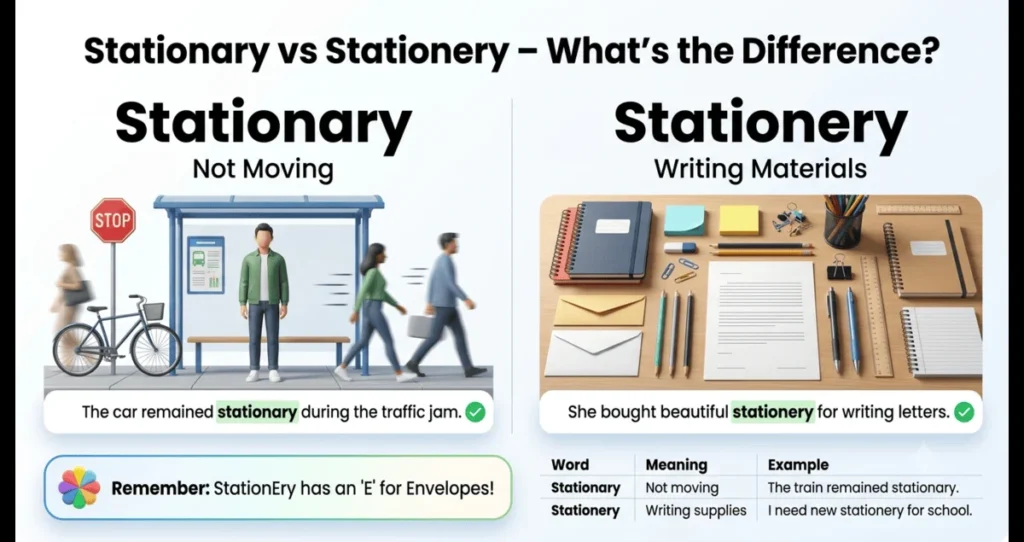
You’ll no doubt have typed one of these words, and then just stopped. Is it ‘stationary‘ or ‘stationery‘? They sound the same and it’s for this reason that so many people get them confused. The meaning of the word is changed entirely by one letter: either an “a” or an “e”.
This mix-up is more significant than you would imagine.
Whether it is by spelling the word “stationary” instead of “stationery,” you have just informed a client that your business
notebooks and pens don’t move. It is a minor mistake which can give your writing a sloppy appearance.
Here you will find the actual definition of each word, its origin, and a method to remember how to use it — for good. We will go over a few memory tricks, common errors and real life examples to make it automatic.
The correct spelling of stationary is with an ‘a’.
In a hurry? Here’s the short version.
- Stationary (with an a) is an adjective to indicate the absence of movement; remaining in the same position.
- Stationery (with an “e”) is a noun for paper, envelopes, pens and other writing supplies.
The bike was not moving and she did the stationery wrapping.
Practice tip: When writing about an object that is not moving, use stationary. Use stationery for paper, pens or letterhead.
Read more:Principal vs Principle Difference (+ Easy Examples)
Meaning of Each Word
Stationary
Meaning: Remaining in one place or position.
Pronounced as “stationary” in word pronunciation.
Part of speech: Adjective.
How to use it: Use stationary when you’re talking about something that’s not moving, such as a person, object, vehicle, or even a situation that doesn’t move, such as prices or growth.
Common situations: cars, exercise machines, weather, economics, physics/engineering objects.
A memory trick: The words stationary contain the “a” found in the word stay. If it’s stationary, it will stay in place.
Examples:
- The car remained at the red light for nearly a minute.
- A stationary bike is a fine exercise item to use for indoor cycling.
- Tropical Storm became stationary over the coast causing heavy flooding.
- He was standing still and watching the parade pass.
Read more:Aloud vs Allowed: What’s the Difference?
Stationery
Writing/paper and office supplies such as paper, envelopes, pens and supplies.
Origin: stationary (same pronunciation).
Part of speech:The word is used as a noun.
Use it: Use stationery when talking about papers used for writing, office correspondence or branding the office.
Typical applications: Office paper, wedding cards, custom letterhead, greeting cards, school supplies.
Memory trick: Stationery has an e, as in “envelope” and “letter. Both are items that you can see on a stationery shelf.
Examples:
- She had to order special invitations for the wedding.
- There was no paper in the office and we weren’t able to print the letters.
- He collects old postcards from the 1950s.
- Our Company Logo is used on all Official Stationery.
Key Differences
| Feature | Stationary | Stationery |
| Meaning | Immobile, unable to be moved. | Writing materials and supplies, including office supplies. |
| Part of Speech | Adjective | Noun |
| Common Usage | Vehicles, weather, objects, situations | Paper, pens, envelopes, letterhead – these are the items that students will need. |
| Example | The train was left idle for an hour. | Need more office stationery. |
| Easy Memory Trick | A for “stay” (stays still) | E for envelope (writing supplies) |
Word Origin (Etymology)
Both are derived from the same Latin base, stationarius which means “belonging to a military station” or “stationed. This became stationarius (as in Medieval Latin) in the Middle Ages, a merchant who was not itinerant, but had a permanent place of business.
Here’s where this gets interesting. The “stationers” were fixed location merchants who typically sold books and paper goods around universities. As time went on, ‘stationer’ came to be closely associated with paper and writing, and ‘stationery’ emerged as a noun for the goods s/he sold.
Meanwhile, the meaning of stationary remained unchanged: “something that is fixed and does not move” – as those old stationery shops were stationary.
This means that the confusion will not be random. They have a common progenitor, and English just divided them into two variants of the same word, having two different meanings today. It’s that common history that keeps us mixing them up so much today.
British English – American English
Fortunately, these two words are the same in meaning and spelling when it comes to British versus American English. Both dialects use:
- Not moving = stationary.
- Writing materials-stationery.
| Feature | British English | American English |
| Spelling | Same | Same |
| Pronunciation | Same | Same |
| Preference | No regional variation | No regional variation |
| Example | The bus remained at a standstill in traffic. | The bus remained in the same position in the line of traffic. |
This is one of the few word pairs which don’t confuse Geography into the mix. This is a spelling and a meaning challenge, not a dialect challenge.
Which One to Use?
For Americans whose language skill in writing is still developing: Stationary: if it doesn’t move, it’s stationary, Stationery: if it moves or is a paper product, it’s stationery. There are no exceptions to this rule for any region.
British users, the same applies: spelling and usage is the same across dialects.
International readers (ESL): Pay attention to the meaning rather than the sound. Both words sound the same, so use context clues: Does the sentence talk about moving or about paper and pens?
Academic writing: Exactitude is important. Use stationary for a fixed point, position, or data that doesn’t change (e.g., a stationary distribution in statistics). Do not use stationery unless specifically talking about paper products.
Business Writing Mistakes are made most frequently in business writing. If a company uses the term ‘we sell stationary’ instead of ‘we sell stationery’ it can come across as less professional. Always read the product description, brochure and websites twice.
Everyday communication: In everyday speech the meaning is usually clear, as they have the same pronunciation. When writing, however, always stop and proofread.
Common Mistakes
1.Correctly using the word “stationery”❌ I need to buy some stationary for the office. ✅ I need to buy some stationery for the office. Explanation: You’re referring to paper and pens, so it needs the e.
2. ❌ The truck was not moving at the loading dock. ✅ The truck was not moving at the loading dock. Explanation: Since the truck is not moving, it must have the a.
3. ❌ She is a wedding custom stationary designer. ✅ She is a custom stationary designer for weddings. Explanation: Weddings are made of paper, hence the use of the term stationery.
4.. Stationary for 2 quarters (needs to be ‘stationary’ not ‘stationery’). Explanation: “Not changing” means a state that doesn’t change (stationary).
5. ❌ Order more stationery supplies. ✅ Order more stationery supplies. Explanation: Supplies used here are paper supplies.
6. He did not ride a stationary bike but did have one in the garage. Explanation: This is a single word question where the answer is stationary (as the bike is not moving the sentence is about this).
7. ❌ The satellite stays stationery above the equator. ✅ The satellite stays stationary above the equator. Explanation: A geostationary satellite is stationary with respect to the earth.
8. ❌ Our company’s stationary includes letterhead and envelopes. ✅ Our company’s stationery includes letterhead and envelopes. Explanation: Letterhead and envelopes are types of paper.
9. ❌ The car sat stationery in the driveway all winter. ✅ The car sat stationary in the driveway all winter. Explanation: If the car is not moving, then it is stationary.
10.. ❌ He went to the teacher’s office to ask about the problem.12. ❌ He visited the teacher’s office and asked him/her about the problem. Explanation: Pens are stationery items.
Everyday Examples
Telephone: “Here’s the updated stationery template for client letters attached to my email.
School writing: “My favourite subject is Science, but I also like to use stickers on my stationery.
Business communication: “We are changing our company letterhead to reflect the new company colors.
News: “The forecasters said that the system had stalled, raising the possibility of flash flooding.
Books: “She stored his letters in a drawer, the fine stationery that he used to write them on was also there.
Vintage stationery: “I can’t find my own stationery shop.Business card: “I can’t find my own business card! 🖨️
Conversations each day: “Could you please get some paper from the office? We don’t have any envelopes left.
Grammar Tips
- Sentence position: Adjectives, such as stationary, take the place of a noun (a stationary object) or after a linking verb (the object is stationary). Stationery is a noun, so it takes the position a noun would — as a subject or object in a sentence.
- Common collocations: Stationary with bike/vehicle/ object/ position/ source/ front (as in weather). Set, shop, store, supplies, custom, personalized, letterhead, are common words to accompany stationery.
- Punctuations: No special rules for punctuation, but be careful with compound terms such as “stationery store” – don’t hyphenate unless it’s a modifying phrase in front of another noun in unusual constructions.
- Verbs: None of the words have verbs. Stationary is an adverb (adjective); Stationery is a noun. Be careful – the verb “stationarize” doesn’t exist!
Easy Memory Tricks
- A is for “stAy”: Stationary has an a just like stay. When an object is not moving, then it is stationary.
- E is for “lEtter” and “EnvElope“: Stationery has an e and so do the words for stationery, letter and envelope.
- Alphabetical trick: Stationery and envelope both have an e for writing supplies; stationary and parked both pertain to standing still.
- Visual Trick: Imagine a stationARy car with a car hAzard on — the a is a hint to the word staying.
Google Trends & Usage
In general, the term stationary is more likely to be used in the search; this is in part because it is used in a broader spectrum of daily life: vehicles, weather, fitness, and science classes all have some uses of the term. By contrast, “stationery” is a more limited term that only applies to paper items, office supplies and planning for weddings.
However, the frequency of “stationary vs stationery” is consistently high, indicating it’s not a fleeting confusion but a regular one. This is because the spelling is the only difference between them and they are homophones, so they are confused across English speaking countries such as the US, UK, Canada, countries that use English as a second language and Australia.
The intent of “stationary vs stationery” is almost always clarifying; the users are looking for a simple, straightforward explanation to be used quickly—usually in writing an email, essay, or product listing.
Related Words
English is no exception to such pairs of words that are similar in sound, but different in meaning. Here are some you may want to refresh yourself on:
Affect vs Effect: Affect is generally a verb, which means to influence and effect is generally a noun, which means a result.
Accept vs Except: The meanings are “accept” means “to receive or agree to” and “except” means “excluding.
Principal vs Principle: Principal means “the head of a school” or “primary,” and principle means “a fundamental rule or belief.
Frequently Asked Questions
Should it be “stationary bike” or “stationery bike”? It will always be “stationary bike” because the bike doesn’t move while it is being used. It would be misleading to use “stationery bike”, as there is no connection with paper products.
Why is there no difference in the sound between stationary and stationery? They both share the same Latin origin, stationarius, meaning “relating to a fixed place. English has retained almost the same pronunciation over hundreds of years and split the spelling and meaning into two separate words.
How can you easily tell the difference? Identify the letters a and e in stationary and stationery. This is a simple association which aids recall in writing.
Is there ever a time for paper products to be “stationary”? No. Stationary only means that it does not move. It’s an easy but distinct error to make when describing paper products.
What is the part of speech of the word “stationery”? Generally, the term “stationery” is used as an uncountable noun and is like furniture or equipment. You would say “some stationery” and not “a stationery” or “stationeries.
Are these words spelt differently in British English and in American English? No, stationary and stationery are the same in both dialects for both the spelling and meaning.
What’s a stationary version of ‘stationery store’? No. You can use the term “stationery store” for a business that sells paper supplies, but not “stationary store.
What part of speech is “stationary”? Adjective to modify a noun that’s not moving, such as a vehicle, object, or system.
What accounts for this business writing common sense error? The two words are also spelled the same, so writers often rely on auto-completion or memory instead of checking for spelling, particularly when pressed for time.
Are there any exceptions to these rules? No exceptions exist. Always you can use the term stationary to mean “not moving” and always you can use the term stationary to mean “writing materials”.
Key Takeaways
- Stationary (with an a) – not moving.
- Written material, such as paper and pens: stationery (with an e).
- Both words are derived from the same Latin origin, but have different meanings.
- There’s no difference in usage between British and American English.
- Avoid getting the two confused using the memory aids ‘a for stay’ and ‘e for envelope’.
- This is where it typically comes up in business and academic writing—double check before sending!
Conclusion
It’s a simple difference between stationary and stationery; but that little letter means a lot. If something isn’t moving, it is stationary. Stationery is paper and writing implements.
Now that you know the memory tricks (a for stay, e for envelope) the decision becomes an automatic one. You’ll no longer worry about second guessing yourself in emails, reports, and general writing.
Even people who are experienced writers can make mistakes with these words as they sound the same. Knowing the history, the meaning and just a few good tips to help them stay straight, though, you can now use both words correctly every time! Be sure to have this reference around to avoid any confusion.
Not sure of the difference between stationary and stationery? Discover the difference, some tips for easy memory, and actual scenarios which will make it easy to never get them confused.

I am Bahadar Ali, a professional content writer and the author behind GrammarDrive.com. I am passionate about making grammar simple and accessible for everyone. Through my writing, I aim to help learners and professionals communicate with clarity and confidence.