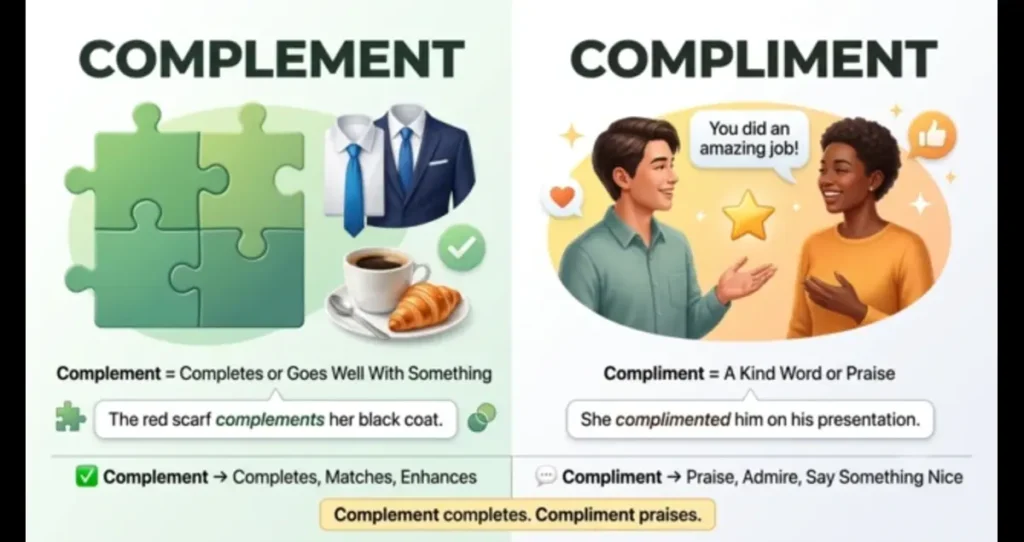
You are composing an e-mail message. You want to let a colleague know that their presentation was outstanding. Is it their slides that complement the report or their compliment? You haven’t been alone if you took a moment to stop and think.
One of the most confused word duos in English is complement vs compliment. Their sound is identical when spoken aloud and the spellings are nearly identical. They are separated by just one letter. However, the definitions are quite different.
It’s not a big deal when making them up for a friend. However, in a resume, business email or school essay, it might make you look careless. Readers notice. When they see one wrong thing, they begin to search for others as well.
meaning of each word, how to use each one and how to remember the difference for good. Real life examples, typical errors, grammar advice, and memory techniques that really work. At the end of the day, you will never have to worry about what to do or what you should do.
complement vs Compliment – Quick Answer
If you’re pressed for time, here is the short version:
- Complement (with an “e”) means to complete, enhance or go with something else. Think: Matching or completing.
- Compliment (with an “i”): A friendly comment that is used to praise or admire someone. Think: Say something nice.
Easy examples:
- The wine goes great with the food. (It is served at the same time as the meal.)
- My haircut was done by her and she gave me a nice compliment. (“She said some kind words.”)
If it does something, use complement (e). Use compliment (i) if it is a compliment to someone’s self-esteem. I for an “I feel good inside” complement!
Read more:Altar vs Alter: What’s the Difference? (+ Easy Examples)
Meaning of each word.
Complement
Complement means to make whole or enhance: Definition: Complete, improve, or match: Definition: Complete: Definition: Make whole or enhance: Definition: Make better:
Part of speech: May be used as a noun (a nice complement) or the verb (To complement something).
To use it: When two things join together to make a better thing or when something fills in a blank.
Common contexts: Fashion (“the shoes complement the dress”), food and wine pairings, teamwork, design, and grammar (a “complement” is also a particular grammar term, meaning a word or phrase that completes a sentence’s meaning).
Memory Fist: Complement has the word “complete. The first two begin with “comple-.” Complements are words that make the picture.
Read more:Stationary vs Stationery: What’s the Difference?
Examples:
- The blue eyes look great with this scarf.
- She is very calm and his style is very energetic.
- The food was very delicious with a spicy main course and a perfect dessert.
Compliment
Compliment: A polite statement of praise, admiration or approval, typically expressed towards a person.
Pronunciation: {Can be a noun (a type of compliment) or a verb (to compliment someone).}
Use when: It is used when someone says something good or praises another person’s looks, job or abilities.
Common applications: Discussions, social media feedback, performance evaluations, dating, customer support.
Memory trick: Compliment has an “I”. I feel good when somebody says “I like you”. Well, that little “I” is your reminder:
Examples:
- He expressed his high praise for her presentation.
- It was a lovely garden, she said, “what a lovely garden”.
- It is always a lovely feeling to receive a sincere compliment from my boss.
Key Differences
| Feature | Complement | Compliment |
| Meaning | That which is added to augment, complete or enhance. | A nice remark or praise |
| Part of Speech | Noun or verb | Noun or verb |
| Common Usage | Pairing, matching, completing | Praising, flattering |
| Example | The tie complements the suit. | She complimented my cooking. |
| Easy Memory Trick | Write numbers in base 10, with “complete” starting by “comple-“. | Compliments feel good and are like an “I” for your ego |
Word Origin (Etymology)
The two words go back to the same Latin origin: complere, which means “to complete” or “to fill up”. It is this common ancestry that is the source of the almost identical appearance of the words and the hazy confusion it causes for many modern writers.
The other term, complement, retained its Latin roots in Old French complement, meaning “that which completes.
It’s a slightly different route that Compliment took. In English, it came in via Italian complimento and French compliment in the 1600’s and originally meant an act of civility or courtesy, such as a formal expression of respect. With time, the meaning became a particular type of comment, or a compliment.
So, although they have different meanings, both words have the same DNA- of completing something, whether it’s a garment or a polit.
British English vs American English
Lucky for you, there is no difference in usage between British and American with these words.
The meaning and use of compliment, ‘praise’, and complement ‘something that completes’ are the same in both dialects, and the spelling is identical across the Atlantic.
| Feature | British English | American English |
| Spelling | Same (complement / compliment) | Same (complement / compliment) |
| Pronunciation | Same | Same |
| Preference | No dialect preference | No dialect preference |
| Example | If I may, Lovely dress. | If I may say so, lovely dress. |
The mix up of these two words is not regional. It is seen in all countries where English is spoken; all the words sound the same regardless of accent.
Which one do you choose?
For those whose native language is the American English variety: Both are common in US English. Just look out for this one, as spell check may not pick it up up (both words are spelled correctly, but in the wrong order).
British people: Same rules apply. No regional variation to be concerned about here.
If you are from outside the U.S. and Canada: If English is not your first language, concentrate on the memory tricks below. The “I for I feel good” trick is applicable in every
English speaking situation.
In academic writing: Accuracy is key. When talking about how ideas, theories and data complement each other, use ‘complement’. Avoid using the word “compliment” except when referring literally to praise or flattery in the topic.
In business writing: This is where errors are most likely to be detected. The term ‘compliments the team’ can come across as unprofessional for a performance review when it should be ‘complements’. If you’re writing anything that refers to teamwork, pairing, or fit, please double check.
In daily communication: Avoid over-exciting messages and chats. However, it’s better to get into the habit early on so that it becomes second nature.
Common Mistakes
1. ✅ Thank you for the compliment on my dress.3. ❌ Thank you for the compliment on my dress. Why: This is for praise, and therefore must be spelt with the ‘i’ sound.
2. ❌ The new software compliments our existing system well. ✅ The new software complements our existing system well. Why: The software actually completes or enhances the system, that’s why it’s “complement.
3. ✅ She gave a genuine compliment about his cooking. ❌ She gave a sincere compliment about his cooking. Why: If you say something to show you like someone or something, it is a “compliment.
4. ❌ These colors really compliment each other. ✅ These colors really complement each other. Why: The words are matching each other, “complement.
5. I want to compliment you on your excellent work.6. ❌ We need to compliment you on your excellent work.6. We should compliment you on your excellent work. Why: It is not about completing something, it is about praising the person.
6. ❌ The side dish is a nice compliment to the main course. ✅ The side dish is a nice complement to the main course. Why: The side dish complement and supports the meal.
Everyday Examples
Phone Calls: “Thank you for your calm demeanor in that phone call. It helped put the client at ease.
School writing: Author creates imagery that fits the dark story.
Marketing and sales: “Our marketing objectives are aligned with the objectives of the sales team.
News: The director’s bold new approach was well received by critics, who said it works well with the film’s minimalist style.
Books: “Her quiet strength complemented his bold personality and he never missed a chance to compliment her wisdom.
Social media: “Loving this palette 😍 the gold really complements the navy! Plus, thanks a ton to the man or woman who came up with the idea for this.
Everyday conversations: “That jacket really goes with your clothes! Well, that’s a good compliment!”
Grammar Tips
Sentence position: Both words usually go after the verb and subject of a sentence. The word “compliment” is frequently followed by verbs such as take, pay, receive, and give, for example, “take a compliment”. Phrases such as is, serves as, or acts as tend to be followed by the word “complement”.
Common collocations:
- Compliment: pay a compliment, take a compliment, backhanded compliment, compliment someone on something
- Complement: perfect complement, nice complement, complement each other, complement a dish
Punctuation: No special rules, but use “complement” as a term in punctuation sparingly. In grammar, a “complement” is a word or phrase which completes the meaning of another, such as a direct object or predicate adjective. This is nothing to do with the entire “praise” definition.
Verb forms: Both of these words are verbs. Complement, complements, complemented, complementing. Compliment, Compliments, Complimented, Complimenting.
Easy Memory Tricks
- The “I” trick: As in the word “compliment,” there’s an “I” in it; and as in the feeling you get when someone complements you, there’s an “I” in that. “I love compliments!”
- The first six letters were the same for the “complete” trick: complete. Complements something when it comes to a look, a meal or an idea.
- The pairing trick: When two people are pairing up, imagine the word “complement” as a puzzle piece. Two items which “complement” each other fit into a larger picture.
- The praise trick: Remember that the word “compliment” is similar to “compliment-ary”. It means “given freely” like a kind word given as a gift.
Google Trends & Usage
The word “compliment” tends to be queried more often in the casual, everyday sense, as users often ask questions on how to give a compliment, how to accept a compliment, and the like.
In a professional, academic or design related setting, “complement” is more in demand, whether it be for colour theory, business strategy or grammar homework.
The problem lies in the fact that both use the same way of saying the word, not in the dialects of the countries from which they come, so it is easy to mix them up in all the English-speaking countries. The people who use this specific set of keywords are typically broken into two groups: individuals who are trying to determine if they have used a correct spelling in their email or essay, and individuals who are looking for a spelling to fit in a specific sentence.
Related Words
There are a lot of confusing word pairs in English. Here are some additional ones that you may encounter:
- Affect vs Effect: Affect is normally a verb (to affect). Effect typically is a noun that refers to the result of a change.
- Accept vs Except: Accept – to take or agree to something. Except indicates that something isn’t included.
- Principal vs Principle: Principal is used in reference to someone with authority or something that is most important, such as a school principal. Principle: A fundamental rule or belief.
Frequently Asked Questions
1.For a colour that matches well, is it “complement” or “compliment”? Use “complement.” Colors that complement each other and look good when together are called complementary colors, and they complete or balance a palette.
2. What is the difference between complement and compliment? The simplest one is to recall that the word “compliment” contains the letter “I”, which represents the feeling you have when you are complimented. The word ‘complement’ is related to ‘complete’ because it completes or enhances.
3. Can “compliment” be used as a verb? Yes. If you want to say that someone is worthy of being praised, you can say that you “compliment” him.
4. Can “complement” be used as a verb? Yes. To “complement” means to add to, complete or improve something, like “The sauce complements the pasta.
5. What is the most typical style of backhanded compliment? Backhanded compliment: A comment that seems like a compliment but has a hidden insult, e.g., “You’re actually pretty smart for someone who didn’t go to college.
Key Takeaways
- Complement (with an “e”) means to complete, enhance, or complement.
- Compliment (with the letter “i”) is a kind word or a statement of praise.
- The roots of both words are the same, complere (“to complete”).
- There’s no difference in usage between British and American English.
- The “I” in compliment means the feeling of good nature the praise brings you.
- This error will not be picked up by Spell-check, so proofread with care, particularly in professional writing.
- Be aware of the difference between the terms complementary (matching/ enhancing) and complimentary (praising/free).
Conclusion
Complement and compliment are pronounced the same, but they have different meanings. To complement or complete: to add to, to enhance or extend, as in a colour palette, meal or team of players. Compliment is a polite and favorable comment; such as when you tell your friend you like her new haircut.
Both words have the same Latin origin and are almost the same in spelling, which may lead to the confusion. The memory tricks, such as the “I” in compliment refers to how good it makes you feel, will stay in your memory forever once you commit them to it.
In emails, resumes, and professional writing, double check your writing before you press send, since the computer won’t catch this one for you! After some practice, it will get easier and easier to select the right word.
Complement vs compliment: definitions, examples, memory hacks that will help you not to mix them up again.

I am Bahadar Ali, a professional content writer and the author behind GrammarDrive.com. I am passionate about making grammar simple and accessible for everyone. Through my writing, I aim to help learners and professionals communicate with clarity and confidence.