You are writing a Wedding scene. The couple is standing in the front of the church, holding place for the vows. Wait — is it the “altar” or the “alter”? A single letter can make all the difference, and miss one correct letter, and your writing is going to look sloppy in no time.
This mix-up is more common than you’d think. The sounds of the words are very close to each other when spoken aloud. Your spell checker won’t be able to tell, either, since both are spelled right, but for different meanings. That’s the trick then.
The good news is that the same is true for you if you learn the trick! This guide will explain the meaning of each word, its origin and how to memorize which to use. We will be learning from real examples in emails, news and everyday writing. At the end you will be completely comfortable with using “altar” and “alter”.
Altar means alter; Alter means alter.Altar is alter, Alter is alter.
So, here is the brief explanation.
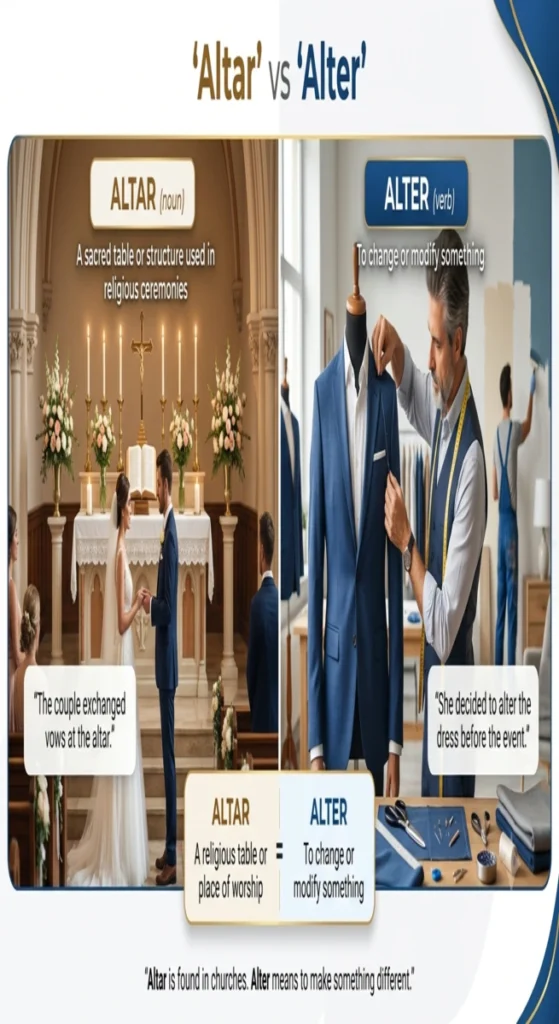
- Altar is a noun. It is a raised platform for religious services, worship, etc., such as a table at the front of a church.
- Alter is a verb. To modify or alter something.
A place: Example: “The priest was at the altar. “A change: Example: “She changed her clothes before the wedding.
Quick tip: When you can get through with the word “change,” use alter. If you are referring to a literal area of a church or temple you should use altar.
Read more:Complement vs Compliment: What’s the Difference
Meaning of Each
Altar
Raised platform or table in a religious assembly, for offerings, prayers or ceremonies such as marriage.
The part of speech: Noun
Pronunciation: AWL-ter
Use it when: You are discussing a physical, sacred building; typically within a church, temple or shrine.
Common contexts: Weddings, religious services, churches, historical/cultural writing.
Memory trick: Altar contains the word “tar” – picture a tarred stone slab in the church. It’s a physical thing.
Read more:Stationary vs Stationery: What’s the Difference?
Examples:
- The bride was walking slowly towards the alter.
- It was during this ceremony that they lighted the candles on the altar.
- The old temple was surrounded by a stone altar in the center.
Alter
Meaning: To alter, modify or adjust something.
Part of Speech: Verb
Onomatopoeia is a word that mimics the sound it represents, such as the word for thunder, which is ‘thunder’.Onomatopoeia is a word that imitates the noise it makes, e.g. ‘thunder’ for the noise of thunder.
Use when: When there is a change, adjustment or modification of any type.
Employed in the following situations: Making appointments, modifying plans, editing documents, modifying agreements.
Memory aid – Change the letter a with an alter-ation. You must make an alteration if you require one.
Examples:
- Contract may need to be adjusted prior to signing.
- Your tailor will make the changes to your suit by Friday.
- Travel plans can change rapidly due to weather.
Key Differences
| Feature | Altar | Alter |
| Meaning | A place to set down sacred objects; an altar or a stone platform. | To change something |
| Part of Speech | Noun | Verb |
| Common Usage | Religious ceremonies, weddings | Editing, changing, adjusting |
| Example | They were married in a marriage ceremony. | Kindly modify the schedule. |
| Easy Memory Trick | Has “tar” (Think stone slab) | Sounds like “alter-ation” |
The Origin of Altar and Alter
They are both of Latin origin and are phonetically similar in this way.
The origin of Altar is from the Latin word altare from which the term altus means “high. This makes sense – altars were usually platforms or raised areas, standing above the surrounding floor, indicating their sacred role.
The etymology of Alter is from the Latin word alter meaning “other” or “the other one.” The concept “other” came in and over time turned into the verb “other”, which became synonymous with “change.
Even in Latin these two different words had different origins. These were only confusing in English because they sounded the same when spoken aloud. This sort of pair is known as a homophone — words that sound the same but are spelled differently and have different meanings.
British English vs American English Spelling
Thank the heavens, there isn’t any spelling difference between British English and American English for these two words. They’re written the same way in both regions, altar and alter.
Unlike many other British-American word pairs (colour/color or theatre/theater, etc.).
The confusion doesn’t come with the region with alter and alter. Geography isn’t the thing, it’s what it means.
| Region | Altar (noun) | Alter (verb) |
| American English | altar | alter |
| British English | altar | alter |
| Australian/Canadian English | altar | alter |
The spelling rules do not differ, regardless of where your readers are located. It’s only a matter of which word fits the sentence!
Which Spelling is Correct?
The only thing that changes with region is the selection of the correct word for the correct meaning – spelling doesn’t.
In the USA: altar is used for religious or ceremonial purposes, alter is used for any kind of change. No exceptions for regions.
If you are from the United Kingdom or Commonwealth countries: Same rule applies. Local variant is not a concern here.
For international global audiences : If this is not a regional spelling problem, then concentrate on the context. Think about whether you are describing a place or a change by thinking: “Am I describing a place or a change? That’s the answer you need – use that word, all over the world.
For academic and business writing :When it comes to academic or business writing, accuracy is key. The two spellings are both correct, so a misspelling wouldn’t be caught by a spell-checker. For this, always proofread by hand.
In everyday communication: Texts and casual emails will be more forgiving, but it’s still important to get right, particularly for formal communications such as RSVPing or writing wedding-related correspondence.
Alter vs Alter in Common Mistakes.
1. The couple exchanged vows at the altar. . The couple exchanged their vows at the altar. Why: It’s a physical place, you’ll need the noun, “altar.
2. ❌ We have to modify the plan before Monday. ✅ We have to change the plaan before Monday. Why? “Plan” is changing to “alter” so you must use the verb, “alter.”
Original document should not be altered: 3. ❌ Please don’t altar the original document. ✅ Please don’t alter the original document. Why: Again, this is a change, and requires “alter.
3. ✅ She placed flowers on the altar.6. ❌ She placed flowers on the alter. Why: The altar is a physical thing to which the flowers are being given.
4. ❌ His mood can alter the mood of the whole room is this one correct? — This one is correct, “alter” fits as a mood is changed.
5. ✅ The dress should be altered before the big day. ❌ The dress needs to be altared before the big day. Why – “Altered” is not an alter form of “altar,” it is a past tense form of “alter.”
6. ❌ They made a new altar to their business plan. ✅ They created a new iteration of their business plan. Don’t use “altar” as a metaphor; use “alter” which means to change an abstract concept, such as a plan.
7. The boy who is not in the altar lit the candles. ✅ The altar boy lit the candles. Why: “Altar boy” is a fixed term for a person who helps with the altar in a church.
Alter, alter, everyday examples,
In writing: “Please change the meeting time from 2 PM to 3 PM.
wedding planning : While arranging a wedding, the florist will adorn the altar with white roses.
news writing: The altar of the historic church goes back to the 1800s. The new law may affect the way businesses work, officials say.
In books and fiction :Her hands shook as she stood before the altar in books or fiction: “She stood before the altar, her hands shook. The spell would change his destiny for ever.
On social media posts: “Just said ‘I do’ at the most beautiful altar 💍” “Life has a way of changing plans — and that’s okay.
In daily conversation : When speaking to others: “Can you change this so it doesn’t contain gluten?” We saw an ancient temple whose inner altar was of stone.
Grammar Tips
- Altar is always a noun. It can follow words such as articles “the” or “an” (“the altar,” “an altar”) and it can be made possessive (“the altar’s candles”).
- Alter the word alter is NEVER a noun. It is conjugated with the normal verb conjugations (alter, alters, altered, altering).
- Some common collocations with altar: wedding altar, church altar, altar boy, at the altar.
- These are some common collocations with alter: alter course, alter plans, alter ego, alter the outcome.
- Note: “alter ego” is a set phrase, which means ‘second identity’ — DO NOT use ‘altar’ to mean ‘alter’.
Easy Memory Tricks
1.The “TAR” trick: Altar is based on the word “tar,” which is used in boat-building, etc. to make or seal a solid — like a physical structure.
2.The “-ation” trick: If you can insert “-ation” into a real word (alteration), then you need the word alter.
3.The swap test: Experiment with substituting the word with the word change. If it still makes sense, alter. Change plan is good, alter is good, “We need to change the plan” works.
4.Place test: If you’re pointing at a physical location they might stand in – use altar.
Google Trends & Usage Data: Altar vs Alter
The most common reason for looking up the term altar vs alter is to find out how to spell it, for wedding-related writing, and also for church use. People search for this couple in the typical wedding months, so there’s a peak in search volume during this period.
This is common everywhere English is spoken, as it isn’t bound to regional spelling differences. The majority of the searches are from people writing invitations, planning ceremonies, drafting formal documents, or proofreading documents themselves. For almost every search, the meaning is the same, “I know that these sound similar — which one do I need?
Both the spellings are correct words in English and thus the error can easily go undetected by spell-checkers, leading people to look for the answer on their own.
Comparison Table : Word Variations
| Word Form | Meaning | Example |
| Altar | Noun — sacred structure | “At the altar they knelt.” |
| Alter | Verb (present) — to change | I’ll make some changes to the design. |
| Alters | Verb (present, singular) | She changes clothes for a living. |
| Altered | Verb (past tense) | The document has been modified. |
| Altering | Verb (present participle) | “He’s changing his tactics.” |
| Alteration | The verb to change. | The tailor did a little modification. |
| Alter ego | Fixed phrase — second identity | Bruce Wayne is Batman’s alter-ego. |
Related Words
Word pairs that are confusing are all around in English. These are some of the additional words that you may encounter:
- Affect vs Effect: Affect is a verb, that is, it is used to describe an action (“to influence”), and effect is a noun, that is, it is used to describe a result or effect (“the effect”).
- Accept vs Except: Accept is defined as “to agree to take in” and except is defined as “excluding.
- Principal vs Principle: Principal is someone who’s in charge or something that’s most important, while Principle is a basic rule or belief.
Frequently Asked Questions
1.Does altar or alter mean marriage? The correct word for weddings is “altar. The place in front of the church or place of worship where couples exchange vows in a marriage.
2. What does the term ‘alter ego’ mean and why is it not ‘altar ego’? Alter ego translates to “second self” or “hidden identity. It always contains “alter” since it has to do with the Latin word for “other,” not with the noun for a religious building.
3. Is there ever a time when “altar” is used as a verb? No. “Altar” can only be a noun. When you need a word that means “to change,” you always need “alter.
4.Why is it that the words altar and alter sound the same? They have the same sound, but different spelling and meaning — homophones. They both come from different Latin stems which coincidentally became the same in English pronunciation.
5. Do you recognize the word “alter” from the Latin word? No: They are spelt exactly the same in American and British English. The “confusion” has to do with meaning and not the spelling of the region.
6. What’s the past tense of “alter”? The word “altered” means “changed in the past. For instance: “The report was changed prior to publication.
7. What is a quick way to keep track of which word is which? Use the “swap” test, substitute the word for “change”. If it is still appropriate, use “alter. Describe a place: use “altar.
8. What is the correct spelling of “altar boy”? (a or e) It’s spelled “altar boy” and is a young man assisting at a church altar.
Key Takeaways
- Altar = Noun, a physical structure dedicated to the sacred (weddings, churches, temples).
- Alter: a verb that means to change.
- There is no difference in British and American spelling — it is just a matter of the meaning.
- Use the swap test: If ‘change’ can be used, use alter.
- Look out for common phrases that never change; e.g., “altar boy” and “alter ego.
- This is a type of error that can’t be detected by spellchecker, so don’t rely on it unless you proofread by hand.
Conclusion
The word alter and altar sound the same, but have different meanings in a sentence. An altar is a place, where ceremonies occur, the holy place. Alter – is an action – a change. Clearing the verb from the noun and the noun from the verb is an end to the confusion.
You should remember the simple swap test: If you can replace the word in the sentence with the word change, then the word alter should be changed. If you are thinking of a building in a temple or church, you need altar. Be aware of words that are fixed such as ‘alter ego’ and ‘altar boy’—these do not alternate.
Unlike many other pairs of English words, there is no British-American spelling disagreement in this pair and this is an easier change to make. Now all you need to do is carefully proofread, as this is one that you will have to read yourself.
Now you can use words correctly — every time, in every piece of writing you create — with the tips, examples and memory tricks in this guide.

I am Arshman Ali a professional English writer and English professor with a passion for language and a commitment to excellence. I bring precision and clarity to my writing, and the same high standards into my classroom. For me, language is not just a profession it is a purpose.