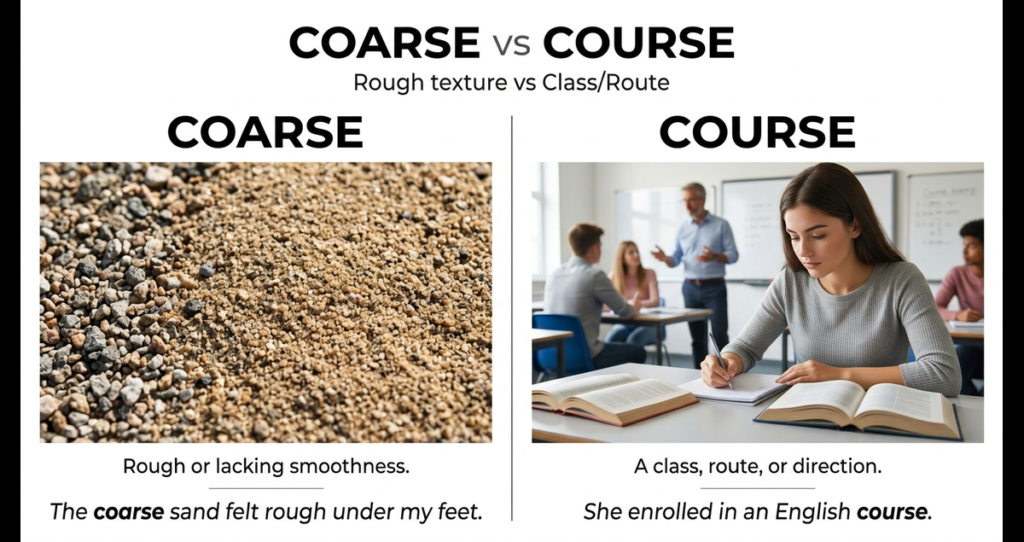
You are creating an e-mail. You would like to tell about some rough sandpaper, or perhaps the golf course down the street. Then it suddenly occurs to you: Is it “coarse” or “course“? Your cursor simply remains there and blinks.
You’re not alone. These two words have exactly the same sound, but quite different meanings. It makes all the difference when that one letter, the “a”, changes. Stir them into a work e-mail or even a school essay, and it could make your writing appear messy, even if your ideas aren’t.
This guide will put the issue to rest. You will discover the meaning of each word, know which word to use and how to remember, and how to avoid the pitfalls that even confident writers get into. At the end, you will never have to take a guess again.
Coarse or Course Quick Answer.
Coarse:The word coarse is an adjective. It means rough or harsh, or containing large, coarse particles, such as coarse sand or coarse fabric. The term can also refer to a rude or crude manner, as in “coarse language.
Course: noun (also verb). It means a route, way or direction; a course of study; a sequence of events; or a course of food and drink, such as the main course of a meal.
Quick takeaway :If you’re referring to “rough,” then use coarse. If you’re talking about anything else, such as a path or a class, a plan, or a meal, use course.
Example: “When I fell on the running course I scraped my knees on the coarse gravel.
The meanings of each word.
Coarse
Definition:Roughness, harshness, or coarseness in texture, made of large particles; lacking refinement, especially in speech or manners.
Gender: Masculine
Pronunciation: /kɔːrs/ — the same as course which is why people think they’re the same word.
When to use it: Use coarse for texture, grain or quality that isn’t smooth. It can also be used to refer to rude or crude language and manners.
Typical contexts: cloth, soil, hair, salt, gravel, jokes, words, behavior.
Memory trick: Coarse has an “a”, and “rough” does also — no wait that trick doesn’t work.
Try this instead: Coarse has the word ‘ars’ in it, which is the word for ‘ars’ (the back of the arse, the bottom) as you would feel it in your hands, so ‘art class fabric’. It’s all about the connection of the texture.
Read more:Will or Would: What’s the Difference ?
Examples:
- The blanket was coarse and itched her skin.
- He has a coarse sense of humour which offends others.
- Coarse sandpaper will remove material more quickly than fine sandpaper.
Course
Part of a meal: a path or direction of movement; a series of lessons; a route; a plan of action.
Part of speech: Noun (and sometimes a verb, such as “the water is running down the drain”).
The term “coarse” is synonymous with “cors”.
Use of it: Use course in describing direction, education, food and a series of events. It also occurs in such expressions as “in due course” and “of course.
Familiar environments: School, golf, meals, rivers, ships, plans, time.
Memory trick: Course is a route, it relies on the sound ‘r’ — ‘r’ indicates movement or direction in both words. Imagine a ship traveling through a path.
Examples:
- This term she’s studying graphic design.
- The vessel turned off course to steer clear of the storm.
- As a first course on the menu, we had soup.
- I’ll be moving this weekend and naturally, I will help you out.
Read more:The Difference Between Hole and Whole! (+ Easy Examples)
Key Differences
| Feature | Coarse | Course |
| Meaning | Roughness; rudeness | Path, Class, meal part or Plan |
| Part of Speech | Adjective | Noun (occasionally a verb) |
| Common Usage | Talking about fabric, sand or manners: | The school, sport, direction, and food are all excellent. |
| Example | Coarse burlap sack | Study Excel! |
| Easy Memory Trick | “Coarse” = rough to the touch – Do not use a fine brush. | A run you take is a “course.A run you take is a “course”. |
Word Origin (Etymology)
The meaning of coarse is from the Middle English in course “in the ordinary way” or “common. The word “in course” was eventually shortened to “course” and eventually developed into the spelling “coarse,” which meant ordinary, plain, or unrefined, and also rough or crude.
The word course comes from the Old French word cours; from the Latin word cursus, meaning “a running” or “a race. That Latin root is the source of the modern meanings of “course,” which means movement, direction and sequence, as in the course of a river or a course of study.
The division in spelling occurred over a period of time and was not completely consistent, as both words are derived from the same historical source and have the same pronunciation. It is this common origin that makes them so hard to tell apart now they sound similar, are almost indistinguishable in appearance, and even began as the same word centuries ago.
British English vs American English
Fortunately, there is nothing to distinguish the spelling or meaning of coarse and course in British English from American English.
| Feature | British English | American English |
| Spelling | coarse / course | coarse / course |
| Pronunciation | /kɔːs/ | /kɔːr/ and /kɔːʃ/ (rhotic and slightly more rhotic respectively) |
| Preference | Same usage rules | Same usage rules |
| Example | He is taking a course at a college. | He’s studying a course in college. |
The only difference is in pronunciation: American English is harder to hear the r than British. Spelling and meaning remain the same across the Atlantic.
Which of them is the right one?
American English: Use standard spelling and usage. Simply remember that coarse is used to describe something that is rough, and course is used to describe anything else.
British readers: There’s no difference. British English does not have a different spelling for either of these words.
International students (ESL): Pay attention to meaning rather than to sound as both words sound exactly the same. Consider “am I talking about texture or rudeness? (coarse) or “Am I talking about a path, class or meal? (course).
Academic writing: This means that precision is most important here. Read carefully all instances, particularly in essay writing about literature (coarse language, coarse humor) versus an academic setting (a course of study, a course requirement).
Business writing: course” is used much more frequently in the business environment, such as in courses, courses of action, polite responses to questions, “of course”. Use the term ‘coarse’ sparingly and only in particular contexts.
Everyday Communication: Trust Context. Most people use “course” in casual writing since it is used more — which is why it’s important to double check if you really mean to use “coarse.
Common Mistakes
1. ❌ I’m taking a coarse on digital marketing. ✅ I’m taking a course on digital marketing. Why: A class or program of study is always “course” and never “coarse.
2. ❌ The fabric was rough on her skin. ✅ The fabric was coarse on her skin. Always “coarse” – Why: “coarse” is a texture description.
3. ❌ Of coarse, I’ll be there on time. ✅ Of course, I’ll be there on time. Because: “Of course” is a set phrase and does not use the word “coarse.
4. ❌ He said some very coarse language during the meeting, talking about what he thought the course of action should be.
5. ✅ The golf course was closed for maintenance. ❌ The golf coarse was closed for maintenance. Why: Golf Course is a place, not texture.
6. ❌ She has a course sense of humor. ✅ She has a coarse sense of humor. Why: The word coarse is needed in describing personality or humour that is rough/crude.
7. ❌ The river changed its coarse after the flood. ✅ The river changed its course after the flood. Why: Direction or path always have the word course.
8. ✅ We took the appetizer as first course. ❌ We ordered the appetizer as our first coarse. Why: Meal segments are “courses,” not “coarses.
9. (✅) This beach has very coarse sand. Why: Texture once again — grainy or rough materials are “coarse.
10. ❌ In due coarse, we’ll finalise the details. ✅ In due course, we’ll finalise the details. Why: “In due course” means “eventually” and always has “course.
Everyday Examples
Phone call: “Absolutely, I would be pleased to see the draft before Friday.
School writing: This semester, I am taking a class in the environmental sciences.
Business Communication: “It is time to take a new look at the product launch plan.
News: Hurricane’s trajectory changed overnight, new evacuation orders issued.
Books:He had coarse and calloused hands “from years of manual labor.
Social media: “Just finished an amazing online course on photography! 📸”
Everyday dialogue: “This towel is too rough, can they get some other, softer ones?
Grammar Tips
- Sentence position: “Coarse” is an adjective and is normally placed in front of a noun (coarse fabric) or after a linking verb (the fabric is coarse). The word “course” is a noun and it typically comes after an article or possessive (“a course,” “her course,” “the course”).
- Common collocations “Coarse” associates with sand, salt, hair, language, humor, fabric. The word “course” agrees with of action, of study, golf, main, obstacle, and due.
- Punctuation:No special rules for punctuation, but be aware of the idiom “of course” that is frequently used as an interjection and should be surrounded by commas: “Of course, I understand.
- Verbs: Sometimes “course” is used as a verb meaning “to flow rapidly,” such as “Tears coursed down her cheeks. “Coarse” is never used as a verb.
Easy Memory Tricks
- Texture test: If rough, it is coarse. Coarse means sandpaper, burlap or gravel.
- Route rule: If it involves path, direction or sequence, it’s course. Use of the word “of course” meaning “along the most likely route.”
- The letter count trick: Coarse has an additional “a” (as rough has that rough, jagged sound). Both rough and coarse are abrasive.
- Course = Class: If you’re referring to a class or program, pick course.
Google Trends & Usage
The word “course” is searched much more than the word “coarse” just because it’s a more versatile, common word, it appears in education, sports, dining, and everyday idioms such as “of course. By comparison, coarse is a more specific adjective that is primarily related to texture or rude or coarse behavior.
Homophone spellings are the reason for the confusion between the two, and they appear particularly frequently with learners and writers who spell words by sound. When users type things such as “coarse or coarse“, they’re almost always looking to clarify their own spelling for written purposes, they want an answer that is quick, clear and useful, not a language lesson.
Related Words
Affect vs Effect: Affect is typically a verb that means “to affect” or “to influence” while Effect is typically a noun that means “the effect” or “the result.
Accept vs Except: “Accept” means “to receive willingly” and “except” means “excluding.
Principal vs Principle: Principal is the person who is in charge of something or a thing that is out of the ordinary; principle refers to a rule or a basic truth.
Coarse vs Corpse: Less common, but sometimes confused because of the similarity in the letters — Corpse means a dead body, and is unrelated to texture or paths in any way.
Frequently Asked Questions
1.Is it ‘of course’ or ‘of coarse’? It’s always of course. The phrase “as expected” or “certainly” is used, but it doesn’t have the “coarse” spelling, although it sounds the same.
2.In what way is the texture coarsened? Coarse can mean rough, grainy and made up of large particles instead of fine particles. Common examples include coarse salt, coarse fabric and coarse sand.
3.Does the word “course” ever have the meaning of rough or rude? No, Course doesn’t mean texture or rudeness. For crude language or rough material “coarse” is required.
4.How is it that the terms coarse and course are pronounced the same? Both words have the same linguistic origin and were not fully standardised in English for several centuries after the first use of the words, so that they are now homophones.
5.When is “golf coarse” appropriate? No, this is a common misspelling, it is spelled “hazardous. Always use the word “golf course” to mean a golf course.
6.What is the plural of ‘course’? Plural = courses (more than one class, more than one segment of a meal, or more than one path, for example “She’s taking three courses this semester.
7.Is there a comparative of coarse? Yes. The comparative is ‘coarser’ and the superlative is ‘coarsest’, as in ‘This is coarser than that’.
8.Does “coarse” equate to negative? Not necessarily. When used to describe texture it can be neutral (e.g. coarse sand), but when describing behaviour or language, it will generally take a negative connotation.
9.Is the word “course” a verb? Yes but not as often. In the case of “to course” it may refer to “to move quickly”, such as “Adrenaline coursed through his veins.
10.When spelling quickly, how do I recall the correct spelling? Ask: “Is it something rough I’m describing? If yes, call it “coarse. Use “course” when referring to anything other than a class (such as a meal, path, or plan).
Key Takeaways
- Coarse is an adjective that describes something as being rough, grainy, or crude.
- A course is a noun for a path, a class, a part of a meal or a plan.
- Confusingly, both words are spelled the same and sound the same.
- The “course” spelling is always used for the word “of course” and the word “in due course”.
- When it comes to texture and rudeness, “coarse” always comes into the picture.
- There’s no difference in usage between British and American English.
- If you are not sure, check if you are referring to rough (coarse) or route/class/meal (course).
Conclusion
The difference between coarse and course is simply a question is it coarse as in “rough,” or is it coarse as in “path,” “class,” “meal,” or “plan”? As soon as this distinction comes in place, the confusion is banished forever.
Keep in mind that coarse refers to texture and rough actions/crusty language. Everything else from golf courses to college courses to the main course at a dinner is “course”. The fixed phrases “of course” and “in due course” are always spelt with the “course” spelling.
Typical errors are typically committed out of rush, and when in doubt, pause and think to understand what you really mean. Now that you’ve got these tips and tricks, and more examples in this guide, you can use both words correctly, confidently and without hesitation. This handy guide will help you never confuse them again.

I am Bahadar Ali, a professional content writer and the author behind GrammarDrive.com. I am passionate about making grammar simple and accessible for everyone. Through my writing, I aim to help learners and professionals communicate with clarity and confidence.