You are composing an email message. You wish to write “whole,” but your fingers type “hole. Sound familiar? You’re not alone. The pair of these words are one of the most confused in English and it’s easy to see why.
The sound of hole is the same as the sound of hole whole. Hence, they are so difficult. These are indistinguishable to your ear, and sometimes your brain gets the wrong one when you write.
However, the problem is that they can be mixed up, and your writing can end up looking shoddy, even if you’re a genius with your ideas. The wrong selection of words can be distracting to readers or unprofessional for a business email.
In this guide, you will discover just when to employ “hole” and the time to use “whole.” Real examples, common pitfalls, memory hacks and answers to the most popular questions that people search for will be presented. Before the end, you will not have to think twice.
Hole or Whole – Quick Answer
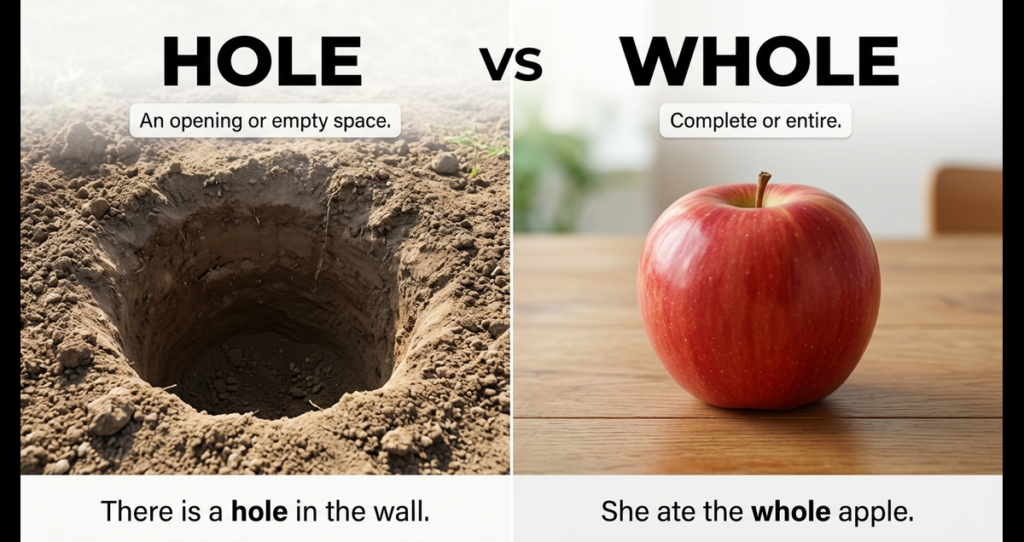
Hole is a noun which refers to an opening, gap, or empty space in something. Remember a hole in the ground or a hole in the sock.
Whole is an adjective (and sometimes a noun) that means complete, whole, or not divided. Imagine that you have to eat a whole pizza or go without working for a whole day.
Quick examples:
- There’s a hole in my jeans. (an opening or gap)
- I devoured the whole sandwich. (whole, entire)
Quick tip: When you refer to a “gap or opening,” use the word hole. Use whole if you are referring to “full or total.
Read more:Brake vs Break: What’s the Difference? (+ Easy Examples)
Explain the meaning of each word.
Hole
Definition: A hole or break in a solid object or surface.
Part of speech: used where noun is used as a verb, as in ‘hole up’ (informal).
Use: “hole” when discussing a gap, empty space, problem, defect in a plan or argument.
Common contexts: holes in clothing, holes in the ground, holes in a theory, golf holes and black holes.
Memory aid: The shape of a hole has an O in the middle as does the word hole. Imagine a donut that has a hole in it.
Read more:Which Award or Trophy : Which One Should You Really Use?
Examples:
- The dog chewed a hole in the back yard.
- There’s a hole in your argument.
- He sank the ball in one hole.
- A small hole is big enough for mice to fit through.
Whole
Definition:Full, not divided into parts, complete, entire.
Part of speech: Adjective (also can be used as a noun, as in “the whole of the country”).
Use when: Use “whole” to describe something when nothing has been taken away or added.
Common contexts: Whole numbers, whole foods, a whole day, the whole story, whole milk.
Memory trick: Remember, the letter W is not pronounced in the word “whole,” which is similar to its use in the words “wonderful” and “wholesome. If you’re referring to “full,” consider the W for “wow, that’s everything.
Examples:
- She ate the whole cake by herself.
- I was reading all weekend.
- He was telling me all the truth.
Key Differences
| Feature | Hole | Whole |
| Meaning | An opening or gap | Complete or entire |
| Part of Speech | Noun | Adjective (or noun) |
| Common Usage | Physical gaps, flaws | Totality, completeness |
| Example | There’s one hole in the wall. | I have read the entire book. |
| Easy Memory Trick | Is in the shape of an ‘O’, such as a hole | Silent word with W as in silent W in “how, now”. |
Word Origin (Etymology)
The Old English word for hole is hol, meaning a hollow place, cavity. It is related to the word “hollow” itself, which also shares its roots with the old Germanic words that refer to a hollow or concave space.
The Old English word for whole was ‘hal’ meaning healthy, uninjured, or complete. The word “hal” also has an interesting connection to “heal,” as it is the ancestor of that word. Hence, the term “whole” evokes the notion of wholeness and health, rather than simply fullness.
That’s because this spelling change is one of the reasons for the similarity in sounds between “hole” and “whole,” but dissimilarity in letters.
As English speakers began to rely more on the written form than the spoken, it was only a matter of time before confusion became commonplace between both of these words.
British English vs American English
Fortunately, there is no real difference in spelling, pronunciation or usage between British English and American English for the word hole (or whole).
| Feature | British English | American English |
| Spelling | hole / whole | hole / whole |
| Pronunciation | /hoʊl/ | /hoʊl/ |
| Preference | Same usage rules | Same usage rules |
| Example | He filled up the entire hole. | He completely filled the pothole. |
This pair doesn’t include regional differences to be concerned about, making it easier than some other pairs of confusing words.
Which one is it you should use?
American readers: Use hole for holes and gaps and whole for completeness and wholeness. No adjustments required regionally.
British readers: Rules are the same. This pair doesn’t change its spelling and meaning across the Atlantic.
International students: If English is your second language, do not pay attention to pronunciation but pay attention to the meaning. The sound of the words is the same, so double check spelling; ask yourself: Am I talking about a gap or something complete?
Academic writing: precision is the most important. Use “whole” for complete data, complete argument/condition, or for the whole population. Only use hole when referring to a literal hole, for example, a hole in a theory or an ozone hole.
Business writing: Common phrases like “the whole team,” “whole picture,” or “whole process” all use “whole.” Use “hole” to mean an actual hole, like a “hole in the budget.
Everyday communication: Don’t worry about the meaning in your sentence.
Common Mistakes
1. ❌ I ate the hole pizza. ✅ I ate the whole pizza. Why: All of it means all of it; there should be no gap there.
2. ❌ There’s a whole in my shirt. ✅ There’s a hole in my shirt. Why: If a shirt gets damaged there is a “hole” there.
4. ❌ She was at work for the whole day. ✅ She had been working the whole day. How: “Transient” means “temporary.
4. ✅ He dug a hole in the yard. ❌ He dug a whole in the yard. Why: Digging makes an opening; that is a “hole”.
5.When used correctly, but is often written as: ❌ This is the whole story, there’s nothing missing. but when it is written as: ✅ This is the whole story, there’s nothing missing. Why: A full story is not “hole” and is not “whole story holes.
6. ❌ There is a large hole in your logic. ✅ There is a large missing piece in your logic. Why: A flaw or gap in reasoning is a “hole.”
7. ✅ I need the whole document, not just a summary. ❌ I need the hole document, not just a summary. Why: “whole” for example should be used with “entire document”.
8. ❌ The rabbit went away in its hole. ✅ The rabbit went into its hole. Why: A hole in which an animal lives is called a “burrow.
Everyday Examples
Emails: “Take a moment to look at the entire document prior to our meeting.
School writing: “The student described a flaw in the design of the experiment.
Business communication: “A hole in our budget needs to be filled before the whole team meets”.
Books: “He read the whole chapter before he found a plot hole in the story.
Social media:“No wait, he’s eating the entire pizza solo, shouldn’t be doing that!People: “Wait a minute, he ate the whole pizza by himself, that’s wrong!
Daily conversation:Phrases used in everyday speech: “Watch out, there’s a hole in the sidewalk!” / “I’ve been thinking about this whole situation all day!
Grammar Tips
Sentence position: Hole follows an article (a, the) as it is a noun: a hole, the hole. The word “whole” is typically used in front of a noun it describes; it is an adjective: a whole cake, a whole year.
Common collocations:Use “hole” with words such as in the ground, punch, drilled and golf.
Punctuation: There is no special punctuation required for either word, but watch for compound words such as wholehearted, wholesome, pothole, loophole, manhole—these are not two words, but one.
Verb forms: hole can also be an informal verb, for example, they holed up in the cabin, meaning “to hide” and “to take shelter”. The word “whole” is never used as a verb.
Easy Memory Tricks
- Hole = has a hole. In the word “hole,” the letter “O” in the middle of the word resembles the shape of a hole.
- Whole = with everything. The “W” is silent and means “with,” “whole” means “with everything included.”
- Imagine a donut, the round part is “whole,” the donut hole is the “hole.
- If it’s possible to replace the word with entire and the sentence still reads well, you will need whole.
Google Trends & Usage
Overall, the word “whole” is searched and used more often, perhaps partly because of the inclusion in common phrases such as “whole foods,” “whole number,” and “whole life insurance,” which have to do with shopping, mathematics, and finance.
Both are often confused by English learners worldwide, especially in areas where English is a second language and pronunciation is taught prior to spelling. Due to the homophones, search intent for “hole or whole” includes nearly always spelling and correct usage clarity, rather than definitions per se.
Related Words
Affect vs Effect: Affect is typically a verb (affects) and effect is typically a noun (effect)
Accept vs Except: ‘Accept’ means to take or agree to something; ‘except’ means excluding something.
Principal vs Principle: Principal means “main person” or “the principal sum of money” and principle means “a fundamental rule or principle.
Frequently Asked Questions
1.It’s “whole hearted” or “wholehearted?” One word: “wholehearted. It is when someone acts in a manner that is sincere and dedicated, such as “he offered a heartfelt apology.
2.Why is the word “hole” the same sound as “whole”? They both came from different sources in Old English but, over the course of history, they also ended up with the same pronunciation, and are now considered homophones.
3.Does the word “whole” ever take the place of a noun? Yes. Whole can also be a noun which means the whole, the whole thing, the whole body of people, such as when someone says: “The whole of the city was affected.
4.What’s a “loophole”? A loop hole is an opening or a grey area in a rule, law or agreement that enables someone to evade its application. It employs ‘hole’ as it refers to a figurative hole.
5.Does “whole” equal “hole” in the math realm? No. For maths, the term “whole number” means “whole”, which is nonfractional numbers such as 1, 2 or 3. None of the uses of the word “hole” apply here.
6.What does the term “hole” represent in this sentence? ‘A hole is a problem or weakness. Yes. The word “hole” is also used figuratively, for example, “There’s a hole in your argument,” which means a gap or missing element in an argument.
Key Takeaways
- Hole: A space, opening, or cavity. It’s a noun.
- Whole complete or entire. It is primarily an adjective, and sometimes a noun.
- They both sound the same, and that’s why they are so easily confused when written.
- Follow the “entire” substitution test: if “entire” can be substituted, use “whole.
- Look out for compound words such as wholehearted, loophole and pothole – these are single words with fixed meanings.
- This word pair is used in exactly the same way in British English and in American English.
Conclusion
The decision between “hole” and “whole” depends on one simple question: “Gap” or “Complete”? If you keep in mind that the word hole refers to an opening, the whole word means entire, the confusion goes away.
Be sure to hang onto memory tricks! The “O” in “hole” resembles an actual hole. The word “whole” means “with everything included” in the silent “W”. The little details can make a big difference in avoiding an embarrassing misspelling in an email or essay.
Be careful not to make the same common errors listed in this guide, particularly when it comes to compound words, such as wholehearted, and phrases, such as the whole story. You’ll never look back at this pair again.
Whenever you write, take a halfsecond break next time. What is the question? Gap or complete? Then trust yourself. You’ve got this.

I am Bahadar Ali, a professional content writer and the author behind GrammarDrive.com. I am passionate about making grammar simple and accessible for everyone. Through my writing, I aim to help learners and professionals communicate with clarity and confidence.