Your fingers are going numb while you are typing an e-mail. Should it be ‘hit the break‘ or ‘hit the brake‘? You’re not alone. It’s one of the most frequently confused words in English, and it is no less frequently confused by native speakers.
This is the confusion they’re in: These two words sound exactly the same when pronounced. However, they have two different definitions, and using one in place of the other can lead to confusion and/or alter the meaning of your writing.
Here, you’ll discover how to know when to use each term, why they get confused, and how to keep them straight for good. At the end, you will never regret it again!
Break vs Brake Quick answer
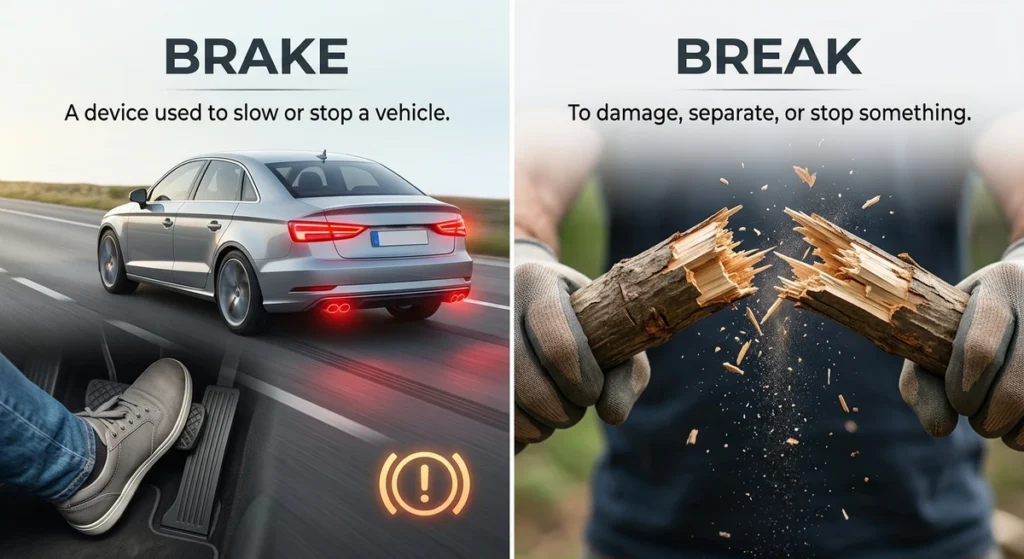
Brake is a device that slows down or stops a vehicle. Also a verb with the meaning “to slow down” or “to stop.
Break: Divide into parts; stop; interrupt. As a noun it has dozens of uses and as a verb it has dozens of uses.
Quick examples:
- To avoid the dog, she stepped on the brakes. (brake = stopping device/action)
- He accidentally knocked the vase over; it broke. (break = shatter)
Quick takeaway: If stopping a car, use brake. For all other “break” operations, like shattering, pausing, interrupting, use break.
Read more: Axel or Axle: Which Spelling is Correct?
Meaning of Each Word
Brake
Definition:To slow down or bring to a halt. To slow or stop a vehicle or machine.
The part of speech: Noun and verb.
Use of it: It is used almost exclusively with regard to vehicles, machinery or to slow down (literally or figuratively).
Common contexts: Cars, bikes, trains, machinery and phrases such as “put the brakes on a plan.
Memory trick: Brake has an A as in “Apply the brake” you apply the brake to stop.
Read more:Rode vs Ridden: What’s the Difference? Easy Examples
Examples
- The mechanic changed the worn out brake pads.
- She slowed down quickly when the traffic light turned red.
- The company decided to put the brakes on the new project.
Break
Definition:To divide into parts; to cease to operate; to interrupt or halt an activity; to break a relationship or affiliation with someone or something.
Part of speech: Noun, verb (irregular: break, broke, broken).
Use of it: For breaking up an object, to take a break, to interrupt a pattern, to describe a failure.
Common uses: “take a break, break a bone, break the news, coffee break, break the ice.
Memory trick: Rhyme with cake – you may need a break to eat cake.
Examples:
- He worked all morning and needs a break.
- It broke into glass when it fell on the floor.
- Coffee break was at 10 am.
- Don’t violate the rules.
Key Differences
| Feature | Brake | Break |
| Meaning | Device or action to stop/slow a vehicle | To separate, stop, pause or interrupt |
| Part of Speech | Noun, verb | Noun, verb |
| Common Usage | Cars, bikes, machinery | Schedule, news, rules, objects |
| Example | She slammed on the brake. | He went for lunch. |
| Easy Memory Trick | “Apply the brake” | “Break for cake” |
Word Origin (Etymology)
The Old English and/or Middle Dutch forms of the word were probably related to crushing or restraining implements, and early “brakes” were mechanical devices to control or restrain motion, such as a harrow used in farming. The term later came to apply only to the braking mechanism in a vehicle.
The origin of break is in Old English brecan, which originally meant “to break, shatter, or destroy.” This word is related to other Germanic words such as the German brechen. It’s one of the original words, so it acquired dozens of new meanings over the centuries, from “to break” to “to break” something to “take a break” from something.
The two words have lost their connection in meaning in the distant past, but the difference in pronunciation was not always significant and in the end they sounded alike, so they are not confused on the basis of logic but simply because they sound alike.
British English vs American English
British English has no clear differences in spelling, pronunciation, or preference from American English when it comes to words like brake or break. Both words are spelt and used the same way in both dialects.
| Feature | British English | American English |
| Spelling | brake / break | brake / break |
| Pronunciation | /breɪk/ (same for both) | /break/ (same for both) |
| Usage | Similar meaning and context words or phrases | Identical meanings and contexts |
The only differences you may encounter are the regional terms used for vehicles, with the British English term being “handbrake” and “parking brake” or “emergency brake” being used in American English. However, the meaning of the word “brake” remains unchanged.
Which is the best one to use?
- American readers :Use brake for vehicles and machinery; use break for all other uses No peculiarities to be concerned with in the region.
- British readers: As is all things British. Look out for compound words such as “handbrake.
- International readers: Spelling and meaning are not regional, so consider context not dialect.
- Academic writing: Abstract or figurative meaning (breakthrough, break a pattern): use break, but only when literally talking about mechanical systems: brake.
- Business writing: Common phrases such as “slow down” (put the brakes on a decision) and “take a break” (stop work) are all right just be certain you are using the right one.
- Everyday communication: If it’s a question, ask yourself: Am I talking about stopping a car? If yes, it’s brake. If it is not, then it is invariably break.
Common Mistakes
1.❌ I need a break from driving, so I’ll hit the break. ✅ I need a break from driving, so I’ll hit the brake. The only word in English that is spelled brake is the stopping device.
2.❌ The brakes on the car are squeaking. ✅ Brakes on the car are squeaking. brake is always used for vehicle parts.
3.❌ Let’s take a brake for lunch. ✅ Let’s take a break for lunch. Pause or Rest is always break.
4.❌ She broke the news softly. ✅ She gently broke the news. The term “break the news” is a fixed idiom with break.
5.❌ He was not able to stop in time and crashed into the wall. ✅ He was unable to stop on time and crashed into the wall. Slowing down a vehicle is a brake, not a break.
6.❌ Let’s break the ice at the party. ✅ Let’s brake the ice at the party. Break the ice = idiom, not related to vehicles.
7.❌ The machine’s brake down again. ✅ The machine broke down again. Break down (malfunction) requires using break.
8.❌ I need new break for my bicycle. ✅ I need new breaks for my bicycle. The part used to stop a bicycle.Brakes are the part used to stop a bicycle.
9.❌ Don’t break too hard on ice. ✅ Don’t brake too hard on ice. Brake is to slow down while driving.
10.❌ We had a break in our program. ✅ We had a break in our program. Break is a gap or pause in plans.
Everyday Examples
Emails: “I am taking a short break this afternoon and may not respond to emails for the next few days.
School writing: “The essay described the conversion of kinetic energy to heat when brakes are applied.
Business communication: “Before the meeting let’s take a look at the quarterly numbers”.
News: “Brake failure could be a contributing factor in the accident.
Words: “She let out a hesitant chuckle.
Social media: “This week, I’m taking a break from social media.
Daily Conversations: throughout the day: “Please inspect brakes before going to the mountains?”
Grammar Tips
- Position of the word in the sentence: Often brake is placed close to nouns related to the vehicle (pedal, pads, system). Break is scattered in a much greater variety of contexts because it plays this role in idiomatic phrases, phrasal verbs, and abstract expressions.
- Common collocation:Slam on the brakes, brake pads, emergency vs. take a break, break the news, break a habit, coffee break.
- Punctuation; No special rules to punctuate either word.
- Verb forms: brake – regular (brake, braked, braked) Break is irregular (break, broke, broken) This irregularity is a big hint that you’re not talking about brake.
Easy Memory Tricks
- Brake = Apply. Both words begin with “A” energy Apply the brake to stop a car.
- Break = Cake. Rhyme it: take a break and eat cake.
- If the sentence has wheels, pedals or vehicles, it’s brake. When pieces don’t show up, pauses, or plans go awry, it’s a break.
Google Trends & Usage
The interest in “brake vs break” is always high because these terms are homophones, and spellcheckers can’t differentiate between them as they are both correct. This is a search people usually do when composing a formal text such as an email, essay, or article, and they want to verify with this search before printing them out.
As the problem is a phonetic one rather than a regional one, confusion is likely to be distributed evenly among English speaking countries. Searchers who are looking for brake vs break are not likely to have any doubt that the word they are looking for is plural, and are hoping to get a quick,
Related Words
- Affect vs Effect Affect typically is a verb (to influence) and effect is a noun (a result).
- Accept vs Except: Accept – to agree to take something except – to exclude.
- Principal vs Principle:Principal one of the most important rules or beliefs, a person who is in charge.
Frequently Asked Questions
1.What is the word “brake” in a car? When talking about the component of the vehicle which slows or stops the car, it is always brake. Although both “break” and “brake” sound alike, “break” is not the correct word here.
2.What does “break a leg” mean? A phrase, usually used before performers before a show, meaning “good luck. It doesn’t refer to brakes or cars; it’s just a figurative expression with the word break.
3.What is the reason for the double “r” sound in “break? They are Homophones; they have the same pronunciation and different meaning are words that have different origins. Occurs frequently in English and leads to common spelling errors.
4.How about “brakes” as plural for automobiles? While it’s not always the case, it’s normal to talk of a car’s entire braking system as “brakes” (plural), when talking of “brake” (singular) is about one component or the overall concept of braking.
5.What is the word for the past tense of “brake”? The word brake is broken in the past tense, as in “She braked quickly to avoid a collision. Conjugates regular verbs.
6.What’s the past tense of “break”? Both the past tense and the past participle of break are irregular, and are broken.
7.Is “break” ever used to describe a car? Yes, but only when it’s sense of faulting, i.e., “The car broke down,” meaning the car failed to operate, not that the brake was applied.
8.Does the word “brake” have a meaning other than in the context of a vehicle? Rarely. It is sometimes used in phrases such as “put the brakes on” (to slow down or stop a plan), but it is not used as much as break is outside of the context of vehicles.
Key Takeaways
- Brake is a term used specifically for stopping or slowing vehicles and machinery.
- The word break has a much wider usage, it means shattering, pausing, interrupting and more.
- They are homophones – that is why people get them confused when they are writing.
- There is no British/American English difference in spelling and usage.
- A quick test: If it’s a situation involving a car stopping, use brake. Otherwise, use break.
Conclusion
Brake and Break is one of the easiest misspelled words that people can make; it is because they sound alike. Once you’ve mastered it, however, the distinction is no longer obvious: brake is for cars, bikes and machinery, break is for broken glass, earned coffee breaks.
Be alert for the occasional trap, such as the words “break the news” or “break down,” and the common mistake of people sticking with a spelling that is correct for the familiar meaning, but not for the intended use.
And don’t forget the irregular verb forms, broke and broken, as a clue to the fact that you’re working with break, not brake.
With the tips, examples and memory tricks in this guide, you should now be able to use both words correctly every time. Bookmark this page and you’ll never get the wrong “brake” when writing again.

I am Bahadar Ali, a professional content writer and the author behind GrammarDrive.com. I am passionate about making grammar simple and accessible for everyone. Through my writing, I aim to help learners and professionals communicate with clarity and confidence.