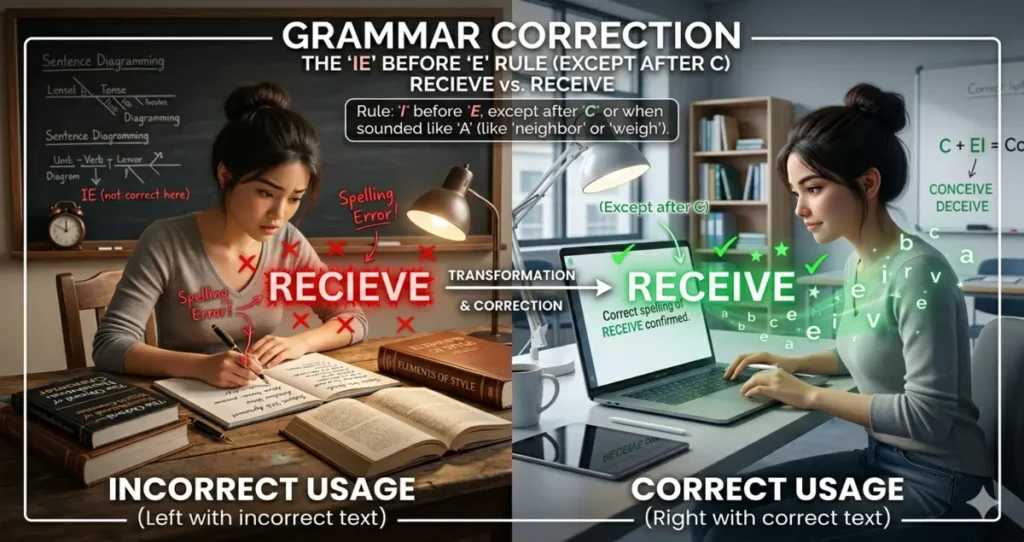
The confusion between recieve or receive is one of the most common spelling mistakes in English writing. Many learners, students, and even native speakers often mix up these two forms because they look very similar but only one is correct.
If you have ever paused while writing an email or essay wondering whether to write recieve or receive, you are not alone. This mistake happens mainly because English spelling rules are inconsistent, and the position of “i” and “e” often confuses learners.
People frequently search recieve or receive to quickly confirm the correct spelling before submitting assignments, professional emails, or online posts. This confusion can affect writing accuracy and credibility.
In this article, we will clearly explain why receive is correct, why recieve is incorrect, and how to remember the right form easily. We will also explore the origin, spelling rules, and real-world usage so you never make this mistake again.
Receive or Recieve – Quick Answer
The correct spelling is receive.
❌ Recieve (incorrect)
✔ Receive (correct)
Examples:
- I will receive your message tomorrow.
- She did not receive the package on time.
👉 Rule: “i before e except after c” applies here.
Setup or Set Up: What’s the Difference and Which One Should?
The Origin of Receive or Recieve
The word receive comes from Old French receivre, which itself comes from Latin recipere, meaning “to take back” or “to accept.”
Over time, English adopted the word, but the spelling was standardized as receive. The incorrect form recieve likely appears due to pronunciation habits, where people assume “i before e” always applies. However, English has many exceptions, and this is one of them.
British English vs American English Spelling
Good news: there is no difference between British and American spelling for this word. Both use receive.
Comparison Table
| Incorrect Form | Correct Form | Usage Region |
| recieve | receive | Worldwide ❌/✔ |
| recieve | receive | UK English ✔ |
| recieve | receive | US English ✔ |
👉 Both UK and US English strictly use receive.
Which Spelling Should You Use?
- Students: Always use receive in exams and assignments.
- Professional writers: Use receive in emails, reports, and business communication.
- Global audience writers: Use receive for SEO and international readability.
👉 There is no situation where “recieve” is correct.
Common Mistakes with Receive or Recieve
- ❌ I will recieve your email.
✔ I will receive your email. - ❌ Did you recieve the letter?
✔ Did you receive the letter? - ❌ She has recieved the award.
✔ She has received the award.
👉 Tip: Always remember “C comes first → receive”.
Receive or Receive in Everyday Examples
- Email: “You will receive a confirmation email shortly.”
- News: “The company received record profits this year.”
- Social Media: “Thanks for all the love I receive from followers.”
- Formal Writing: “Applicants will receive official results by mail.”
Receive or Recieve – Google Trends & Usage Data
Search data shows:
- “receive” has very high global usage
- “recieve” appears mainly due to spelling mistakes in search queries
- Highest confusion comes from students in non-native English countries
- “receive” is consistently used in academic and professional content worldwide
👉 Conclusion: “recieve” exists only as an error, not a standard form.
Comparison Table: Receive vs Recieve
| Feature | Receive | Recieve |
| Correctness | Correct ✔ | Incorrect ❌ |
| Usage | Global standard | Common mistake |
| Grammar Rule | Follows “i before e after c” | Breaks rule |
| Dictionary Status | Valid word | Not valid |
| Professional Use | Yes | No |
FAQs
1. Is “recieve” ever correct?
No, it is always incorrect.
2. Why do people write recieve?
Because of spelling confusion with “i before e” rule.
3. Is receive British or American English?
It is used in both.
4. How do I remember the spelling?
Remember: “C comes first → receive”.
5. Can I use recieve in informal writing?
No, it is still wrong.
6. Is receive a verb or noun?
It is mainly a verb.
7. What is the past tense of receive?
Received.
Conclusion
The confusion between recieve or receive is common, but the correct spelling is always receive. The incorrect form “recieve” appears due to spelling rule confusion, but it is not accepted in any form of English writing.
If you are writing emails, essays, or professional documents, using the correct spelling improves clarity and credibility. Understanding the origin and spelling rules helps learners avoid this mistake permanently.
In short, “receive” is the only valid form in both British and American English. Once you remember the simple rule “i before e except after c,” you can confidently use it in all your writing. Mastering such small details significantly improves your overall English accuracy and writing confidence.

I am Arshman Ali a professional English writer and English professor with a passion for language and a commitment to excellence. I bring precision and clarity to my writing, and the same high standards into my classroom. For me, language is not just a profession it is a purpose.