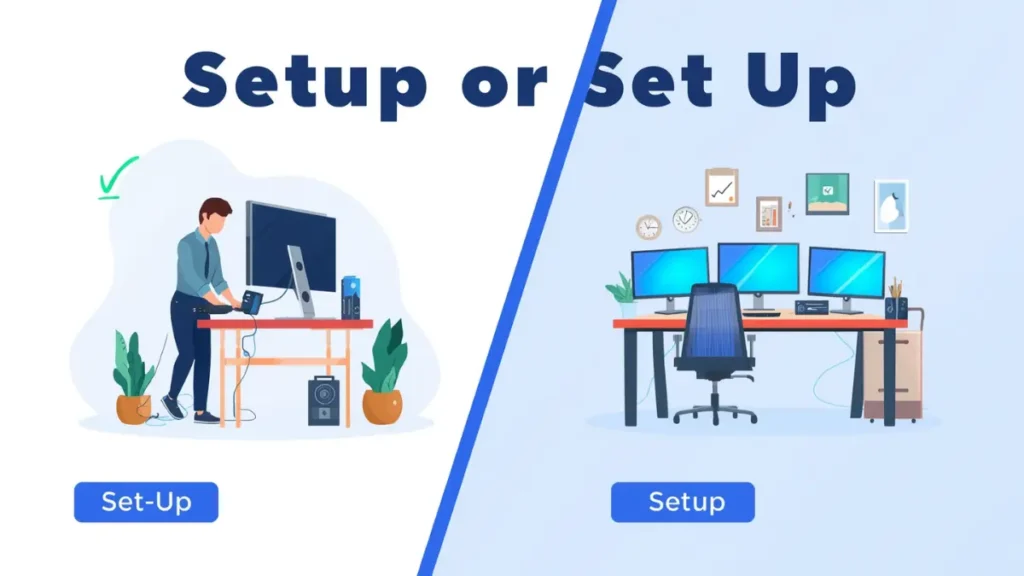
Many English learners and even native speakers get confused between setup and set up. The two forms look almost the same, but they work differently in sentences. One small space changes the grammar completely.
People often search for “setup or set up” because they want to avoid writing mistakes in emails, blogs, school assignments, and professional documents. For example, should you write “I will set up the computer” or “I will set up the computer”? That confusion is very common.
The good news is simple: both forms are correct, but they have different jobs in English. One is mainly a noun or adjective, while the other is a verb phrase. Once you understand this rule, using them becomes easy.
This guide explains the meaning, origin, spelling rules, examples, and common mistakes related to setup and set up. You will also learn how British and American English use these forms and which one fits best in formal and casual writing.
Setup or Set Up – Quick Answer
“Set up” = Verb
Use set up when talking about an action.
Examples:
- I will set up the meeting.
- She helped me set up my phone.
“Setup” = Noun or Adjective
Use setup when talking about a thing, arrangement, or system.
Examples:
- Your computer setup looks great.
- The office has a modern setup.
To Much or Too Much: Which One Is Correct?
Simple Rule
| Form | Grammar Role | Example |
| Set up | Verb | Please set up the table. |
| Setup | Noun/Adjective | The setup is complete. |
The Origin of Setup or Set Up
The phrase set up started as a phrasal verb in early English. It joined the verb set with the small word up to show action.
Examples from older English:
- set up a tent
- set up a business
- set up a meeting
Over time, English speakers began combining the two words into one noun: setup.
This happened with many English words:
Requester or Requestor: Which Spelling Is Correct?
| Verb Phrase | Noun Form |
| log in | login |
| shut down | shutdown |
| set up | setup |
The closed form became popular because people wanted shorter and faster writing, especially in technology and business.
Today:
- set up usually stays a verb
- setup usually acts as a noun or adjective
British English vs American English Spelling
Both British and American English follow the same grammar rule for these words.
British English
British English uses:
- set up → verb
- setup → noun
Examples:
- We need to set up the room.
- The office setup is simple.
American English
American English follows the same pattern.
Examples:
- They will set up the software.
- This setup works well.
Comparison Table
| Usage | British English | American English |
| Verb form | Set up | Set up |
| Noun form | Setup | Setup |
| Common in technology | Yes | Yes |
| Used in formal writing | Yes | Yes |
There is almost no major spelling difference between UK and US English for this keyword.
Which Spelling Should You Use?
The correct choice depends on grammar, not location.
Use “Set Up” When Showing Action
Choose to set up if someone is doing something.
Examples:
- I will set up your account.
- They set up the chairs.
Use “Setup” for Things or Systems
Choose setup when naming an arrangement or structure.
Examples:
- The gaming setup looks amazing.
- Our camera setup is expensive.
Best Advice
Ask yourself this question:
“Is this an action or a thing?”
- Action → set up
- Thing → setup
This simple trick works almost every time.
Common Mistakes with Setup or Set Up
Many writers mix these forms incorrectly.
Mistake 1: Using “Setup” as a Verb
❌ I will setup the computer.
✅ I will set up the computer.
Mistake 2: Using “Set Up” as a Noun
❌ Your set up looks clean.
✅ Your setup looks clean.
Mistake 3: Forgetting the Grammar Role
❌ We finished the setup the room.
✅ We finished setting up the room.
Mistake 4: Using Both Forms Incorrectly Together
❌ The set up team fixed the setup system.
✅ The setup team set up the system.
Setup or Set Up in Everyday Examples
In Emails
- Please set up the Zoom meeting.
- Your desk setup looks professional.
In News Writing
- The company set up a new office.
- The security setup failed during testing.
In Social Media
- Check out my gaming setup!
- I finally set up my new laptop.
In Business Writing
- We need to set up a client account.
- The office setup saves time and space.
Setup or Set Up – Google Trends & Usage Data
Search data shows that both terms are popular because people often confuse them.
“Set Up” Trends
Most searches for set up are related to:
- technology
- business
- meetings
- accounts
- software installation
“Setup” Trends
Most searches for setup are related to:
- gaming setup
- computer setup
- office setup
- room setup
Popular Countries
| Country | Common Search |
| United States | setup / set up |
| United Kingdom | setup / set up |
| Canada | setup |
| Australia | set up |
General Trend
- Set up is more common in grammar-focused searches.
- Setup is highly popular in technology and gaming topics.
Comparison Table: Setup vs Set Up
| Feature | Setup | Set Up |
| One word | Yes | No |
| Two words | No | Yes |
| Grammar type | Noun/Adjective | Verb |
| Shows action | No | Yes |
| Used in tech topics | Very common | Common |
| Example | Nice setup | Set up the room |
| Common mistake | Used as verb | Used as noun |
FAQs About Setup or Set Up
Is it setup or set up?
Both are correct, but they are used differently in sentences.
When should I use set up?
Use “set up” when describing an action.
Is it one word?
Yes. “Setup” is one word when used as a noun or adjective.
Is it formal English?
Yes. It is common in professional and technical writing.
Which is correct: set up a meeting or set up a meeting?
“Set up a meeting” is correct because it describes an action.
Can setup be a verb?
No. Standard English uses “set up” as the verb form.
Why do people confuse setup and set up?
The words sound the same, but grammar changes because of spacing.
Conclusion
The difference between setup or set up is simple once you know the grammar rule. Set up is a verb phrase that shows action. Setup is a noun or adjective that names a system, arrangement, or design.
This small spacing difference matters in professional writing, emails, blogs, and daily communication. Using the wrong form can make sentences look incorrect or confusing. That is why many people search for this keyword online.
The easiest way to remember the rule is to ask whether the sentence shows an action or describes a thing. If someone is doing something, use set up. If you are naming a system or arrangement, use setup.
Both British and American English follow the same rule, so you can use it confidently anywhere. Keeping the forms consistent will make your writing clearer, more professional, and easier to understand.