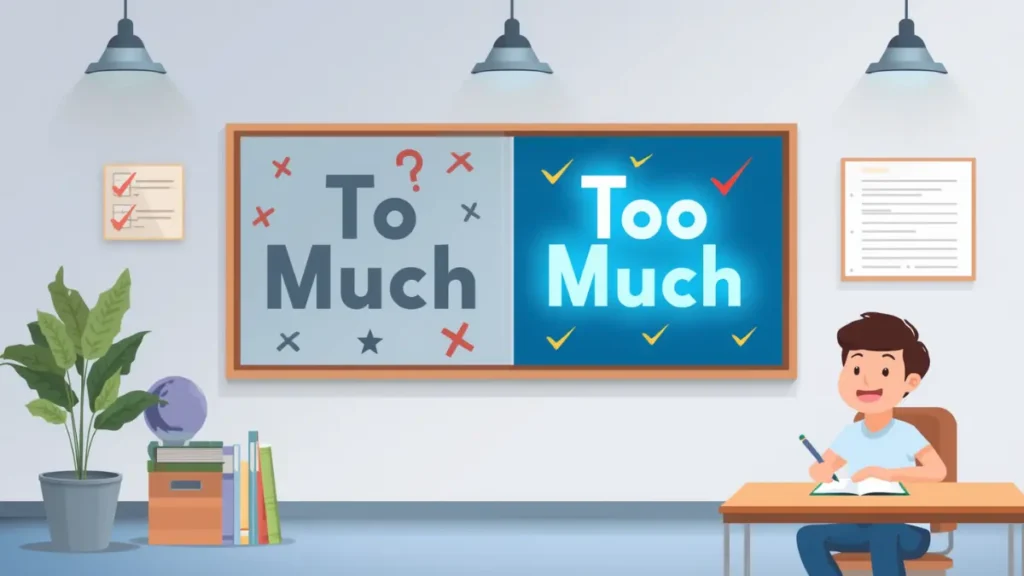
Many English learners and writers search for “to much or too much” because the two phrases look similar but only one is grammatically correct in most situations. This confusion happens because the words “to” and “too” sound exactly the same in spoken English. As a result, people often type “to much” when they actually mean “too much.”
The correct phrase is usually “too much.” It means an excessive amount of something. Meanwhile, “to much” is rarely correct and only appears when “to” belongs to a verb phrase, not as a quantity expression.
This article explains the difference between “to much” and “too much” in simple English. You will learn the correct spelling, meaning, common mistakes, real-life examples, and which version to use in formal and casual writing. Whether you are writing emails, social media captions, school assignments, or business content, this guide will help you avoid one of the most common English spelling mistakes.
To Much or Too Much – Quick Answer
✅ Too much = Correct phrase in most cases
❌ To much = Usually incorrect
Meaning of “Too Much”
“Too much” means:
- More than needed
- Excessive amount
- More than acceptable
Examples
- “There is too much sugar in this tea.”
- “He talks too much.”
- “I spent too much money.”
Boxers or Briefs: Which One Should You Choose?
About “To Much”
“To much” is rarely used correctly in English.
Example:
- “I am looking forward to much better days.”
Here, “to” belongs to the phrase “looking forward to.”
The Origin of To Much or Too Much
The confusion comes from the words “to” and “too.”
Origin of “To”
The word “to” comes from Old English. It is mainly used:
- As a preposition
- Before verbs
Examples:
- “Go to school.”
- “I want to learn.”
Origin of “Too”
“Too” also comes from Old English and means:
- Excessively
- Also
- More than enough
Examples:
- “It is too cold.”
- “She talks too fast.”
Over time, English kept both spellings even though they sound alike. That is why many people confuse them today.
Boxers or Briefs: Which One Should You Choose?
British English vs American English Spelling
Good news:
There is no spelling difference between British English and American English for “too much.”
Both countries use:
✅ “Too much”
Examples
| Region | Correct Usage | Example |
| American English | Too much | “This costs too much.” |
| British English | Too much | “There is too much rain today.” |
| Australian English | Too much | “You worry too much.” |
| Canadian English | Too much | “He drinks too much coffee.” |
Comparison Table
| Phrase | Correct? | Meaning |
| Too much | ✅ Yes | Excessive amount |
| To much | ❌ Usually No | Rare grammatical structure |
Which Spelling Should You Use?
Use “Too Much” If:
- You mean “excessive”
- You talk about quantity
- You describe something more than needed
Examples:
- “Too much noise”
- “Too much work”
- “Too much pressure”
For American Audiences
Use:
✅ Too much
For British & Commonwealth Audiences
Use:
✅ Too much
For Global Writing
Use:
✅ Too much
This spelling is correct worldwide.
Common Mistakes with To Much or Too Much
People often write “to much” by mistake because the words sound the same.
Common Errors
| Incorrect | Correct |
| I ate to much. | I ate too much. |
| She talks to much. | She talks too much. |
| This costs to much money. | This costs too much money. |
| There is to much traffic. | There is too much traffic. |
Easy Memory Trick
- Too has an extra “o”
- Think of the extra “o” as “extra amount”
👉 “Too much” = extra amount
To Much or Too Much in Everyday Examples
Emails
- “I received too much information in one email.”
Social Media
- “This meme is too much 😂”
News Writing
- “Too much rainfall caused flooding.”
Formal Writing
- “The company spent too much money on advertising.”
Casual Conversation
- “You worry too much.”
To Much or Too Much – Google Trends & Usage Data
“Too much” is far more popular than “to much” in Google searches and published writing.
Popularity by Country
| Country | Most Common Form |
| United States | Too much |
| United Kingdom | Too much |
| Canada | Too much |
| Australia | Too much |
| India | Too much |
Why “To Much” Gets Searches
People search “to much” because:
- Spell-check confusion
- Fast typing errors
- Pronunciation similarity
- English learning mistakes
Search engines usually correct it to:
✅ “Too much”
Comparison Table: To Much vs Too Much
| Feature | To Much | Too Much |
| Correct everyday phrase | ❌ No | ✅ Yes |
| Means excessive amount | ❌ No | ✅ Yes |
| Common in English | ❌ Rare | ✅ Very common |
| Used in formal writing | ❌ Rarely | ✅ Yes |
| Used worldwide | ❌ No | ✅ Yes |
FAQs About To Much or Too Much
1. Is “to much” ever correct?
Yes, but only in rare sentence structures like:
- “Looking forward to much better results.”
2. Which is grammatically correct: “to much” or “too much”?
Usually:
✅ “Too much”
3. Why do people confuse “to” and “too”?
Because both words sound the same in spoken English.
4. Does British English use “too much”?
Yes. British and American English both use:
✅ “Too much”
5. What does “too much” mean?
It means:
- Excessive
- More than needed
- More than acceptable
6. Is “too much” formal or informal?
It works in both formal and informal English.
7. How can I remember the correct spelling?
Remember:
- “Too” has an extra “o”
- Extra “o” = extra amount
Conclusion
The difference between “to much” and “too much” is simple once you understand the meaning of each word. In almost every situation, the correct phrase is “too much.” It describes something excessive or more than necessary. Whether you are talking about money, food, stress, work, or noise, “too much” is the proper spelling used in both British and American English.
Meanwhile, “to much” is very rare and only appears in special grammatical structures where “to” belongs to another phrase. Because the two words sound identical, many people make typing mistakes, especially in quick messages and online searches.
The easiest way to remember the difference is this:
“Too” has an extra “o,” and it means an extra amount.
Using the correct spelling improves your grammar, writing clarity, and professionalism. If you want your English to look polished and natural, always choose “too much” when talking about something excessive.

I am Bahadar Ali, a professional content writer and the author behind GrammarDrive.com. I am passionate about making grammar simple and accessible for everyone. Through my writing, I aim to help learners and professionals communicate with clarity and confidence.