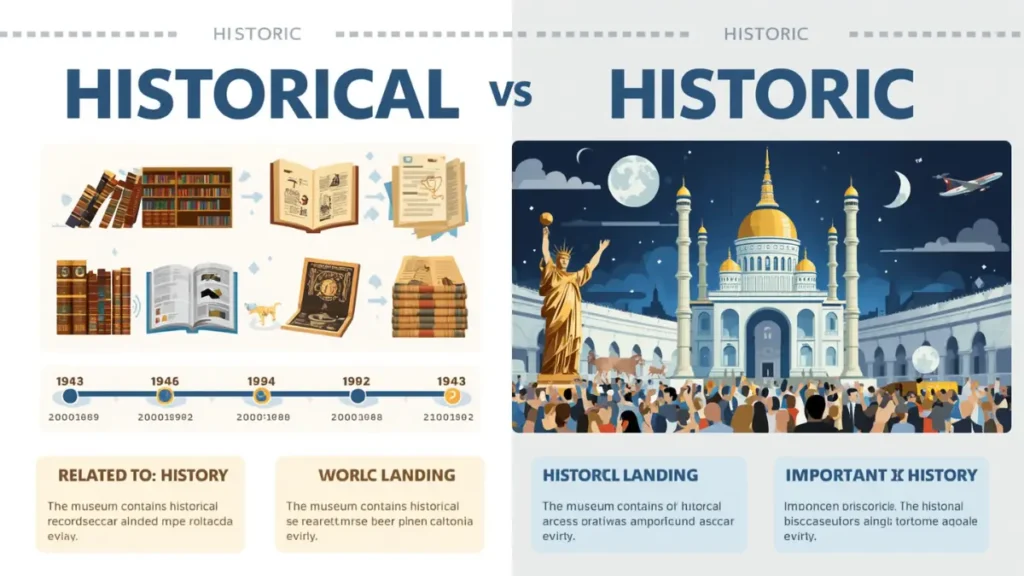
Have you ever wondered whether to write historical or historic? Many English learners, writers, and even native speakers confuse these two words because they both relate to history. At first glance, they seem interchangeable, but they have different meanings and uses.
Imagine reading a news headline that says, “A historic agreement was signed today.” Now compare it with “The museum contains historical documents.” Both words refer to the past, yet they communicate different ideas. This is why people frequently search for historical or historic online.
Understanding the difference between historical or historic helps you write more accurately and professionally. Whether you are preparing an academic paper, creating content, writing a news article, or simply improving your English, knowing when to use each word will make your writing clearer.
In this guide, you’ll learn the meanings, origins, examples, common mistakes, and practical usage tips for historical or historic so you can use them confidently in any situation.
Historical or Historic – Quick Answer
Simple Rule
- Historical = related to history or the past.
- Historic = important or significant in history.
Examples
✅ The library contains historical records.
✅ The moon landing was a historic event.
❌ The moon landing was a historical event. (Not wrong, but less precise.)
❌ The museum displayed historic documents. (Usually historical documents.)
Easy Memory Trick
- Historical = About history
- Historic = Makes history
Read more: Who or Whom: Easy Grammar Rules Explained with Examples
The Origin of Historical or Historic
Both words come from the Greek word historia, meaning “inquiry” or “knowledge gained by investigation.”
Origin of Historical
The word historical appeared in English during the 15th century. It developed to describe anything connected with history, whether important or not.
Origin of Historic
The word historic appeared later and evolved to describe events, places, or moments that are important enough to be remembered in history.
Why Confusion Exists
People confuse these words because:
- They share the same root.
- Both relate to the past.
- They are sometimes used interchangeably in casual speech.
- Their meanings overlap slightly.
Read more: Beside or Besides: What’s the Difference ?
British English vs American English Spelling
There is no spelling difference between British English and American English for historical and historic.
Comparison Table
| Word | British English | American English |
| Historical | Historical | Historical |
| Historic | Historic | Historic |
| Meaning | Same | Same |
| Usage Rules | Same | Same |
Examples
British English
- The castle has great historical value.
- It was a historic victory for the team.
American English
- Researchers study historical records.
- The election became a historic moment.
Which Spelling Should You Use?
Since the spelling is identical worldwide, the choice depends on meaning rather than location.
Use Historical When:
You are referring to something connected with history.
Examples:
- Historical evidence
- Historical documents
- Historical research
- Historical figures
Use Historic When:
You are describing something important or memorable in history.
Examples:
- Historic speech
- Historic agreement
- Historic achievement
- Historic victory
Global Advice
For any audience:
- Choose historical for information about the past.
- Choose historic for events or things of major importance.
Common Mistakes with Historical or Historic
Mistake 1
❌ The museum contains historic records.
✅ The museum contains historical records.
Mistake 2
❌ The signing of the peace treaty was historical.
✅ The signing of the peace treaty was historic.
Mistake 3
❌ It was a historical achievement.
✅ It was a historic achievement.
Mistake 4
❌ Historians study historic documents.
✅ Historians study historical documents.
Historical or Historic in Everyday Examples
In Emails
- Please review the historical data from last year.
- This project marks a historic milestone for our company.
In News Writing
- Historians discovered new historical evidence.
- The nation celebrated a historic election result.
On Social Media
- Visiting historical sites this weekend!
- What a historic win for the team! 🎉
In Formal Writing
- The report examines historical trends.
- The agreement represents a historic turning point.
Historical or Historic – Google Trends & Usage Data
Searches for historical or historic remain popular because writers often struggle to choose the correct word.
Popular Countries
| Country | Search Interest |
| United States | Very High |
| United Kingdom | High |
| India | High |
| Canada | High |
| Australia | High |
Why People Search This Keyword
People search this phrase when:
- Writing essays
- Preparing academic papers
- Creating website content
- Studying grammar
- Writing news reports
Common Contexts
| Context | Preferred Word |
| Research papers | Historical |
| History textbooks | Historical |
| Major events | Historic |
| News headlines | Historic |
| Museums | Historical |
Comparison Table: Historical vs Historic
| Feature | Historical | Historic |
| Meaning | Related to history | Important in history |
| Importance Required? | No | Yes |
| Common Usage | Records, research, facts | Events, moments, achievements |
| Example | Historical documents | Historic victory |
| Focus | Past connection | Historical significance |
FAQs About Historical or Historic
What is the difference between historical and historic?
Historical means related to history. Historic means important enough to be remembered in history.
Is a historic event historical?
Yes. A historic event is also historical because it belongs to history.
Can I use historical instead of historic?
Sometimes, but historic is usually more precise for significant events.
Which word is used for old documents?
Historical documents.
Which word describes a major achievement?
Historic achievement.
Is there a spelling difference in British and American English?
No. Both use the same spelling.
Why do news headlines prefer historic?
Because headlines often focus on major events that make history.
Conclusion
Understanding historical or historic can improve both your writing accuracy and communication skills. Although the words are closely related, they serve different purposes. Historical refers to anything connected with history, including records, facts, research, and documents. Historic, on the other hand, describes something important, memorable, or influential enough to be recognized in history.
A simple way to remember the difference is that historical is about history, while historic makes history. This distinction is useful in academic writing, journalism, content creation, and everyday communication.
Whether you are writing about ancient artifacts, historical research, or a historic political event, choosing the correct word makes your message clearer and more professional. With practice, the difference becomes easy to recognize.
The next time you face the choice between historical or historic, think about whether you are describing something from history or something that changed history. That simple question will guide you to the correct word every time.

I am Arshman Ali a professional English writer and English professor with a passion for language and a commitment to excellence. I bring precision and clarity to my writing, and the same high standards into my classroom. For me, language is not just a profession it is a purpose.