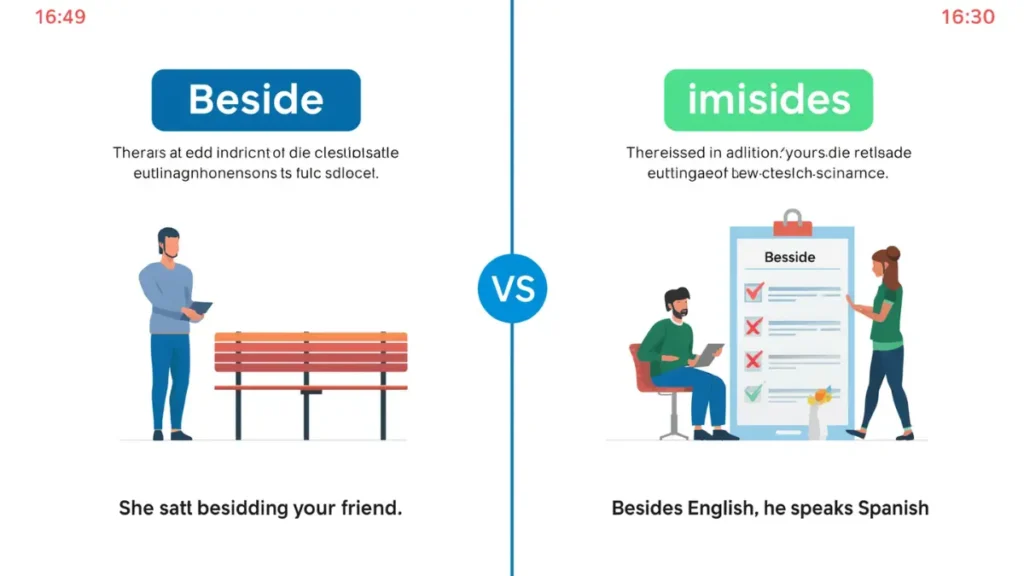
Many English learners get confused by beside or besides because the two words look almost identical. The only difference is the letter “s” at the end, yet that small change creates a completely different meaning. This is why many people search for “beside or besides” when writing emails, essays, blog posts, or professional documents.
For example, should you write, “The chair is beside the table” or “The chair is besides the table”? Only one of those sentences is correct. Likewise, if you want to say “in addition to,” you need a different word. Understanding beside or besides helps you avoid grammar mistakes and communicate more clearly.
The good news is that the rule is simple. Beside usually refers to a position or location, while besides means “in addition to” or “apart from.” Once you learn this distinction, choosing the correct word becomes much easier.
In this guide, you will learn the meanings, origins, usage rules, examples, common mistakes, FAQs, and professional tips for mastering beside or besides in everyday English.
Beside or Besides – Quick Answer
Simple Rule
- Beside = next to or at the side of.
- Besides = in addition to or apart from.
Examples
✅ The lamp is beside the bed.
✅ Besides English, she speaks Spanish.
Easy Memory Trick
- Beside = Side
- Besides = Plus
Read more: Who or Whom: Easy Grammar Rules Explained with Examples
More Examples
| Word | Example |
| Beside | He sat beside his friend. |
| Besides | Besides coffee, we also serve tea. |
| Beside | The dog slept beside the sofa. |
| Besides | Besides being smart, she is kind. |
The Origin of Beside or Besides
Both words come from the Old English word besidan, which meant “by the side of.”
Origin of “Beside”
The word beside kept its original meaning of location or position. It refers to something being next to something else.
Origin of “Besides”
Over time, besides developed an additional meaning. Writers began using it to mean “in addition to” or “apart from.”
Why the Confusion Exists
The confusion happens because:
- The words differ by only one letter.
- Both come from the same root word.
- They sound very similar.
- Many learners assume they are interchangeable.
However, modern English gives each word a distinct purpose.
Read more: Burnt or Burned: Which Spelling Is Correct?
British English vs American English Spelling
There is no spelling difference between British English and American English for beside and besides.
Comparison Table
| Usage | British English | American English |
| Next to | Beside | Beside |
| In addition to | Besides | Besides |
| Formal writing | Same usage | Same usage |
| Everyday speech | Same usage | Same usage |
Examples
British English
- The bicycle is beside the house.
- Besides football, he enjoys cricket.
American English
- The car is parked beside the building.
- Besides math, she studies science.
Which Spelling Should You Use?
The spelling does not depend on the country. It depends entirely on meaning.
Use “Beside” When:
- Talking about location.
- Describing something next to another thing.
- Referring to physical position.
Examples
- Sit beside me.
- The school is beside the park.
- The phone was beside the laptop.
Use “Besides” When:
- Adding information.
- Meaning “in addition to.”
- Excluding or including extra points.
Examples
- Besides English, I know French.
- Besides that, there is another issue.
- Who besides Sarah is coming?
Global Writing Advice
Remember:
- Beside = location
- Besides = addition
This rule works in all forms of English.
Common Mistakes with Beside or Besides
Mistake 1
❌ Besides the chair was a lamp.
✅ Beside the chair was a lamp.
Mistake 2
❌ Beside math, I study history.
✅ Besides math, I study history.
Mistake 3
❌ The hotel is besides the beach.
✅ The hotel is beside the beach.
Mistake 4
❌ Beside that, we need more time.
✅ Besides that, we need more time.
Beside or Besides in Everyday Examples
In Emails
- The file is beside the printer.
- Besides the report, please send the invoice.
In News Writing
- The memorial stands beside the river.
- Besides economic growth, experts discussed inflation.
On Social Media
- My cat is sleeping beside me.
- Besides pizza, what should we order?
In Formal Writing
- The laboratory is beside the main building.
- Besides financial benefits, the program improved productivity.
Beside or Besides – Google Trends & Usage Data
Searches for “beside or besides” remain popular because many English learners struggle with the difference.
Countries with High Search Interest
| Country | Popularity |
| United States | Very High |
| United Kingdom | High |
| India | High |
| Canada | High |
| Australia | High |
Why People Search This Keyword
People often search for beside or besides when:
- Learning English grammar.
- Writing school essays.
- Preparing for exams.
- Editing professional documents.
- Improving speaking skills.
Common Usage Contexts
| Context | Common Word |
| Physical location | Beside |
| Additional information | Besides |
| Academic writing | Both |
| Business writing | Both |
Comparison Table: Beside vs Besides
| Feature | Beside | Besides |
| Meaning | Next to | In addition to |
| Function | Location | Addition |
| Example | Sit beside me. | Besides me, everyone agreed. |
| Physical Position | Yes | No |
| Extra Information | No | Yes |
FAQs About Beside or Besides
What is the main difference between beside and besides?
Beside means “next to,” while besides means “in addition to.”
Can beside and besides be used interchangeably?
No. They have different meanings and should be used in different situations.
Is beside a preposition?
Yes. Beside is a preposition that shows position or location.
Is besides a preposition?
Yes. Besides can act as a preposition meaning “in addition to.”
Which word refers to physical location?
Beside refers to physical location.
Which word means “also” or “in addition”?
Besides means “also,” “apart from,” or “in addition to.”
Is there a spelling difference in British and American English?
No. Both varieties use the same spelling and meanings.
Conclusion
Understanding beside or besides is important for clear and accurate English writing. Although the words look very similar, their meanings are different. Beside refers to physical position and means “next to.” Besides refers to additional information and means “in addition to” or “apart from.”
A simple way to remember the rule is that beside relates to “side,” while besides relates to adding something extra. This distinction helps you avoid common grammar mistakes in emails, essays, reports, and everyday conversations.
There is no spelling difference between British and American English, so the same rule applies everywhere. Whenever you write, ask yourself a simple question: Are you talking about location or addition? If it is location, use beside. If it is an addition, use besides.
With practice, choosing between beside or besides becomes easy, helping you write with greater confidence and professionalism.

I am Bahadar Ali, a professional content writer and the author behind GrammarDrive.com. I am passionate about making grammar simple and accessible for everyone. Through my writing, I aim to help learners and professionals communicate with clarity and confidence.