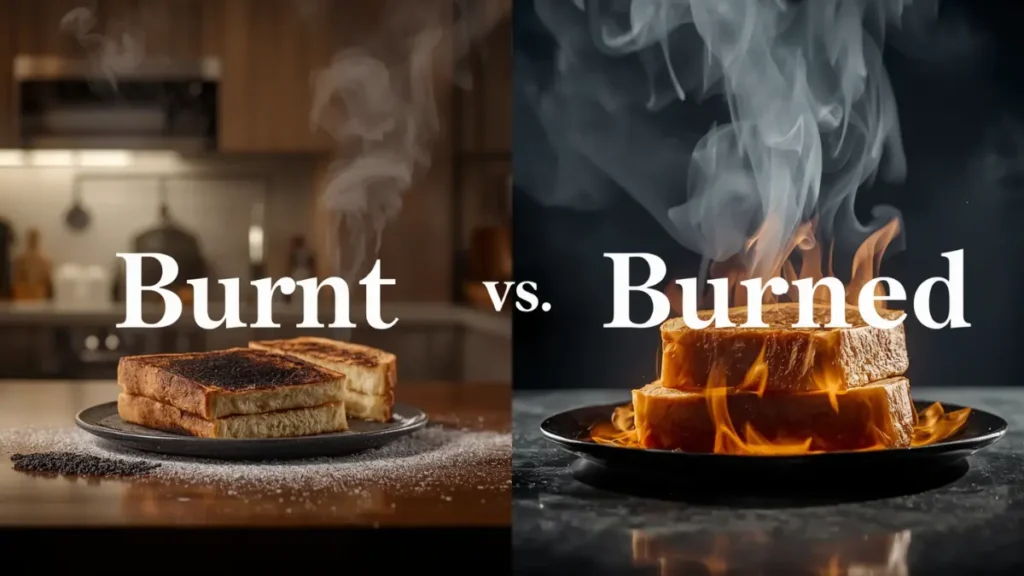
Have you ever written “burnt toast” and wondered if it should be “burned toast” instead? Many English learners and native speakers get confused by burnt or burned because both words are correct. The difference depends on where you live, how the word is used, and the style of English you follow.
In British English, “burnt” is very common in daily writing and speech. In American English, “burned” is usually preferred, especially in formal writing. Still, both spellings appear in books, newspapers, recipes, and social media posts around the world.
This guide explains the difference between burnt and burned in simple language. You will learn the origin of the words, spelling rules, common mistakes, and when to use each version. You will also see examples, comparison tables, FAQs, and usage advice for US, UK, and global audiences.
If you want a quick answer and clear examples, this article will solve your confusion fast.
Burnt or Burned – Quick Answer
Both burnt and burned are correct forms of the verb burn.
- Burned is more common in American English.
- Burnt is more common in British English.
Examples
| Word | Example Sentence |
| Burned | I burned my hand on the stove. |
| Burnt | The toast looks burnt. |
Quick Rule
- Use burned for formal American writing.
- Use burnt in British English or as an adjective.
Read more: Smelled or Smelt: What’s the Difference ?
The Origin of Burnt or Burned
The word burn comes from Old English and Germanic roots. Over time, English developed two past forms:
- Burned → regular verb form
- Burnt → older irregular form
In early English, many verbs had irregular endings like:
- dreamt
- learnt
- spoilt
British English kept many of these older forms. American English later moved toward simpler regular spellings ending in -ed.
That is why:
- British English often uses burnt
- American English often uses burned
Both forms survived because English changed differently in different countries.
Read more: Adviser or Advisor: Which Spelling Is Correct ?
British English vs American English Spelling
The main difference is regional preference.
British English
British writers often use:
- burnt toast
- burnt wood
- burnt smell
American English
American writers usually prefer:
- burned toast
- burned skin
- burned paper
Comparison Table
| British English | American English |
| burnt | burned |
| dreamt | dreamed |
| learnt | learned |
| spoilt | spoiled |
Usage Examples
| Context | British English | American English |
| Cooking | The pizza is burnt. | The pizza is burned. |
| Injury | He got burnt. | He got burned. |
| News | Burnt buildings remained. | Burned buildings remained. |
Which Spelling Should You Use?
Choosing between burnt and burned depends on your audience.
Use “Burned” If:
- You write for Americans
- You create formal business content
- You follow AP or Chicago style guides
- You write academic papers in US English
Use “Burnt” If:
- You write for British readers
- Your audience is in the UK, Australia, or New Zealand
- You want a natural British tone
Best Choice for Global Audiences
If your readers come from many countries:
- use burned in formal writing
- use burnt casually or descriptively
Common Mistakes with Burnt or Burned
Many writers mix the forms incorrectly. Here are common errors.
| Incorrect | Correct |
| I have burnt my homework. | I have burned my homework. |
| The burned toast smells bad. | The burnt toast smells bad. |
| She burnted the food. | She burned the food. |
Mistake 1: Using “burnt” in very formal US writing
American editors usually prefer burned.
Mistake 2: Creating fake forms
Words like:
- burnted
- burn’t
are incorrect.
Mistake 3: Mixing styles
Avoid switching between British and American spelling in one document.
Burnt or Burned in Everyday Examples
In Emails
- “Sorry, I burned the report by mistake.”
- “The wiring smells burnt.”
In News Writing
- “Several homes were burned in the fire.”
- “Burnt cars lined the street.”
On Social Media
- “My cookies got burnt again!”
- “I burned dinner tonight.”
In Formal Writing
- “The documents were burned safely.”
- “The forest area was burned during the wildfire.”
Burnt or Burned – Google Trends & Usage Data
Search trends show that:
- Burned is more popular in the United States.
- Burnt is more common in the United Kingdom and Commonwealth countries.
Country Preferences
| Country | Preferred Form |
| United States | Burned |
| United Kingdom | Burnt |
| Canada | Both |
| Australia | Burnt |
| New Zealand | Burnt |
Context Differences
| Context | Common Form |
| Formal writing | Burned |
| Casual British speech | Burnt |
| News reports | Burned |
| Food descriptions | Burnt |
People also search these terms because spell-check tools sometimes mark one version as incorrect depending on language settings.
Burnt vs Burned Comparison Table
| Feature | Burnt | Burned |
| Correct spelling | Yes | Yes |
| British English | Common | Less common |
| American English | Less common | Common |
| Formal US writing | Rare | Preferred |
| Casual speech | Common | Common |
| Adjective use | Very common | Common |
FAQs About Burnt or Burned
1. Is burnt or burned correct?
Yes. Both are correct spellings of the verb “burn.”
2. Which is more common in America?
Americans usually use burned.
3. Which spelling is British English?
British English commonly uses burnt.
4. Can burnt be used as an adjective?
Yes. Example:
- burnt toast
- burnt sugar
5. Is burned more formal?
Yes. In American English, burned is often preferred in formal writing.
6. Do dictionaries accept both words?
Yes. Major dictionaries list both spellings as correct.
7. Should I use one spelling consistently?
Yes. Pick either British or American English and stay consistent throughout your writing.
Conclusion
The difference between burnt or burned is mostly about regional English preferences. Both spellings are correct, but they are used differently depending on the audience and writing style.
In American English, burned is the standard choice, especially in formal writing, journalism, and academic work. In British English, burnt appears more often in everyday language and descriptive writing. Many people also use “burnt” as an adjective for food, smells, or objects damaged by fire.
The safest choice for international or professional writing is usually burned, especially if your audience includes American readers. However, if you write for UK or Commonwealth audiences, “burnt” sounds natural and familiar.
The key is consistency. Do not mix British and American spelling styles in the same article, email, or report. Once you choose one style, use it throughout your writing.
Understanding small spelling differences like these helps your writing look polished, professional, and easier for readers to trust.

I am Bahadar Ali, a professional content writer and the author behind GrammarDrive.com. I am passionate about making grammar simple and accessible for everyone. Through my writing, I aim to help learners and professionals communicate with clarity and confidence.