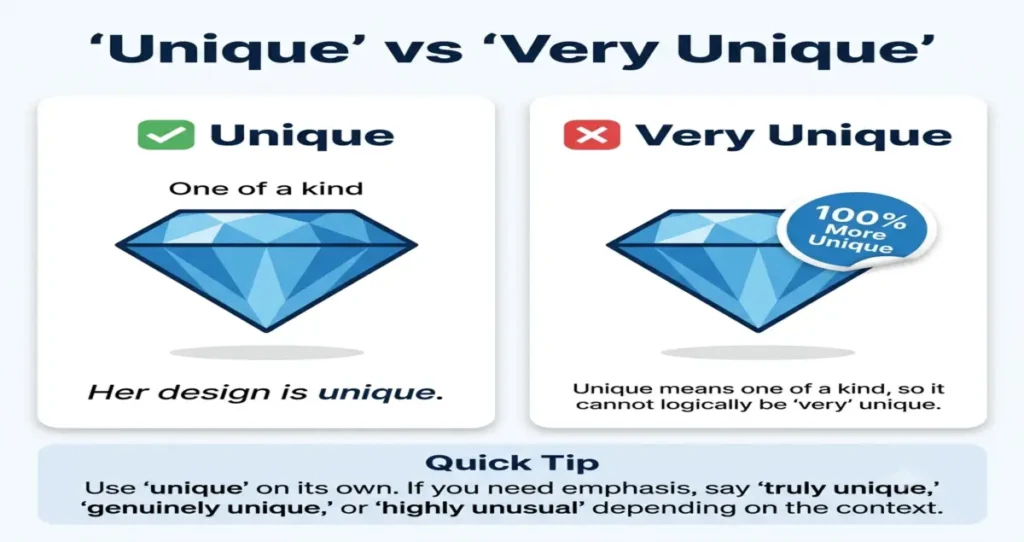
Many ELLs and native speakers ask if they should write something unique or very unique. Both forms may have been encountered in books, advertisements, blogs, and in common speech. This results in confusion because some grammar experts state that the word “very” with “unique” is incorrect, and others feel it can be used in informal conversation.
People look for something different or very different as they want to sound professional and not make grammar errors. It’s not the meaning of the word unique, it’s the confusion. In the traditional sense, unique means “one of a kind” or “unlike anything else. Can something that is already one of a kind be “very” one of a kind?
It all depends on the context, style, and audience. For formal writing, numerous editors prefer just unique. Very unique is used in casual talk or advertising to emphasize.
This guide will help you understand the difference between unique and very unique, when to use them, rules for using them, common mistakes, examples, and professional writing tips to make correct choices in your writing.
Unique or Very Unique – Quick Answer
Short Answer
The word “unique” is usually the one that is used, and it is the grammatically correct word.
Very unique is used in informal contexts of everyday speech but is rarely used in formal writing.
Examples
✅ This design is unique.
✅ Her approach is unique.
⚠️ A very special design.
Her method is extremely special!
Read more:Whether a colon should follow i.e or e.g. and when is up to debate.
Easy Rule
- Formal writing → Unique
- Very unique (informal language/marketing) → acceptable
The root cause of uniqueness or very uniqueness
Unique
The term unique is derived from the French word unique and the Latin word unicus, which means “only one” or “single.
It was borrowed into English in the 17th century and was originally:
- One of a kind
- Unlike anything else
- Sole or singular
Read more:Difference between their, theres and they’re, how to use them.
Very Unique
As language developed, the use of very peculiar words was adopted to highlight the unusualness or specialness of something that appeared
.
This was the source of controversy among grammarians, because “one of a kind” is not a number, and thus cannot be “more one of a kind.
What is the reason for the confusion?
The confusion is due to the fact that contemporary English uses words with emotions rather than in literal sense.
Examples:
- Very perfect
- Very complete
- Very unique
These forms are found in ordinary usage, but are sometimes disallowed by traditional grammar.
British English vs American English Spelling
No difference in spelling between British and American English.
Comparison Table
| Expression | British English | American English |
| Unique | Unique | Unique |
| Very Unique | Very Unique | Very Unique |
Examples
| British Usage | American Usage |
| The building is unique. | The building is eye-catching. |
| It has a very unique design. | It has a very unique design. |
The discussion is not on spelling, but on style and grammar.
Spelling – which spelling?
There will be no spelling change so it’s up to the audience and purpose.
For US Audiences
Professional writing:
✅ Unique
Informal content
:
✅ Unique
⚠️ Very unique (acceptable for emphasis)
For UK Audiences
Editors generally prefer:
✅ Unique
For Global Audiences
The best thing to do is:
✅ Unique
It is professional-sounding and will not be criticized by the grammar purists.
Common Errors: Unique and Very Unique
Mistake 1
❌ This artwork is very unique.
✅ This artwork is unique.
Mistake 2
❌ The company offers the most unique solution.
✅ The company offers a unique solution.
Mistake 3
❌ This product is extremely unique.
✅ This product is unique.
Better Alternatives
Consider using one of these alternative ways to say very unique:
- Highly unusual
- Remarkably distinctive
- Exceptionally rare
- Truly original
- One of a kind
Correction Table
| Less Preferred | Better Choice |
| Very unique | Unique |
| Extremely unique | Unique |
| Most unique | Unique |
Unique or Very Unique in Everyday Examples
Emails
Professional:
The scheme has a novel solution.
News Writing
The artist ‘created a distinctive style’.
Social Media
It’s a really special café!
Marketing
“We offer a super unique customer experience with our brand.
Academic Writing
The article offers a unique analysis.
For formal situations, it’s preferable to use unique.
Google Trends & Usage Data – Unique or Very Unique
Both of these are frequently used online searches.
Unique
- More frequently used in dictionaries.
- Academic writing: Preferred.
- Often used in the workplace to establish a professional tone.Often used in professional correspondence to create a professional tone.
Very Unique
- Frequently used in blogs / advertising.
- Frequently used in social media, such as Facebook and Twitter.
- Used in spoken English
Country Usage
| Country | Unique | Very Unique |
| United States | Very High | High |
| United Kingdom | Very High | Medium |
| Canada | High | Medium |
| Australia | High | Medium |
| India | High | High |
Unique vs Very Unique Comparison Table
| Feature | Unique | Very Unique |
| Traditional Grammar | Correct | Debated |
| Formal Writing | Recommended | Usually avoided |
| Informal Speech | Common | Common |
| Marketing Content | Common | Common |
| Academic Writing | Preferred | Not preferred |
| Professional Tone | Strong | Less formal |
FAQs
1.Is very unique grammatically correct?
It is not suggested in many style guides as “one of a kind” is unique enough.
2. May I use something very unique in normal parlance?
Yes. It’s used informally by many native speakers.
3.. Because it is grammatically incorrect.B. Because it is considered to be “very” common.
Unique is known as a traditional absolute quality.
4. Is the word “unique” better to use in professional writing?
Yes. This is the most secure and trusted one.
5. Are there differences between British and American English?
No, both spellings and grammar rules are the same.
7. How do you say “very unique” in a different way?
Try:
- Remarkably distinctive
- Highly unusual
- Truly original
- Exceptionally rare
7. What is the grammatical form of students in writing essays?
Use unique: It’s preferred by teachers, editors and style guides.
Conclusion
The issue of unique or very unique has been a debate for many years. The traditional definition of unique is one of a kind, so many grammar experts believe it is not necessary to add very to unique. In terms of grammar, the only more unique thing is unique.
Language, however, is subject to change. In today’s discussion, advertising, and social media, a lot of people use a lot of words that are very unique, just to add emphasis. Most readers know what it means, although it is not everyone’s favourite of editor terms.
For professional, academic or formal writing, select unique. Virtually all style guides accept it, and it is clear and concise. Very unique might be OK if you are using it in a casual piece or marketing copy, depending on your audience and style.
The safest guideline to follow is “when in doubt, use unique. It conveys originality without any grammar issues and can be used in all types of writing.

I am Bahadar Ali, a professional content writer and the author behind GrammarDrive.com. I am passionate about making grammar simple and accessible for everyone. Through my writing, I aim to help learners and professionals communicate with clarity and confidence.