Ever come across an email in progress and thought, Should I use “i.e.” or “e.g.”? You’re not alone. These two little Latin abbreviations are a source of confusion to students, professionals, writers and even native English speakers every day.
They are often confused and misused because they are alike and may be used in formal writing.Fortunately, if you know what each means, the difference is not hard to remember. The right choice of abbreviation will allow your writing to be clearer, more professional and comprehensible.
You may find it useful for your writing when you’re drafting a business e-mail, a school essay, a blog post, or a social media update, to know when to use words like i.e. and e.g. to prevent common grammatical errors.
You will find out what each abbreviation means, from where they originated, how they’re used in British and American English, and many examples of them in use. At the end you’ll have the answer to which one to use in each situation.
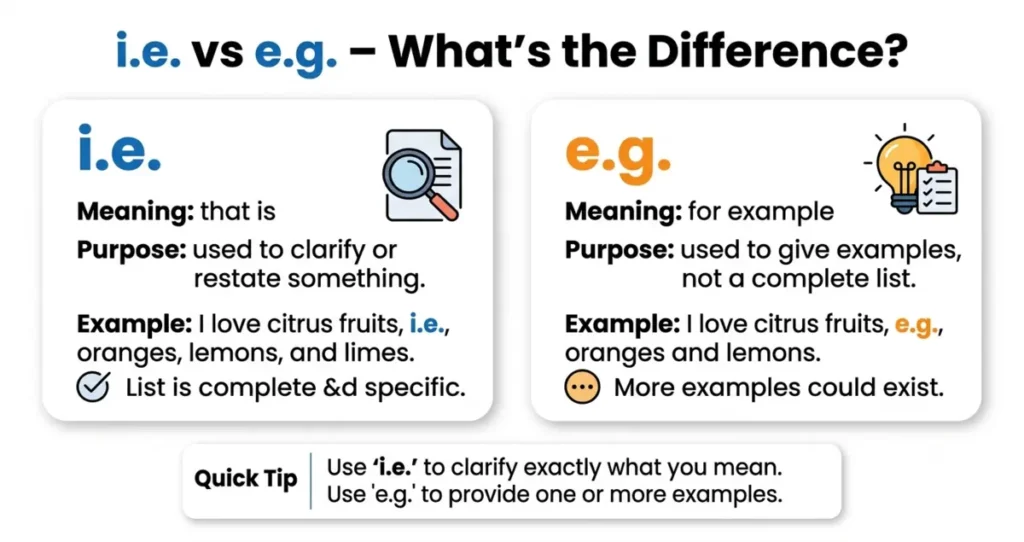
i.e. or e.g. – Quick Answer
It’s a very simple difference:
- With i.e. you should use “that is” or “in other words”. Describes or restates.
- The word ‘e.g.’ indicates that you have given examples. Provides one or more examples.
Read more:Difference between their, theres and they’re, how to use them.
Examples
✅ i.e.
I work remotely, i.e., I work from home.
In this case the second part provides an explanation for the first part.
✅ e.g.
I like to go outside, such as hiking, camping and cycling.
These are only examples—not a complete list.
Easy Trick
- i.e. = In essence (explains)
- e.g. = Example Given (gives examples)
Read more:Spoke or Spoken: What’s difference between them
The beginning of i.e. or e.g.
The two abbreviations are both Latin.
| Abbreviation | Latin Phrase | English Meaning | Purpose |
| i.e. | id est | That is | Explains or restates |
| e.g. | exempli gratia | For example | Gives examples |
These abbreviations have been used in academic, legal and professional writing for hundreds of years.They are derived from Latin, but are commonly used by modern English speakers as they allow for writing in a concise manner and save space.
The spelling of the words i.e. and e.g. is consistent between dialects of English. The only difficulty is deciding which one is the right fit for the sentence.
Differences between British English and American English spelling.
The spelling of the words is identical in British and American English, except for i.e. (or e.g.) and colour/color.
The minor difference is punctuation and style.
- British English can use the standard punctuation.
- Fewer and varying periods and commas are now allowed by American English style guides depending on the publisher.
Comparison Table
| Feature | British English | American English |
| i.e. spelling | i.e. | i.e. |
| e.g. spelling | e.g. | e.g. |
| Meaning | Same | Same |
| Usage | Same | Same |
| Modern style | Sometimes fewer commas | Follows the style guide |
Example
British:
Bring warm clothes, e.g., a coat and gloves.
American:
Bring warm clothes, e.g., a coat and gloves.
Both are acceptable usage in the context of applying a style guide.
Which Spelling: to use?
There is no spelling difference – focus on the choice of the appropriate abbreviation.
If your audience is American:
Use:
- i.e. for clarification.
- e.g. for examples.
Use the punctuation that is appropriate to your organization.
If your audience is British
It’s the same rule.
- When your audience is around the world
- These abbreviations are nowadays being replaced by plain English by many writers.
Instead of:
I.e.
Write:
that is
Instead of:
E.g.
Write:
for example
It makes it easier to read for everyone to write.
Common mistakes with i.e. and e.g.:
These abbreviations are often combined since they are similar.
Mistake 1
X I prefer non-tropical fruits such as apples, oranges and berries.
✅ I like tropical fruits, e.g. mangoes and bananas.
Mistake 2
❌ The meeting is virtual, e.g. nobody needs to travel.
✅ The meeting is virtual, i.e. nobody needs to travel.
Mistake 3
Thinking e.g. means “etc.
Wrong:
I bought apples, e.g., oranges.
Correct:
I bought fruit, e.g., apples and oranges.
Mistake 4
Using i.e. to introduce only one example.
Wrong:
In many countries (e.g. Canada).
Correct:
Many countries, e.g. Canada.
Mistake 5
Adding etc. after e.g.
❌ e.g. apples, oranges, etc.
Better:
✅ e.g. apples and oranges.
The word etc. is redundant since it means “for example.
i.e. or e.g. in Everyday Examples
In Emails
Please send the following documents: Passport and signed application.
Bring writing materials, e.g., pens or pencils.
In News Articles
Several cities, e.g., London and Toronto, reported heavy rainfall.
On Social Media
Weekend activities: outdoors activities such as hiking and biking.
In Business Writing
All staff are required to take required training, e.g., the Cybersecurity course.
In Academic Writing
Renewable energy sources, e.g., solar and wind power, are becoming more popular.
i.e. or e.g. – Google Trends & Usage Data
The interest in “i.e. or e.g.” has remained stable across the year due to learners’ confusion over the two abbreviations.
The word is particularly popular in countries in which English is commonly used or taught, such as:
- United States
- United Kingdom
- Canada
- Australia
- India
- Pakistan
This is a topic that students, bloggers, business writers, and academic writers look for before composing reports, emails, essays, and articles.
Grammar questions are more likely to be asked during searches, typically in school terms and during exam periods.
Comparison Table
| Feature | i.e. | e.g. |
| Meaning | That is | For example |
| Purpose | Explains | Gives examples |
| Latin | id est | exempli gratia |
| Complete list? | Yes | No |
| Easy reminder | In Essence | Example Given |
| Included in formal writing. | Yes | Yes |
| Use in emails | Yes | Yes |
| Common confusion | Used instead of e.g. | Replaces i.e. |
FAQs
1.What is the difference between ‘i.e. and e.g.?
i.e. gives explanation or restatement of information; e.g. gives examples.
2. Is i.e. the same as “for example”?
Use No. i.e. for “that is” and e.g. for “for example.
3. Is it OK to use e.g. in formal writing?
Yes. It aids in academic, business, and professional writing.
4. Should I write “for example” instead of e.g.?
For a wide or global audience, the words ‘for example’ are often more effective.
5. Are there any differences British English and American English?
No. Both have the same meaning in the context, and are used as i.e. and e.g.
6. What is the correct use of the i.e. language?
Yes. Useful for explaining something or elaborating on it.
What is the trick to keeping the difference in mind?
Think:
- In essence (i.e.) means that it explains.
- e.g. = Example Given = examples
Conclusion
It’s really not all that hard to distinguish betweeni.e. ande.g. While both abbreviations are Latin, and are used in formal writing, they are used in different ways: where you want to explain or restate something, use i.e. and where you wish to give examples, usee.g. This subtle difference will help you to write more accurately and clearly.
British English and American English have no difference in spelling, all you need to do is select the appropriate abbreviation for your sentence. For writers targeting an international audience, try to use the complete terms “that is” or “for example,” which are more comprehensible to all readers.
Emails, reports, essays, blog posts, social media posts – you can use i.e. and e.g. correctly and communicate with confidence, no matter what you are writing. The examples, tips, and tables in this guide will help you pick the correct abbreviation each and every time.

I am Bahadar Ali, a professional content writer and the author behind GrammarDrive.com. I am passionate about making grammar simple and accessible for everyone. Through my writing, I aim to help learners and professionals communicate with clarity and confidence.