English learners and writers often look for the words “spoke or spoken” because they are so similar in appearance, but different in usage. Both derived from the verb “speak,” but they may not be interchangeable in all situations
. This can cause problems in writing email, school, business, and even in social media posts.Ever asked yourself if you should use the present tense “I speak to him” or the past tense “I spoke to him”? These forms are also subject to native speaker errors.
It is essential to know the distinction as the wrong word will make your sentence sound wrong or unclear.
This guide provides easy to understand definitions of spoken and spoken. The grammar rules, spelling history, British and American English usage, common mistakes and real-life examples will be covered. By the end, you will be sure when to use each word confidently.
Spoke or Spoken – Quick Answer
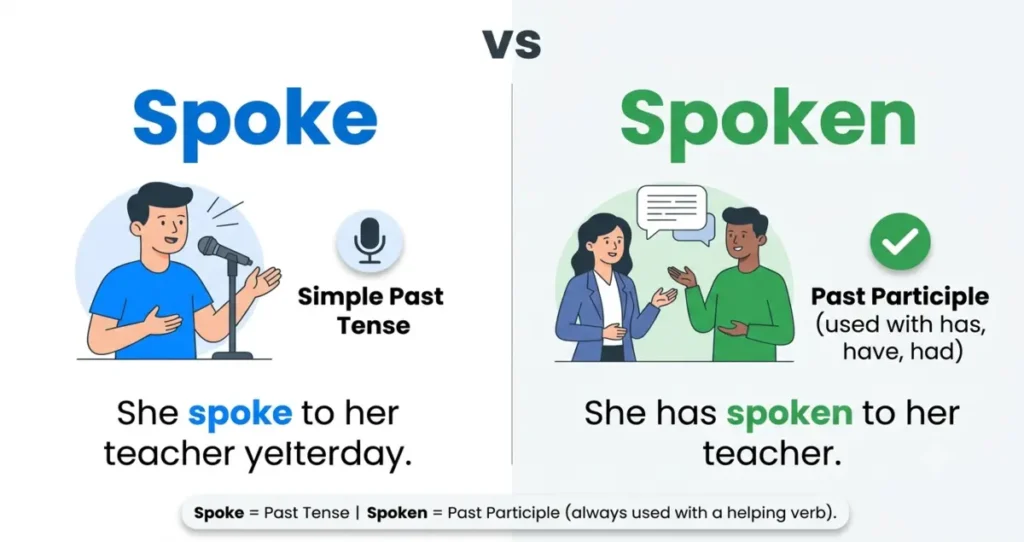
The simple past tense of “speak” is “spoke.”
Spoken is the verb that is made from “speak” in the past participle.
Examples
- Correct: “I wrote to my teacher yesterday.”
- Correct: I have already spoken with my teacher.”
Easy Rule
- Use ‘spoke’ for actions that have already happened.
- Use spoken with helping verbs such as:
- have
- has
- Had
Read more:Went or Gone: What’s Difference and Which One you Use?
Quick Comparison
| Word | Grammar Form | Example |
| Spoke | Simple past tense | “She spoke clearly.” |
| Spoken | Past participle | “Her message has been loud and clear.” |
The Origin of Spoke or Spoken
The Old English verb “specan” or “sprecan” meant “to talk” or “to say words” which is how the words became.
English grammar evolved over time. Verbs in various forms to indicate time and action.
- The past tense of Spoke is Spoke.
- Spoken was the past participle form.
There are lots of irregular verbs in English. These verbs are irregular; they don’t end in “-ed”.
Example
- Walk → Walked
- Talk → Talked
- Speak → Spoke → Spoken
Read more:How to tell the difference between Elicit and Illicit:
That’s why the two forms appear to be different.
How to spell words correctly in British English vs American English.
Fortunately, the spellings are the same for both British English and American English:
- spoke
- Spoken
The two regions are the same in spelling. Sentence style and grammar patterns might vary, however.
British English Examples
- I have spoken to the manager.
American English Examples
- The manager spoke to me yesterday.
Both are correct.
Comparison Table
| Feature | British English | American English |
| Spelling | Spoke / Spoken | Spoke / Spoken |
| Common Formal Usage | “Have spoken” | Spoke: more common in speech (past tense of speak) |
| Grammar Style | Used more frequently: present perfect | The simple past was more frequently used. |
Which Spelling to Use?
Spoke/Spoken should be used in grammar and NOT geography.
Use “Spoke” When:
- Discussing a completed past activity.
- No helping verb is present.
Examples
- He gave a speech at the meeting.
- Last night, we spoke.”
Use “Spoken” When:
- Using helping verbs.
- Composing written, or professional, English.
Examples
- “She said to HR.”
- “Before the event they had said this.”
Audience-Based Advice
| Audience | Best Choice |
| US readers | There are common simple forms such as “spoke” |
| UK readers | The verb “have spoken” is used more frequently. |
| Global audience | Apply appropriate structure and grammar (correction) |
common mistakes with Spoke or Spoken.
There are many people who mix up these words.
Mistake 1
I have said to him.” (Wrong)
Yes! I’ve talked to him.
Mistake 2
❌ “She spoken yesterday.”
✅ “She spoke yesterday.”
Mistake 3
❌ “We had spoke already.”
We had already spoken, ✅
Simple Tip
If you see:
- have
- has
- Had
Use spoken.
Described spoke or spoken in Everyday Examples
In Emails
- I talked to the client yesterday.
- “Talked to the Finance guys.”
In News Writing
- The president addresses the conference.
- “A crisis has been talked about by officials.
”
On Social Media
- I just spoke to my best friend!”
- “Don’t worry, I have said this already.”
In Formal Writing
- The witness had testified in front of the court.
- There is expert input on the matter.
Spoke or spoken, Google Trends & Usage Data.
There is a strong consumer search demand for “spoke or spoken” for:
- English learners
- Students
- Business professionals
- IELTS and TOEFL test takers
This is one of the most popular countries that search for this keyword.
- India
- Pakistan
- Philippines
- United States
- United Kingdom
Usage Context
| Context | More Common Word |
| Casual conversation | Spoke |
| Professional writing | Spoken |
| Grammar lessons | Both |
| English exams | Both |
keyword for irregular verbs as they are hard to remember.
Comparison table Spoke Spoken
| Feature | Spoke | Spoken |
| Verb Type | Past tense | v |
| Needs Helping Verb | No | Yes |
| Example | “I spoke.” | “I have spoken.” |
| Formality | Neutral | More formal |
| Grammar Role | Main verb | With auxiliary verbs |
Frequently asked questions about Spoke or Spoken
1. Does the word “spoken” make sense grammatically?
Yes. The past participle form of “speak” is “spoken.”
2. May I say “I have spoken”?
No. The right sentence is: “I, I have spoken.”
4. What are the uses of “spoke”?
Use “spoke” to indicate a past event that has been finished.
Example:
I talked to her the day before yesterday.
5.When do you use “spoken”?
Use helping verbs such as have, has or had in the word “spoken”.
Example:
“They have already said what they’re going to say.”
6. Does the word “spoken” convey a more formal tone than “spoke”?
Yes. The word “spoken” is frequently used in formal and professional writing.
6. Which English has a different spelling? British or American English.
No, both “spoke,” and “spoken.
7. What makes this verb irregular?
Many of the irregular verbs in English have been inherited from Old English grammar patterns.
Conclusion
If you know the grammar rules, it’s easier to understand the difference between spoken and spoken. Spoke – simple past tense of talk. Spoken is the past participle that is used with the helping verbs “have,” “has,” and “had.”
The spellings are the same in British English and American English, so it isn’t a regional thing. Rather, it relies on the structure and grammar of sentences. Proper form ensures your writing is clear, professional and natural.
When writing emails, reports, essays or social media, keep this simple rule in mind:
- No verbs of helping = talked
- Have (present) = spoken Helping verb past = spoken
Irregular verbs are something that needs practice but knowing “spoke or spoken” will make you more fluent and confident in English. Continue to practice samples and you’ll find the right form comes easily to you in daily conversations.

I am Bahadar Ali, a professional content writer and the author behind GrammarDrive.com. I am passionate about making grammar simple and accessible for everyone. Through my writing, I aim to help learners and professionals communicate with clarity and confidence.