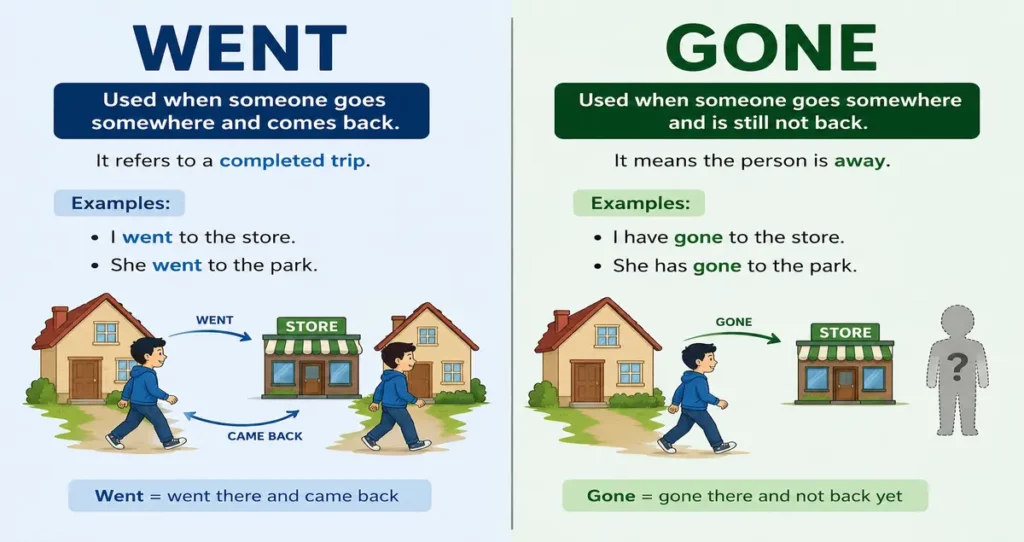
Many people search for “went or gone” because these two words often cause confusion in English grammar. Both words come from the verb “go,” byut they are used in different ways. English learners, students, writers, and even native speakers sometimes mix them up in speaking and writing.
For example, should you say, “She has went to school” or “She has gone to school”? What about “He went home early”? Small grammar mistakes like these can change how professional your writing sounds.
This guide explains the difference between “went” and “gone” in simple language. You will learn when to use each word, common mistakes to avoid, and how these words appear in daily English. We will also compare British and American English usage, show real examples, and answer common questions people ask online.
By the end, you will know exactly when to use “went” and when to use “gone.”
Went or Gone – Quick Answer
“Went” and “gone” are both forms of the verb “go,” but they are used differently.
- Went = simple past tense
- Gone = past participle
Examples
- Correct: “I went to the store yesterday.”
- Correct: “I have gone to the store.”
- Incorrect: “I have went to the store.”
Simple Rule
Use went for actions completed in the past.
Use gone after helping verbs like:
- has
- have
- had
Read more:Smooth or Smoothe: Which Spelling Is Correct ?
Quick Comparison Table
| Word | Grammar Form | Example |
| Went | Past tense | She went home. |
| Gone | Past participle | She has gone home. |
The Origin of Went or Gone
The words “went” and “gone” both come from the old English verb “go.”
Interestingly, “went” originally came from another verb called “wend.” Over time, English speakers started using “went” as the past tense of “go.”
“Gone” comes from the older form “gan,” which later became “goon” and then “gone.”
English changed over hundreds of years, so many verbs developed unusual forms. That is why:
- go → went → gone
does not follow a normal spelling pattern.
These differences exist because English borrowed words from Germanic languages, Latin, and French over time.
Read more:On Board or Onbord : Which Spelling Is Correct?
British English vs American English Spelling
The words “went” and “gone” are spelled the same in both British and American English. However, sentence structure and grammar style can sometimes differ slightly.
British English Examples
- “He has gone to hospital.”
- “She has gone on holiday.”
American English Examples
- “He has gone to the hospital.”
- “She has gone on vacation.”
The grammar rule stays the same:
- use “went” for past tense
- use “gone” with helping verbs
Comparison Table
| Usage | British English | American English |
| Past action | He went home. | He went home. |
| Present perfect | He has gone home. | He has gone home. |
| Common phrase | Gone on holiday | Gone on vacation |
| Hospital phrase | Gone to hospital | Gone to the hospital |
Which Spelling Should You Use?
You should use both words correctly based on grammar, not region.
Use “Went” When:
- talking about a finished past action
- no helping verb is present
Example:
- “They went to London last year.”
Use “Gone” When:
- using has, have, or had
- describing someone who left
Example:
- “They have gone to London.”
Audience-Based Advice
| Audience | Best Choice |
| US readers | Standard American grammar |
| UK readers | Standard British grammar |
| Global audience | Use simple international English |
If you write for a global audience, keep sentences short and clear.
Common Mistakes with Went or Gone
Many English learners make the same grammar mistakes.
Mistake 1
❌ “She has went home.”
✅ “She has gone home.”
Mistake 2
❌ “I gone to the market yesterday.”
✅ “I went to the market yesterday.”
Mistake 3
❌ “They had went already.”
✅ “They had gone already.”
Easy Grammar Tip
- No helping verb → use went
- Has/have/had → use gone
Went or Gone in Everyday Examples
These words appear in daily communication everywhere.
In Emails
- “I went through the report.”
- “The manager has gone to a meeting.”
In News Writing
- “The president went to Europe.”
- “Several workers have gone missing.”
On Social Media
- “I went shopping today!”
- “My weekend has gone so fast.”
In Formal Writing
- “The company went through major changes.”
- “Several documents have gone missing.”
Went or Gone – Google Trends & Usage Data
Search interest for “went or gone” is high among:
- English learners
- students
- job seekers
- content writers
Countries with strong search interest include:
- India
- Pakistan
- Philippines
- United States
- United Kingdom
Most searches happen because people are unsure about:
- present perfect tense
- past tense grammar
- spoken English mistakes
Usage Context Comparison
| Context | Common Word |
| Simple past | Went |
| Present perfect | Gone |
| Daily speech | Both |
| Academic writing | Both correctly used |
| ESL learning | High confusion |
Comparison Table: Went vs Gone
| Feature | Went | Gone |
| Verb type | Past tense | Past participle |
| Used with has/have/had | No | Yes |
| Shows completed action | Yes | Yes |
| Example | I went home. | I have gone home. |
| Common mistake | “Have went” | Missing helping verb |
FAQs About Went or Gone
Is it correct to say “have went”?
No. The correct phrase is “have gone.”
What is the difference between went and gone?
“Went” is past tense. “Gone” is a past participle used with helping verbs.
Can I say “he gone home”?
No. You should say:
- “He went home.”
or - “He has gone home.”
Why is “went” irregular?
English borrowed older verb forms over time, which created irregular verbs.
Is “gone” present tense?
No. “Gone” is a past participle.
Which is more formal: went or gone?
Both are formal when used correctly.
Do British and American English use different rules?
No. The grammar rules are the same.
Conclusion
Understanding the difference between “went” and “gone” is important for clear English communication. These two words come from the same verb, but they serve different grammar purposes. “Went” is the simple past tense, while “gone” is the past participle used with helping verbs like “has,” “have,” and “had.”
Many people confuse these words because both refer to past actions. However, the grammar structure changes how each word should be used. Saying “I went yesterday” is correct, while “I have gone already” is also correct. But phrases like “I have went” are grammar mistakes.
The good news is that the rule is simple once you learn it. Use “went” alone for past actions. Use “gone” with helping verbs. This applies in British English, American English, emails, formal writing, and everyday speech.
If you want professional and natural English, mastering “went” and “gone” is a great step forward.

I am Bahadar Ali, a professional content writer and the author behind GrammarDrive.com. I am passionate about making grammar simple and accessible for everyone. Through my writing, I aim to help learners and professionals communicate with clarity and confidence.