You’re in the middle of an email. You write, but stop, “I have wrote… Something feels off. If that should be written? Or is the word “wrote” OK in this context?
You’re not alone. One of the most frequent and confusing errors in English (even for native speakers) is the spelling of the verb ‘written’. Both words have the same origin as the verb “write,” but they do not function in the same way in a sentence.
It’s not something as trivial as a mix up. It can give your writing a careless appearance in a job application, report or an essay for school. The good news, you only need to remember one rule and they will never get mixed up again.
You will find out when to use “wrote”, when to use “written”, why there is a double form, and how to prevent this error from getting through to the recipient before you press send. We’ll also have some real-world examples in situations that come up in emails, books, and life—making the rule stick.
Wrote vs Written – Simple Answer
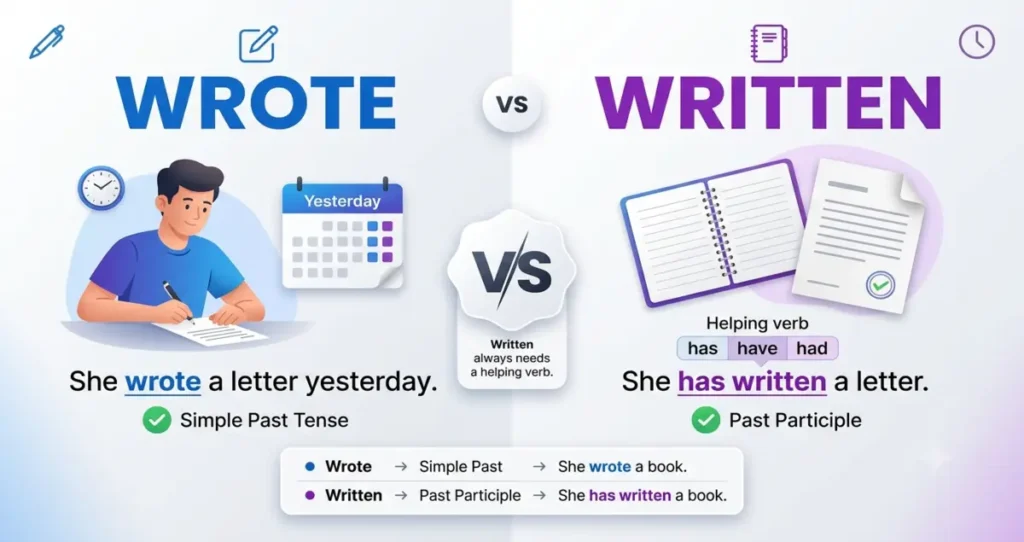
Write is the simple past tense of the verb “write. Don’t use it with a helping verb: “She is writing a letter.
Is the past participle of “write.” Always requires a helping verb such as ‘has’, ‘have’, ‘had’, ‘was’: ‘She has written a letter’.
If there is no helping verb in front of it, use “wrote. Use “written” after a helping verb.
- I created the report the day before today. Simple past (no helper required)
- Report prepared. (has been, has been used, etc)
Read more:Chose or Chosen what is the difference and which one you use
Meaning of Each Word
Wrote
The simple past tense of “write” is used when referring to an action that occurred and ended at a certain time in the past.
Part of speech: Participle (past tense)
Use it: Use wrote when it is used as a single verb and it is referring to a completed action in the past.
Typical situations: Story, past events description, simple past statement of a past event.
Memory trick: Wrote rymes with Boat. Imagine one boat sailing off and one word doing the work without anybody else’s assistance.
Read more:Sung or Sang which word you use from these
Examples:
- While in college she wrote a novel.
- He sent a letter to his sister each week.
- Before they left, they wrote down the address.
Written
The verb write’s past participle. It is used with helping verbs to make perfect tenses or passive.
Sentence: The majority of the population is made up of older people.Part of speech:
When to use:Use it when it is preceded by a helping verb, such as “have,” “has,” “had,” “is,” “was,” or “been.
Common context:
Formal writing, describing a thing done relative to another time, passive sentences, and as an adjective (a written agreement).
Memory aid: Written has two Ts — it requires two things to be written, a helping verb, and whatever it is that’s being written. Does not stand alone.
Examples:
- She is an author of three novels.
- The letter is dated 1990.
- I was already composing the e-mail before you called.
- This is a contract that you sign.
Key Differences
| Feature | Wrote | Written |
| Meaning | Simple past action | Used with helping verbs.Past participle |
| Part of Speech | Verb (past tense) | Verb (past participle) / adjective |
| Common Usage | Is used by itself as a sentence. | Follows “have,” “has,” “had,” “is,” “was,” “been” |
| Example | The essay was composed last night. | I have prepared the essay. |
| Easy Memory Trick | No helper and one word: like a lone boat | Requires assistance — “two-part team” |
Word Origin (Etymology)
The both words are of Old English origin and both originated from the verb writan, meaning ‘to scratch’ or ‘to carve’, referring to the way early writing was cut into wood or stone.
In old English, the past tense and past participle forms of many verbs were irregular, and, remarkably, “write” has retained its past tense form to a large degree. The past tense form of the word wrāt became “wrote,” and the past participle form of the word, writen, became “written.
That’s why the “write” does not use the “walk” prefix to form its past tense “walked”. It is an irregular verb, which is precisely the type that folks get confused on, since there is no regular pattern to follow.
Difference between British English and American English.
Fortunately, there is no difference between British and American English in the case of wrote and written. In the UK, in the US, in Canada, in Australia and in all other countries English is spoken. Both forms are used in the same way.
| Feature | British English | American English |
| Spelling | wrote / written | wrote / written |
| Pronunciation | Same | Same |
| Preference | No regional variation | No regional variation |
| Example | He has been writing to the council. | He has sent a letter to the council. |
This is a place where all English speakers agree – in places where they don’t, ‘colour/color’ and ‘realise/realize’ are exceptions.
Which One Should You Use?
- American readers: As usual, “wrote” is singular, “written” is plural. There are no exceptions to the regional guidelines.
- British readers: Do the same as stated above.
- International/ESL readers: If you are using helping verbs such as have, has, and had, as well as was and been, then you’ve got your cue for “written. When you see one of those words, “written” is nearly always the next word.
- Academic writing: You’ll find that a lot of the time the word “written” is used in passive sentences (such as “the essay was written to explore…”) and in phrases such as “as previously written. Passive voice is a structure that is more common in formal writing than in informal speech.
- Business writing: Avoid expressions such as “as per the written agreement” or “I have written to confirm. These are a common occurrence in professional emails.
- Everyday Communication “wrote” is used much more frequently, because the simple past tense is typically used to describe simple past events (“I wrote you back,” “she wrote me”).
Common Mistakes
1. ❌ I have wrote the report. ✅ I have written the report. Why: Have” is a helping verb, which requires a verb like “written,” not “wrote.
2. ❌ She written the email yesterday. ✅ She wrote the email yesterday. Why: There is no helping verb in the sentence, therefore we use the simple past “wrote”.
3. ❌ The writer of the book is a renowned author. ✅ The author of the book is a renowned author. Why: Passive voice have always written “was/were” followed by “written”.
4. ❌ He has already wrote back to them. ✅ He has already written back to them. Why: The past participle “written” is produced by the verb “has.
5. ❌ This letter is written by me last week. ✅ This letter was written by me last week. Why: Using a past tense passive action in combination with a past tense passive action.
6. ❌ They had wrote the contract before the meeting. ✅ They had written the contract before the meeting. Why: The word “had” is a helping verb and needs “written.
7. ❌ I never written a novel before. ✅ I have never written a novel before. Why: This is because the helping verb “have” is missing, “written” cannot stand alone.
8. ❌ We wrote off by the new policy. ✅ We were written off by the new policy. (or We wrote off the debt.) Why: Depends on meaning — “written off” (passive, dismissed) vs. “wrote off” (active, cancelled something).
9. ❌ She has wrote to her manager twice. ✅ She has written to her manager twice. How: “Why” must be followed by “has” + “written.
10. ❌ The exam wrote by hand only. ✅ The exam was written by hand only. Why: Passive sentences require the use of “was/were” in addition to “written.
Everyday Examples
Emails: “I have e-mailed you about our meeting.
School writing: “This essay was composed during 2 weeks.
Business communication: “Payment is due as previously agreed upon in our contract, within 30 days.
News: “It is by a senior correspondent.
Books: “At the age of 19 she wrote her first novel.
Texts: “Just wrote a thread about this — check it out!”
Conversations: “I wrote you back an hour ago, did you see it?”
Grammar Tips
- Sentence position: The verb “wrote” is normally placed after the subject (I wrote…). A helping verb (I have written, It was written) is always followed by the verb “written”.
- Common collocations: “written” is often used with “agreement,” “consent,” “notice,” “proof,” and “confirmation” (all of which are common in formal or legal contexts). The word wrote is often used with back, down and to (wrote back, wrote down, wrote to).
- Punctuation: There are no particular rules, but be aware of the use of commas in compound sentences: “I wrote the draft and she edited it.
- Form the verb: Be sure to remember all the forms: write (present) wrote (past) written (past participle). None of the three are regular verbs that follow the “-ed” pattern.
Easy Memory Tricks
Imagine ‘wrote’ is a lonely traveller; it goes places on its own without a companion.
Remember that if the word is written, it must have a ride (have, has, had, was, were, been).
One more tip: read out the sentence. If it sounds complete after being plugged in with just “wrote” then just use it. When it sounds like it’s missing before the verb, you should use “written” + a helper.
Google Trends & Usage
Searches and use rates for “wrote” are higher in informal writing, such as writing at home or in a journal; in most cases, people are talking about simple, finished events (“I wrote this,” “she wrote that”). Passive voice and perfect tenses are more likely to appear in formal, academic, and legal contexts such as those in “Written.
The problem with the distinction between simple past and past participle is often confused in the ELS realm, and is no less frequently confused in language areas where they do not differentiate between the two. The two typical search motives for the term “wrote vs written” are: double checking a sentence that you are currently writing and studying a grammar rule with students/ESL learners.
Related Words
Still not sure about “wrote vs written”? Here are some other frequently confused words in English:
- Therapy vs Therapeutic – “Affect” typically refers to the verb “to affect” (to influence) and “effect” is typically a noun (the result).
- Accept vs Except – Accept – to be able to receive or agree to something, Except – to exclude something.
- Principal vs Principle – Principal is a person in charge, such as a school principal or the main amount of money; Principle is any principle, fundamental rule or belief, such as a moral guideline.
FAQS
Should it be ‘I have wrote’ or ‘ I have written’? Always “I have written. The past participle form of the verb is “written,” not “wrote,” when it is preceded by “have,” “has,” or “had.
Is it possible to have “wrote” after “can”? In all cases “have”, “has”, and “had” are always followed by “written”. Even native English speakers make this mistake: “have wrote.
Is the word written a true word? It can’t be the main verb in a sentence without a helping verb: It may, however, also be used as an adjective, e.g. “a written test” or “written proof.
Why does English have two verbs for one past tense? The verb “write” is irregular because it is borrowed from Old English. Irregular verbs tend to have different simple past and past participle forms rather than the regular “-ed” form.
Is ‘wrote’ in the passive voice? NO. Passive voice always includes a form of “to be” (is, was, were, been), followed by the object of the action, e.g., “The book was written in 2020.
What is the difference between “wrote” and “had written” in the following sentence? Wrote is used for a single past action. “Had written” (past perfect) is used to indicate that an action has finished before another action in the past, for example “I had written the letter before she phoned.
Did the word written indicate an adjective? Yes. The “written” in “written consent,” “written agreement,” and “written exam” is a descriptive adjective that could be replaced by the noun it modifies.
Is there any difference in this rule regarding British English vs American English? No. The two words have to be used in the same manner and there is no difference in spelling or usage between regions.
Which of the following is a helping verb that comes before “written”? The most common ones are “have,” “has,” “had,” “is,” “was,” “were,” and “been.”
Does “wrote” have a specific connotation to spoken storytelling? No, “wrote” is used in both speech and writing when the action in the past is simple and there is no other action, for example, “She wrote her thesis last year.
Key Takeaways
- Use ‘wrote‘ (simple past tense) without a helping verb!
- The past participle is “written” which requires a helping verb (have, has, had, was, were, been).
- The two both derive from the irregular verb “write”, from Old English.
- The way that British English is used is not so different from that of American English.
- The word “written” is frequently used as an adjective, such as “written consent” or “written agreement.
- If there is a helping verb in front of the blank, use “written”. Otherwise, use “wrote.
Conclusion
The only way to tell if it is “wrote” or “written” is to check if there is a helping verb nearby. Otherwise use “wrote. Look for “have,” “has,” “had,” “was,” “were,” or “been” followed by the verb and if you do, your answer is “written.
Many even veteran writers make mistakes with this combination because the word write is an irregular verb, so there is no one-to-one correspondence between the words. However, the instant you click it, it clicks. You’ll always choose the correct word when you reread your sentence and look for a helping verb.
This is important for any type of writing, from a short text to a formal report, and will lend style and polish to your writing while giving you greater confidence. Always remember the “solo traveller vs needs a lift” trick and you will never regret once more.

I am Bahadar Ali, a professional content writer and the author behind GrammarDrive.com. I am passionate about making grammar simple and accessible for everyone. Through my writing, I aim to help learners and professionals communicate with clarity and confidence.