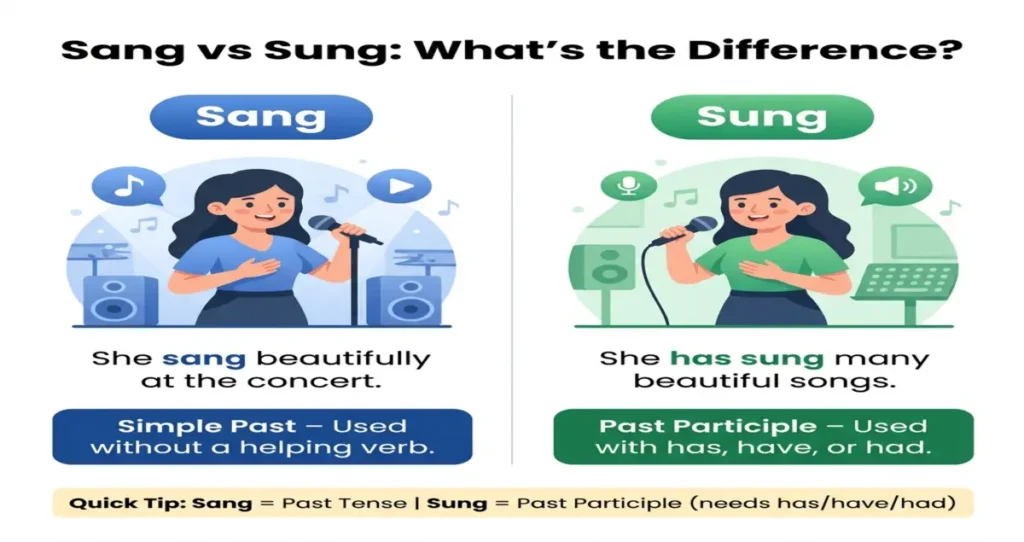
Many students of English and even native speakers struggle with “sung or sang.” The two words are both derived from the verb “sing,” but they have different meanings. For this reason, this keyword is searched for online often.
This can be something you have heard before: “She sang beautifully” or “She has sung beautifully.” Both are right, but the word changes a bit due to grammar. This little nuance leads to a lot of spelling errors in school work, emails and social media posts.
If you don’t know the difference between sung and sung, you will not sound natural or confident when speaking English. It enhances grammar in written and business communication, and everyday conversation.
Here you’ll discover the quick answer, the word’s origin, spelling and grammar guidelines, common errors, and examples. At the end, you will be able to tell, without a doubt, when to use “sung” and when to use “sang.”
Sung or Sang – Quick Answer
- The short answer is very simple:
- Sang = past tense of sing (simple)
The past participle of sing is “sung”.
Examples
Yesterday she sang a song.
She has already performed that song.
Use sang to describe something that has happened or been accomplished in the past.
Use the verb in the sun form with helping verbs such as:
- has
- have
- Had
Read more:Difference between Swam and Swum and which is correct
More Examples
| Correct Usage | Explanation |
| He performed at the concert. | Simple past tense |
| He has performed in numerous concerts. | I have seen a teacher who enjoyed teaching. |
| They sang loudly. | Past action |
| They were singing before their meal. | Past participle form |
The origin of the word ‘sung’ or ‘sang’.
The word sung and sang are both derived from the Old English verb “singan.”
The verbs in English underwent change over time. Some verbs turned to “regular” verbs and added the ending -ed, and others remained “irregular.” The verb sing is an irregular verb.
Read more:Hanged or Hung: What’s Difference and Which You Use
Its forms became:
Base Verb Past Tense Past Participle
Sing Sang Sung
This is analogous to:
- Ring → Rang → Rung
- Drink → Drank → Drunk
- Swim → Swam → Swum
The variations in spelling occur because English persisted with some of the Germanic structure of grammar. Hence the similarity of “sang” and “sung” yet different uses of grammar.
.Compare spelling of British English with American English.
The difference between British and American English is not significant in the spelling of sung and sang. The same forms are used in both countries.
But there may be some variation in sentence style and tone.
Examples
| American English | British English |
| She was treated as a guest and performed at the occasion. | She performed at the event. |
| He has performed in numerous schools. | He has performed in a variety of schools. |
The grammar guidelines remain the same for both English languages.
Comparison Table
| Word | Grammar Role | Example |
| Sang | Past tense | I sang yesterday. |
| Sung | Past participle | I have sung before. |
Which Spelling to Use?
The selection is influenced by the grammar, not the position.
Use “Sang” When:
- Discussing a completed action in the past
- The verb does not have a helping verb.
Examples
- Maria sang beautifully.
- They (the children) sang as one.
Use “Sung” When:
- Using helping verbs
- Perfect tenses: writing.
Examples
- Maria’s singing has been delightful.
- Before lunch, the children had been singing.
Audience-Based Advice
Audience | Best Choice |
| US readers | Use regular grammar conventions |
| UK readers | Use conventional grammar conventions |
| Global audience | Avoid using compound sentences; use simple sentences for clarity. |
Most Frequently Made Errors with Sung or Sang
Many people use a combination of Common Errors and Fixes
| Incorrect | Correct |
| She sung yesterday. | She sang yesterday. |
| He has sang before. | He has sung before. |
| They sung loudly. | They sang loudly. |
| I had sang already. | I had sung already. |
A simple method for memorizing multiplication facts.
- No helping verb? → Use sang
- Helping verb present? → Use sung
Sung or Sang in Everyday Examples
In Emails
- Correct: “She sang at the company party.”
- Correct: “She has performed at numerous occasions.”
In News Writing
- The artist was present to perform at the ceremony.”
- The singer has performed throughout Europe.
On Social Media
- “What I loved to hear was my precious song this evening.”
- I have never sung in front of so many people”.
In Formal Writing
- Before guests are present, the choir has sung.
Google Trends and Usage Data for sung and sang.
The following are typical terms searched for on the Internet:
- United States
- United Kingdom
- India
- Canada
- Australia
This is a popular search term because:
- Irregular verbs cause difficulties for English learners.
- Grammar checker corrects errors.
- Students require assistance in learning the rules of the tenses.
Usage Context
| Word | Most Common Context |
| Sang | Daily conversation |
| Sung | Formal grammar and writing. |
In general, sang is used more in spoken English, and sung is used more frequently in written sentences in the perfect tense.
Comparison Table: Sung vs Sang
| Feature | Sang | Sung |
| Verb Type | Past tense | Past participle |
| Needs Helping Verb | No | Yes |
| Example | She sang well. | She has sung well. |
| Grammar Role | Completed action | Perfect tense |
| Common Error | Using after “has” | Using alone |
Frequently asked questions about “sung” or “sang”
1.Can you say “has sang”?
No. The proper word is “has sung.”
2. Which word is past tense: sung or singing?
Past participle: No. Sung.
3. When to use “sang”?
Use ‘sang‘ for simple past tense actions.
4. May I say “I sang a song yesterday”?
No. The proper sentence is:
5.I sang a song yesterday.
Why is there a problem with people confusing sung and sang?
Both words are related to the verb sing, and are nearly identical in spelling.
6.Do you use helping verbs with ‘sung’?
Yes. Words such as ‘has’, ‘have’, and ‘had’ are used with sung.
7. Are the rules the same in British and American English?
Yes. The grammar rules are the same with both forms.
Conclusion
Once you know the rules for verbs, the difference between sung and sang is easy to understand. The simple past tense of sing is sang, and the past participle is sung (which is used with helping verbs). This small detail in the grammar alters the manner of sentence construction.
When describing a completed action in the past, use sang. Use sung when your sentence contains the words has, have, had. You can use this simple rule to help you steer clear of these common English pitfalls.
The forms are the same in British and American English and you can use either one, based on the rules of grammar. From emails to school assignments, news articles to social media posts, using the right form enhances clarity and professionalism.With this knowledge, you can now get rid of the confusion and use sung and sang in your daily English.

I am Arshman Ali a professional English writer and English professor with a passion for language and a commitment to excellence. I bring precision and clarity to my writing, and the same high standards into my classroom. For me, language is not just a profession it is a purpose.