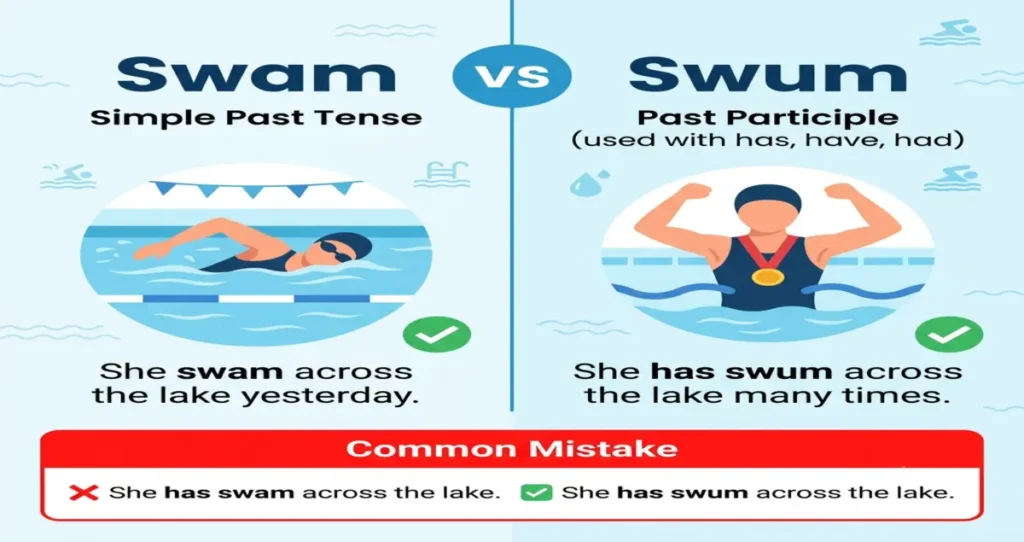
The grammar question that is asked by many ELLs and native speakers is “Should I write swam or swum?” Both words are derived from the verb “swim,” which is responsible for the confusion. They sound alike but have different uses.
The reason why people look for swam or swum is to get it right when writing in school, emails, social media postings, professional work, etc. The incorrect form can result in a sentence reading unnatural or even wrong. English verbs can change from one form to another and irregular verbs such as “swim” can be confusing.
Fortunately, it’s an easy one to understand once you get the grammar rule. Here is a guide to help you know when to use “swam” or when to use “swum.” Also real examples, common errors, spelling comparisons and English tips for American and British English.
By the end, you will be certain of which word to use and with confidence.
Swam or Swum – Quick Answer
The terms “Swam” and “swum” are both correct, but they are used differently.
- Swam = simple past tense
- The past participle is used with helping verbs to form the perfect tense of verbs.
Examples
- Yesterday, I swam in the lake.
- She has been a competitive swimmer for several years.
A simple trick:
- Use “swam” for past completed actions.
- Use swum after words that end in ‘ed’.
Read more:Hanged or Hung: What’s Difference and Which You Use
Swam or Swum, the origin of it.
These two words are both of Old English origin and derived from the verb “swimman.” Irregular verbs are verbs which change their form over time in the English language.
The verb forms are:
| Verb Form | Example |
| Base Verb | swim |
| Past Tense | swam |
| Past Participle | swum |
These forms evolved over a long period of time. Since the word changes rather than taking the “-ed” suffix, the English language retained many of the older Germanic patterns.
That is why we say:
- swim
- swam
- Swum
instead of:
- swim
- swimmed
- Swimmed
Read more:Laying or Lying: What’s Difference and Which One You Use
The spelling variations occur due to the different origins of the languages and the different sounds of the words in English.
Spelling British English vs American English
In British English there is not much difference in spelling between “swam” and “swum” whereas in American English, there is not much difference at all. The same forms are used by both countries.
The difference lies primarily in their use of grammar and in their way of speaking.
American English Examples
- He swam from one side of the pool to the other.
- They have swum previously.
British English Examples
- Yesterday, she swam in the sea.
- It’s been a lot of time since we swum there.
Comparison Table
| Usage | American English | British English |
| Past tense | swam | swam |
| Past participle | swum | swum |
| Formal writing | Common | Common |
| Everyday speech | Common | Common |
All grammar conventions are the same for both.
Which Spelling-Should You Use?
It’s important to use both words correctly, not where they are.
Use “Swam” When:
- Remarks about an activity that has already occurred.
- The sentence has no verb to help.
Examples
- Swam post-school.
- They went swimming in the river.
Use “Swum” When:
Correctly using verbs that help the main verbs, such as has, have, and had
Examples
- He swam this week every morning.
- We had swum prior to sunset.
Audience-Based Advice
| Audience | Recommended Usage |
| US readers | Follow standard grammar |
| UK readers | Follow standard grammar |
| Commonwealth countries | Same grammar applies |
| Global audience | Follow normal rules of standard English. |
The focus is not on the region, but on grammar.
Common mistakes with Swam or Swum
There are a lot of people who combine these words as they both refer to acts that have happened in the past.
Incorrect vs Correct Examples
| Incorrect | Correct |
| I have swam before. | I have swum before. |
| She swum yesterday.They had swam fast. | She swam yesterday.They had swum fast. |
| We swum in the lake. | We went for a swim in the lake. |
Easy Rule to Remember
- No helping verb (swam)
- Passive Voice: Helping verb present
Helping verbs include:
‘swam’ and ‘swum’ in everyday examples.
These words are used in the real world, in the following examples:
In Emails
- We went to the weekend for a swim.
- Our team has swum in many competitions.
In News Writing
- The swimmer ran a new record.
- She has been a swimmer since her youth.
On Social Media
- Today I swam with dolphins!
- We have swum every day this summer.
In Formal Writing
- The scientists swam the testing area.
- By the end of the experiment the participants had completed several laps of swimming.
Swam or Swum – Google Trends & Usage Data
The interest in searching for the phrase “swam or swum” is high in countries where the searcher uses and reads English very extensively.
Popular Regions
| Country | Common Search Interest |
| United States | High |
| United Kingdom | High |
| Canada | Medium |
| Australia | Medium |
| India | High |
This is the keyword that people typically look for:
- grammar help
- school assignments
- professional writing
- English learning
“Swam” is used in casual speech more frequently than in formal speeches; the simple past tense is very common. “Swum” is more likely to be used in more formal grammar lessons and in more advanced writing.
Swam is an unripe plantain, while Swum is a ripe plantain.
| Feature | Swam | Swum |
| Verb Type | Past tense | Past participle |
| Needs helping verb | No | Yes |
| Example | I swam yesterday. | I have swum before. |
| Common in speech | Very common | Common |
| Grammar role | Main verb | Part of verb phrase |
Frequently Asked Questions: FAQs about Swam or Swum
Is “swam” correct English?
Yes. The past tense of the verb “swim” is “swam.
Is ‘swum’ a grammatically correct word?
Yes. The past participle of the verb “swim” is “swum.”
Which is correct: “I have swam” or “I have swum”?
Correct answer: “I have swum.”
May I say that she swam yesterday?
No. The proper sentence to use is “She swam yesterday.”
Why is there a difference between “swam” and “swum”?
Many people get the grammar of both words confused, because they are both used for past actions.
Are there differences in the forms used in British English and American English?
No; both employ “swam” and “swum” as they use them.
What is the trick to recalling the distinction?
The simple rule is that:
- swam = simple past
- swum = after has/have/had
Conclusion
Learning the difference between “swam” and “swum” is not as difficult as you may imagine. Both are correct words but have different parts of speech. Swam is the simple past and swum is the past participle form of swim, which is used with helping verbs such as has, have, and had.
Here’s a little grammar that can make a huge difference when writing and speaking. Appropriate form helps your English be natural, clear and professional. It also avoids some of the mistakes that are commonly made by learners.
The simplest way to remember the rule:
Use “swam” alone.
Use ‘swum’ followed by a helping verb.
From emails to school essays, news articles to social media posts, selecting the right word enhances clarity and confidence. The rule applies to British English as well as American English, since grammar in both is the same.
With this knowledge, you can now use ‘swam’ and ‘swum’ in correct English.

I am Bahadar Ali, a professional content writer and the author behind GrammarDrive.com. I am passionate about making grammar simple and accessible for everyone. Through my writing, I aim to help learners and professionals communicate with clarity and confidence.