You’re composing an e-mail message. You type “I have started the project. There’s something wrong, but you don’t know what.If you’ve experienced it, then you aren’t the only one. Began and begun are two of the most words in English! They both share the word “begin” but they’re not used the same way.
It’s a simple mistake to make. English verbs vary from one form to another to indicate tense, and “begin” is one of those so-called ‘irregular’ verbs that does not follow the regular “-ed” pattern. Even the self-assured writer gets bogged down.
This guide will tell you when to use ‘began’ and when to use ‘began’, give you some easy examples, reveal some common errors, and give you a memory trick to help you remember when to use ‘began’ and when to use ‘began’. At the end, you will not regret a moment of your life.
The correct spelling of the word is begun.
Let’s get the short version.
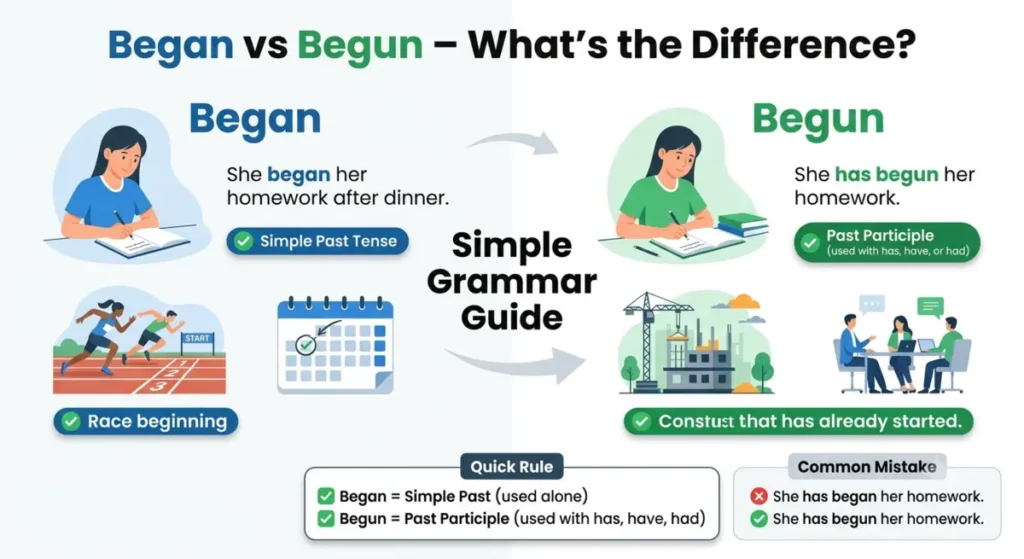
- Simple past of the verb “begin” is “began. Use with no helping verb. Example: She started to do homework at 6 p.m.
- The past participle of the verb “begin” is “began. Must always have a form of the verb (has, have, had or was/were). Example: She has started to do her homework.
Tip: If there is no helping verb in front of it, use began. Use begun if there is a helping verb in the sentence.
Meaning of Each Word
Began
The simple past tense of the verb “begin” is “began. Defines an action that began and ended in the past.
- Time: Past (simple past tense)
- When to use it: When referring to a past action that is finished, and there is no helping verb required.
- Common context: Storytelling, narration, describing past events
- Memory trick: Began stands alone, no helper is required — similar to a sentence standing alone.
Read more:Written vs Wrote: What’s the Difference? (+ Easy Examples)
Examples:
- The meeting was held at Noon.
- He started playing guitar this past year.
- As we were leaving the house, it started to rain.
Begun
The past participle of “begin” is “begun. It’s never used by itself. It is always followed by a helping verb (has, have, had, is, was, and being are examples).
- Part of speech: Verb (past participle)
- When it is used: Perfect tenses (present, past, or future) and/or passive voice.
- Common contexts: Formal writing, reports, describing actions related to the present or another past event.
- Memory trick: Begun requires a friend — it can’t go into a sentence by itself.
- Examples:
- She has begun her new job.
Before we arrived they had started dinner.
The redevelopment is to begin next week.
Read more:Drive or Driven The Simple Guide to Using These Words Correctly
Key Differences
| Feature | Began | Begun |
| Meaning | The simple past of the verb ‘begin’. | The past participle of the verb “begin”. |
| Part of Speech | Verb (past tense) | Verb (past participle) |
| Common Usage | Standalone past action | Used with has/have/had/was/were |
| Example | He began the race. | He has started the competition. |
| Easy Memory Trick | Stands alone | Needs a helper verb |
Word Origin (Etymology)
The origin of “begin” is the Old English ‘be- + ginnan’ meaning ‘to open’ or ‘to start’. It belongs to a handful of verbs which do not form their past tense and past participle regularly by adding the suffix “-ed.
This verb was broken up over time into three separate forms: begin (present), began (past), and begun (past participle). This is like the other irregular verbs ring/rang/rung, sing/sang/sung, etc.
Those ‘unpredictable patterns’ are confusing for many English learners, and even native speakers get . Hence, the ambiguity as to began vs. begun persists in modern usage.
British English vs American English
Fortunately there is no difference between British and American English in this regard: began and begun. Both use:
- Starts the use of the simple past tense
- The way that uses begun as the past participle of the verb, and a helping verb.
| Feature | British English | American English |
| Spelling | began / begun | began / begun |
| Pronunciation | /bɪˈɡæn/ / /bɪˈɡʌn/ | /bɪˈɡæn/ / /bɪˈɡʌn/ |
| Preference | Same rule applies | Same rule applies |
| Example | She began speaking. | She began speaking. |
The same rule can be applied in any English you are writing.
Which One Do You Use?
The choice of the right word depends on the structure of the sentence, and not on your audience or your writing style. Nevertheless, let’s see what it means in various situations:
American readers: No regional exceptions to the same begun/began rule.
British readers: No different here.
International students: If English is a second language: look for the helping verb – it’s your signpost.
Academic writing: The details are important. Be sure to review for the presence of helping verbs, then select begun.
Business writing: Common and correct: The project has begun.
Everyday communication: Texts and casual emails: Usually simple completed actions are described: hence, the word ‘began’.
Common Mistakes
1❌ I have began the report. ✅ I have begun the report. Why: “Have” is a helping verb, so it requires “begin” not “begun”.
2❌ She begun her speech. ✅ She began her speech. Why: The simple past form of the verb began is correct in this case because there is no helping verb.
3❌ They had began eating when we arrived. ✅ They had begun eating when we arrived. Why: The past participle begun is needed with had.
4❌ The show has began. ✅ The show has begun. Why: Has always is followed by begun.
5❌ In 2020 he started to work here.✅ In 2020 he started his work here. Why: There is no helping verb, use the simple past tense, began.
6❌ Last month we started up the project. ✅ Last month, we started our project. Why: This is wrongly mixed up: you can only use simple past with the word “began”.
7❌ It has just begin. ✅ It has just begun. Why: “Begin” is the base form. After “has,” you must use “has begun” and then add the rest of the sentence.
8❌ Today’s class started early. ✅ Today learning has started early. Why: There is no helper verb, so the verb should be in the present tense, in this case, began.
9❌ I had begin my homework already. ✅ I had begun my homework already. Why: “Had” is a helping verb, requiring begun.
10❌ She has began to notice the change. ✅ She has begun to notice the change. Why: “Has” indicates the past participle form, begun.
Everyday Examples
- Phone calls: “The induction process has started.”
- Writing in schools: “It was a dark and stormy night and the wind was blowing strongly.
- Business communication: “Last week, negotiations with the company started.
- News: “Now, recovery efforts have begun in flooded area, officials say.
- Books: “It was the best of times…the trip started long before anyone knew.
- Instagram: “Now I have started my 30 day fitness challenge! 💪”
- Practice conversations: “Has the movie started yet?” / “Yeah, the movie started 5 minutes ago.
Grammar Tips
- Sentence position: Began is frequently used at the beginning of a sentence (She began…). Begun is typically preceded by a helping verb: She has begun…
- Common collocations: “has begun” “have begun” “had begun” “newly begun” “just begun.
- Punctuation: There are no special rules to follow as far as punctuation is concerned, but watch your verb pairing.
- Verb forms: Know the three basic forms: begin (present) / began (simple past) / begun (past participle). Only begun pairs with a helper verb.
Easy Memory Tricks
Consider this: “Begun” walks no alone. It always requires a verb with a buddy such as has, have or had.
“Began” is independent. Isn’t being interpreted as part of a sentence.
Another tip: visualize the alphabet. A is before U — and history repeats itself, beginning (with an “a”) appears first alone in the timeline, and begun (with a “u”) appears later, needing support.
Google Trends & Usage
Both started and started are very commonly searched, as this is a common English grammar mistake all over the world. Many other languages lack the distinction between past tense and past participle, and it is more likely to cause confusion for ELLs.
The user intent behind these queries is typically one of the two: either they are checking out the proper form a word is in with respect to something they are writing at the time, or they are learning the grammar of the English language. This guide directly deals with both intents.
Related Words
There are many words in English that do the same trick and can baffle writers. Here are some of the ones to know:
- Affect vs Effect: Affect is generally a verb (meaning ‘to influence’); Effect is generally a noun (meaning ‘a result’).
- Accept vs Except: Accept means “to receive or agree to,” except means “excluding.
- Principal vs Principle: Principal means a person in charge or something that is of primary importance, principle means a basic rule or belief.
Frequently Asked Questions
1. Does begun ever appear without one of the helping verbs? No. “Begun” requires an auxiliary verb such as has, have, had, is or was. It cannot be used by itself.
2. Does the word ‘began’ ever combine with a helping verb? No, “Began” is a simple past tense verb and is used on its own. It is very common to use it with “has”, “have”, or “had”.
3. What is the correct answer for this sentence: “has began” or “has begun”? The correct verb phrase is “has begun. “Has” is a helping verb and needs to go with the past participle, “begun.”
4.Why are there two English tenses, ‘began’ and ‘began’? The verb “begin” is irregular, so it does not follow the regular rules for forming the past tense. Rather, it uses two different forms, one simple past (began) and one past participle (begun).
5. Is it possible to use “begun” in everyday speech? Yes, as long as it is coupled with a helping verb, such as, “I’ve started” or “we had begun. It’s grammatically correct in any place.
6. What is the verb pattern in the word “began”? Yes. The normal irregular conjugation: start (present), started (simple past), started (past participle).
7. Does the rule apply to questions or negatives? No. The same applies. For instance: “Has the show begun? / It hasn’t begun yet” – both sentences contain the word “begun” due to the helping verbs “has” and “hasn’t.
8. What’s the difference between began and begun? Not in meaning — both have to do with initiating something. This is only a grammatical distinction: the structure of the sentence.
Key Takeaways
- Is the simple past tense of begin, and is used on its own in a sentence.
- The past participle begun is always accompanied by a helping verb (has, have, had, is, was).
- The different uses of British and American English are not relevant.
- The most frequent error is to use “began” before a helping verb or to use “begun” without a helping verb.
- First, take a quick look: Is there a helping verb? If it does exist, use begun. If not, use began.
Conclusion
Both started and started are derived from the same verb but they mean different things in the sentence. Initiated and completed an event in the past without help. A helping verb (has, have, had) always goes with Begun.
The errors are generally common, but the solution is easy: look for a helping verb before you write your sentence. No helper? Use began. Spotted a helper? Use begun.
This rule will prevent you from making the mistake, be it when you’re writing an email, a school essay or a quick text to a friend. Follow the pattern and never get them mixed up again.

I am Bahadar Ali, a professional content writer and the author behind GrammarDrive.com. I am passionate about making grammar simple and accessible for everyone. Through my writing, I aim to help learners and professionals communicate with clarity and confidence.