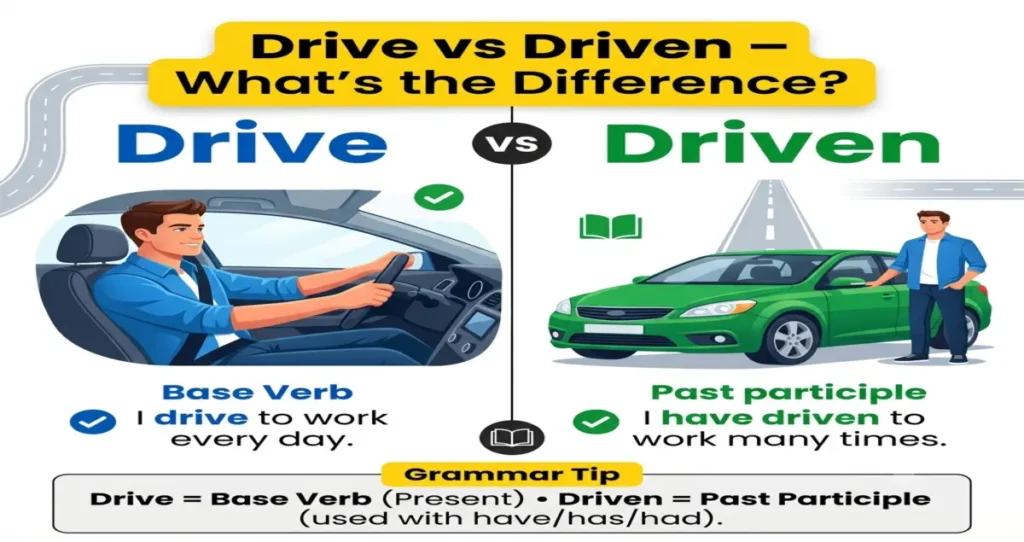
At any point in your writing, have you asked yourself, “Should I use drive or driven here?” You’re not alone. These two words are similar because of sharing the same verb; they serve different purposes in a sentence. They are a source of confusion for many English learners, students, bloggers and even native speakers.
The confusion typically occurs when drive is used as a verb in the base form, and driven is in the past participle form. Having an idea when to use each one can help your writing sound more natural and grammatically correct.
Whether you are composing an email, posting on social media, working on schoolwork, or a professional email, the form you use is important.
In this guide, you will learn what the difference is between drive and driven in simple words. Their meanings, history, grammar rules, real-life examples, common mistakes and usage trends worldwide will be explained. By the end, you will know which word to use, in every situation!
Quick Answer
The answer is very easy:
- The basic form (or root) of the verb is drive.
- The past participle form of driven, which is used with helping verbs like has, have, had, is, was, were, and been.
Examples
✅ I go to work every day.
✅ She likes to drive fast.
✅ He’s travelled all over the country.
✅ After 6 hours they stopped.
❌ I have drive to school.
✅ I have driven to school.
Read more:Chose or Chosen what is the difference and which one you use
Quick Comparison
| Word | Part of Speech | Example |
| Drive | Base verb | I drive to work every day in the morning. |
| Driven | Past participle | This is a car that she has driven before. |
The Origin of Drive or Driven
Drive derives from the Old English word drīfan, meaning push forward, force or guide. They used it hundreds of years ago when they were referring to moving animals, carts or people.
The concept evolved into something over time. Drive today can refer to driving a vehicle, giving someone motivation or energizing a machine.
The past participle form of drive, driven (of motivation) evolved the meaning of driven. Past participles are used in English to create perfect tenses and passive voice.
Read more:Sung or Sang which word you use from these
For example:
- I drive every day.
- Yesterday I drove to work.
- I have driven on that road numerous times.
All three forms of this verb are the same:
- Base: drive
- Past tense: drove
- Past participle: driven
British English vs American English Spelling
Good news! The spelling of British English is the same as in American English.
Both varieties use:
- Drive
- Drove
- Driven
The same grammar rules are in effect.
Examples
American English
- I drive a truck.
- She has gone by car all over Texas.
British English
- I drive a lorry.
- He’s been crossing England in his car.
There is no change in the verb, but there is a change in the vocabulary.
Comparison Table
| Feature | American English | British English |
| Base verb | Drive | Drive |
| Past tense | Drove | Drove |
| Past participle | Driven | Driven |
| Spelling | Same | Same |
| Grammar | Same | Same |
Which Spelling to Use?
Both English varieties are spelt the same way, so you only need to consider grammar.
Drive if necessary:
- Present tense
- Infinitive
- Commands
Examples:
- I drive every day.
- Can you drive?
- Please drive carefully.
When using after the helping verbs use driven.
Examples:
- This is a route that I have driven.
- She has been behind the wheel of numerous vehicles.
- All night long they had been driving.
Audience Guide
| Audience | Best Choice |
| United States | Drive / Driven |
| United Kingdom | Drive / Driven |
| Canada | Drive / Driven |
| Australia | Drive / Driven |
| International audience | Drive / Driven |
Drive or Driven – Common Mistakes
Common grammar errors occur with many learners.
Mistake 1
❌ I have drive to work.
✅ I have travelled to my place of work.
Mistake 2
❌ She driven home yesterday.
✅ She drove home yesterday.
Mistake 3
✅ They went to the airport yesterday by car.
✅ They went to the airport yesterday.
Mistake 4
✅ He is driving the car.
✅ He is driving a car.
Mistake 5
❌ We had drove home.
✅ We had driven home.
drive or driven in everyday Examples
Here are some examples from your daily writing.
- My answer is “I go to work by car every weekday.My response to this is “I drive to work every weekday.
- “You’ve been driving to your place before.”
News
The company will contribute to the economic development.
The rescue team has brought supplies to the affected area.
Social Media
I like driving along the coast.
This month I have driven more than 1,000 miles!
Formal Writing
The results have a direct impact on the future decisions of the business.
The project has been designed based on the customer’s feedback.
Drive or Driven Google Trends & Usage Data.
These are common English verbs and therefore search interest is high for drive and driven.
People often search:
- Drive vs driven
- Have driven or driven
- Drive meaning
- Driven meaning
- verb (used with an object) to urge on in an effort to stretch or push.
- Drive grammar
Popular Countries
- United States
- United Kingdom
- Canada
- Australia
- India
- Pakistan
Students, English learners, writers, and professionals are the primary searchers looking to improve their grammar.
Driven vs Drive Comparison Table
| Feature | Drive | Driven |
| Meaning | Base form of the verb (infinitives): | Past participle |
| Verb Form | Present/Base | Past participle |
| Used Alone | Yes | No |
| Used with Helping VerbExample | NoI drive daily. | YesI’ve been driving every day. |
| Common Use | Present actions | The use of perfect tenses and passive voice. |
FAQs
Should it be have drive or have driven?
Have is the auxiliary verb and driven is the past participle as in have driven away.
What is the verb in the past tense for the word “drive”?
Drive is a irregular verb, its past tense is drove.
Example:
Yesterday I drove to work.
What’s the past participle for the verb drive?
The past participle is “driven.
Example:
I’ve been on that street!
May I use the word ‘I have driven’?
No. The right sentence is:
I have driven.
How do people misunderstand drive and driven?
They are all forms of the same irregular verb. English irregular verbs are not just verbs with -ed added to them, and therefore are more difficult to remember.
Is “driven” always used with a helping verb?
Usually, yes.
Examples:
- has driven
- have driven
- had driven
- been driven
Which word occurs more often?
The word drive is used in the present tense, commands and infinitives and this makes it show up more frequently. Driven is used in perfect tenses and passive sentences.
Conclusion
It’s easier to understand the difference between drive and driven than it sounds. The trick is to remember that the verb’s base form is drive and the past participle is driven. When there is no helping verb, you will typically use drive or another verb (drived, driven, will drive, etc.). When you have a sentence that contains an instance of the verbs“has,” “have,” “had,” “is,” “was,” or “been,” driven is frequently the best option.
The pattern of these forms is the same as that of most irregular English verbs, and by learning these forms, you will learn other tricky verbs. If you have any doubt, try to determine if your sentence is present, simple past or perfect tense. That is one sure step that will, more often than not, put you on the right track.
After practicing the difference and using examples from everyday life, it will be natural to know the difference between drive and driven. Use this guide whenever and wherever you need a quick reminder, and you’ll be able to write with more confidence and accuracy.

I am Arshman Ali a professional English writer and English professor with a passion for language and a commitment to excellence. I bring precision and clarity to my writing, and the same high standards into my classroom. For me, language is not just a profession it is a purpose.