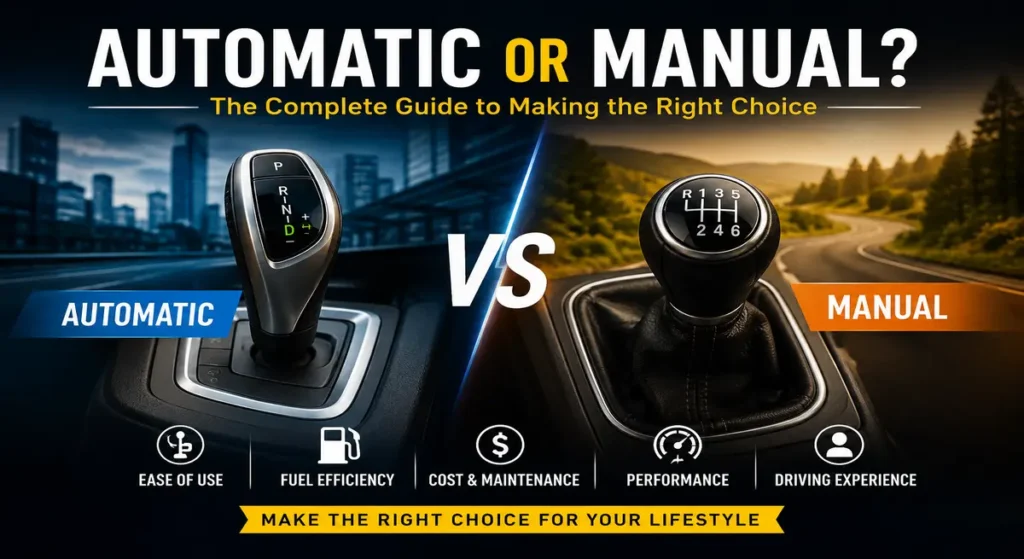
Buying a car often stops at one question: automatic or manual? People type this phrase into Google every day, and most of them are not doing research for fun. They are standing in a dealership, filling out a driving school form, or trying to settle an argument with a partner. The phrase hides a mix of smaller questions: Which is easier to drive? Which one is cheaper? Which one should a new driver learn on? What term is even correct in my country?
This confusion is real. In the US, “manual” often gets called a “stick shift.” In the UK, it is simply “manual” or a “manual gearbox.” New drivers get confused about which license type they need. Buyers get confused about resale value, fuel use, and long-term cost. This article answers all of it in plain language. You will get a quick answer first, then a full breakdown of the history, the regional terms, common mistakes, real-world examples, and search data. By the end, you will know exactly which one fits your needs.
Automatic or Manual : Quick Answer
Automatic transmissions shift gears for you. You just use the gas and brake. Manual transmissions require you to shift gears yourself using a clutch pedal and gear stick.
Choose automatic if you want ease, comfort, and less effort in traffic. Choose manual if you want more control, lower repair costs over time, and a more engaging drive.
Example: A daily commuter stuck in city traffic usually prefers automatic. A driving enthusiast on open roads often prefers manual.
The Origin of “Automatic” and “Manual”
The word manual comes from the Latin word manualis, meaning “of the hand.” This makes sense, since a manual transmission needs hand and foot coordination to shift gears.
The word automatic comes from the Greek word automatos, meaning “acting of itself.” Automatic transmissions were built to remove the driver’s manual effort, letting the car “shift itself.”
Cars started mostly manual in the early 1900s. Automatic transmissions became common in the US from the 1940s onward. Over time, US drivers moved toward automatic cars, while manual transmissions stayed more common in Europe, Asia, and parts of Africa. This is not a spelling difference. It is a difference in driving culture and terminology, which we cover next.
British English vs American English: Terminology Differences
There is no spelling difference between “automatic” and “manual” in British and American English. Both spell the words the same way. The difference is in the terms people use in everyday speech.
| Term | American English | British English |
| Manual transmission | Stick shift / manual | Manual / manual gearbox |
| Automatic transmission | Automatic / auto | Automatic / auto |
| Gear stick | Gear shift / shifter | Gear stick / gear lever |
| Clutch pedal | Clutch | Clutch |
| Driving test category | Manual vs automatic license | Manual vs automatic license |
Americans are more likely to say “stick shift” in casual conversation. British and Commonwealth speakers usually just say “manual.” Both are correct. Neither is wrong.
Which One Should You Use?
This depends on two things: the words you use, and the transmission you actually choose.
For terminology:
- US audience: “Stick shift” and “manual” are both fine. “Automatic” works everywhere.
- UK/Commonwealth audience: Use “manual” rather than “stick shift,” which can sound unfamiliar.
- Global or SEO content: Use “manual” as the primary term, since it is understood worldwide.
For choosing a car:
- New drivers who want simplicity: automatic.
- Drivers in heavy city traffic: automatic.
- Drivers who want lower long-term repair costs: manual.
- Drivers who enjoy control and performance: manual.
- Drivers in countries where manual is standard (much of Europe, Asia, Africa): manual, since automatics can cost more to buy and service.
Common Mistakes with Automatic or Manual
- Thinking manual cars are always cheaper to buy. This depends on the market. In the US, manuals are often cheaper. In parts of Europe, manuals are the default and automatics cost more.
- Assuming automatic means “no clutch at all.” Some automatics still use a clutch internally (like dual-clutch systems), even though the driver never touches one.
- Confusing “semi-automatic” with “automatic.” Semi-automatic cars still need some manual gear input, just without a clutch pedal.
- Believing manual cars always get better fuel economy. Modern automatics often match or beat manual fuel efficiency.
- Mixing up license types. In many countries, passing your test in an automatic means you cannot legally drive a manual car until you retest.
Automatic or Manual in Everyday Examples
In emails (car dealership to buyer): “Thanks for your interest in the 2024 sedan. We have both automatic and manual versions in stock. The manual trim saves you about $1,500.”
In news articles: “Automakers report a steady drop in manual transmission sales, with automatics now making up over 96% of new car purchases in the US.”
On social media: “Just passed my driving test in a manual. It felt like unlocking a secret car cheat code.” or “Automatic gang for life, my left leg thanks me.”
In formal writing (car reviews, manuals, contracts): “This vehicle is available with a six-speed manual transmission or an eight-speed automatic transmission. Fuel economy figures differ by configuration.”
In driving school forms: “Please select your preferred transmission type for training: Automatic ☐ Manual ☐”
These examples show the same core words used differently depending on tone: casual online, plain in emails, and precise in formal or technical writing.
Automatic or Manual : Google Trends & Usage Data
Search interest in “automatic or manual” spikes around a few predictable moments: new driver season, back-to-school periods, and car-buying seasons at the end of the year. The pattern differs by country.
- United States: Searches skew toward “automatic vs manual,” with strong interest in fuel economy, resale value, and which is “easier” for new drivers. Automatic dominates the actual car market here, so many searches are about confirming that choice rather than debating it.
- United Kingdom and Commonwealth countries (Canada, Australia, India): Searches lean toward “manual vs automatic,” and interest is higher overall, since manual cars remain common and many driving tests are still taken in manual vehicles.
- Europe and parts of Asia: Manual is still the default in many markets, so searches often focus on where to find an automatic, rather than whether to choose manual.
| Variation | Common Region | Typical Search Intent |
| Automatic or manual | US, global | General comparison, buying decision |
| Manual vs automatic | UK, Commonwealth | Comparison, driving test prep |
| Stick shift vs automatic | US (casual) | Casual comparison, enthusiast content |
| Auto vs manual | UK, Australia, informal | Quick comparison, texting/chat context |
| Automatic transmission vs manual transmission | Global, formal | Technical or professional content |
FAQs
1. Is automatic or manual easier for beginners? Automatic is easier for most beginners, since it removes clutch control and gear shifting from the learning process.
2. Is manual cheaper than automatic? Often, yes, in markets like the US. In markets where manual is standard, like much of Europe, the price gap can shrink or reverse.
3. Do manual cars really get better gas mileage? Not anymore, in most cases. Modern automatic transmissions, especially dual-clutch and CVT types, often match or beat manual fuel economy.
4. Can I drive a manual car if I only passed my test in automatic? In many countries, no. You may need to retake your test in a manual vehicle before it becomes legal.
5. Is “stick shift” the same as “manual”? Yes. “Stick shift” is the common American term for a manual transmission car.
6. Which is better for city driving, automatic or manual? Automatic, generally. Constant stopping and starting in traffic is easier without a clutch pedal.
7. Are manual cars disappearing? In the US, yes, largely. In parts of Europe, Asia, and Africa, manuals remain common and are not disappearing at the same rate.
Conclusion
Automatic or manual is not just a spelling question. Both words are spelled the same in British and American English, but the terms used around them differ, especially with the American habit of saying “stick shift.” The real decision usually comes down to comfort versus control. Automatic transmissions suit new drivers, city commuters, and anyone who wants a simpler drive. Manual transmissions suit drivers who want lower long-term repair costs, more control, and a more engaging experience, and they remain the standard in many countries outside the US.
When writing or speaking about this topic, match your terms to your audience: “manual” for a global or UK audience, “stick shift” for a casual US audience, and “automatic” or “auto” almost anywhere. When choosing an actual car, base your decision on where you drive, how you drive, and what your local market makes available and affordable. Understanding both the words and the mechanics behind them means you will never be confused by this question again.

I am Arshman Ali a professional English writer and English professor with a passion for language and a commitment to excellence. I bring precision and clarity to my writing, and the same high standards into my classroom. For me, language is not just a profession it is a purpose.