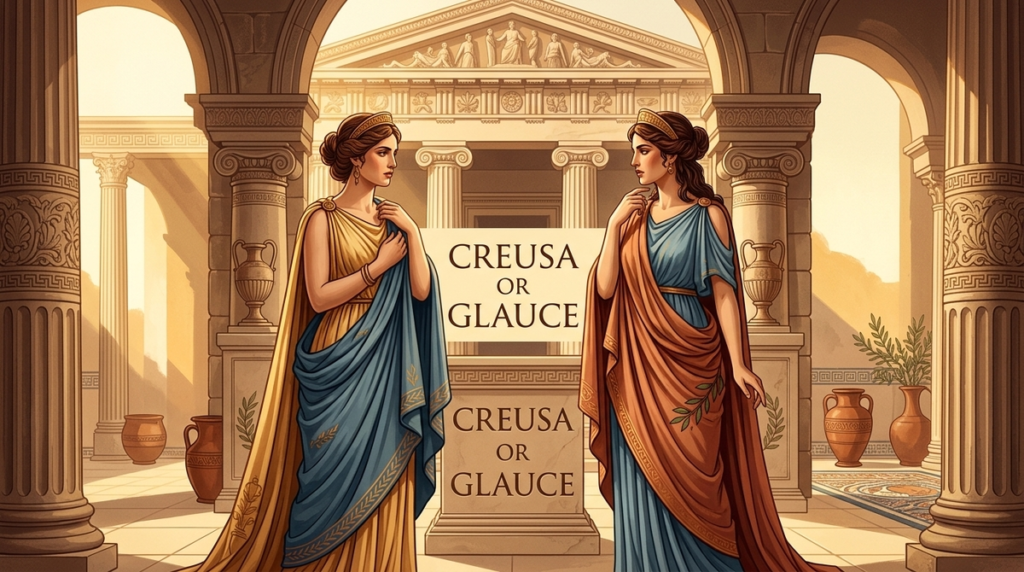
When readers search “Creusa or Glauce,” they often wonder whether these names describe two different women or two versions of the same character. The confusion mainly comes from the story of Medea and Jason, where different ancient and later sources use different names for Jason’s Corinthian bride.
In the story associated with Euripides’ Medea, Jason leaves Medea and marries the daughter of King Creon of Corinth. A surviving account by Apollodorus calls this woman Glauce. (Perseus Digital Library) Other literary traditions call her Creusa, and major reference collections identify Creusa and Glauce as names associated with the same Corinthian character. (Getty)
So, if you are checking a spelling, the key point is simple: Creusa and Glauce are not British and American spellings of the same word. They are alternate names used for the same mythological character in different traditions and works.
This guide explains the difference, the history behind both names, common mistakes, and which form you should use in different contexts.
Creusa or Glauce : Quick Answer
Creusa and Glauce can refer to the same woman: the daughter of King Creon of Corinth and the woman Jason marries after leaving Medea.
The important distinction is that these are alternate names, not spelling variants like color and colour.
| Name | What it refers to | Common context |
| Creusa | Corinthian princess, daughter of Creon | Latin and later literary traditions |
| Glauce | The same Corinthian princess in many sources | Greek mythology and ancient sources |
| Glauke | Greek-form transliteration | Ancient Greek contexts |
| Kreousa | Transliteration of Greek Κρέουσα | Classical Greek studies |
Apollodorus specifically calls Creon’s daughter Glauce and describes her marriage to Jason. (Perseus Digital Library) The Getty’s art and cultural database, however, lists Creusa as the preferred English name for the character and gives Glauce as another name. (Getty)
Simple example
- Jason married Glauce.
- Jason married Creusa.
Both statements can describe the Corinthian bride in the Medea tradition, depending on the source being discussed.
One important warning: Greek mythology has several characters named Creusa and Glauce. The names do not always refer to Jason’s bride. (Wikipedia)
The Origin of Creusa or Glauce
The two names come from different Greek forms.
Creusa
Creusa comes from the Greek Κρέουσα (Kreousa). One name reference traces it to a Greek root associated with a ruler or lord and gives the sense of “princess.” (Behind the Name)
The spelling Creusa represents a Latinized form of the Greek name.
The name also belongs to other mythological figures. For example, Euripides uses Creusa for a different character in Ion, the daughter of Erechtheus of Athens. (Perseus Digital Library)
That means readers should always check the character’s family and story before assuming which Creusa a text means.
Glauce
Glauce represents the Greek name Γλαυκή (Glaukē/Glauke) in a Latinized form. The name connects with the Greek word glaukos, which carries meanings related to blue-gray, bright, or gleaming colors. (Alatius)
The name appears in several Greek myths. For example, Greek mythology includes Glauce among the Nereids, while another Glauce appears among Arcadian nymphs. (Theoi)
The Corinthian Glauce became especially associated with the story of Jason and Medea.
Why do both names appear?
Ancient mythology passed through many poets, playwrights, historians, translators, and later writers. They did not always use the same names.
A particularly useful source is the Metropolitan Opera’s educational guide to Medea. It notes that Glauce is often called Creusa in English, while Euripides’ play itself does not give Jason’s bride a personal name. (Metropolitan Opera)
So the difference developed through literary tradition and naming practice, not through British-versus-American spelling.
British English vs American English Spelling
This is an important point for SEO readers.
Creusa vs Glauce is not a British English versus American English spelling difference.
British and American English do not normally change Creusa into Glauce or vice versa.
Instead, the difference comes from different naming traditions, translations, transliterations, and literary sources.
For example:
| Form | Type | Main use |
| Creusa | Latinized name | English and Latin literary traditions |
| Glauce | Latinized form | English translations and classical sources |
| Glauke | Greek-based form | Classical Greek studies |
| Kreousa | Transliteration | Greek-language scholarship |
| Κρέουσα | Ancient Greek script | Original Greek form |
The Getty records Kreousa, Creúsa, Creusa, and Glauce among the names associated with the Corinthian character. (Getty)
British English
British English may use either Creusa or Glauce, depending on the book, translation, or academic source.
American English
American English also uses both forms. The choice usually depends on the edition or tradition being followed.
Therefore, you should not treat this as a normal spelling rule such as:
British: colour
American: color
Instead:
Creusa ↔ Glauce = alternate names/traditions
Which Spelling Should You Use?
Your choice should depend on your source and audience.
For a general mythology article
Use Creusa or Glauce together when you want readers to understand that the names can identify the same Corinthian character.
For example:
Creusa (also called Glauce) was the daughter of King Creon of Corinth.
This approach reduces confusion.
For a discussion of Apollodorus
Use Glauce, because Apollodorus calls Creon’s daughter Glauce. (Perseus Digital Library)
For a literary discussion of later Latin works
Creusa may appear more often. The Getty’s classical-art record, for example, uses Creusa as the preferred English name while listing Glauce as another name. (Getty)
For classical Greek studies
You may see forms such as Kreousa or Glauke because scholars often preserve or transliterate Greek forms.
For SEO content
A useful approach is to include both terms naturally:
“Creusa or Glauce: Are They the Same Character?”
This lets you answer readers who search either name.
Common Mistakes with Creusa or Glauce
1. Treating them as British and American spellings
Incorrect:
“Creusa is the British spelling and Glauce is the American spelling.”
Correct:
They are alternate names associated with the Corinthian bride of Jason in different traditions.
2. Assuming every Creusa is Jason’s wife
Greek mythology contains several characters named Creusa. Euripides’ Ion, for example, features another Creusa, the daughter of Erechtheus. (Perseus Digital Library)
3. Assuming every Glauce is Jason’s bride
Greek mythology also contains several Glauces. Some are nymphs or other mythological figures. (Theoi)
4. Calling Glauke an English spelling mistake
Glauke reflects the Greek form more closely. It is not simply a misspelling of Glauce.
5. Confusing Creusa with Creon
Creon is the king of Corinth and the father of the Corinthian bride.
Creusa is one of the names used for his daughter in later traditions.
6. Assuming Euripides clearly names her Creusa
The surviving Medea tradition is more complicated. The Metropolitan Opera’s guide notes that Euripides’ play does not actually give Jason’s bride a personal name. (Metropolitan Opera)
Creusa or Glauce in Everyday Examples
These names appear in different types of writing, especially mythology, classics, literature, opera, and educational material.
In an email
I am writing a paper on Creusa, also known as Glauce, in the Medea tradition.
In a news or culture article
The opera presents Glauce as Jason’s new bride and Medea’s rival.
On social media
I just finished reading about Creusa and Medea. Greek mythology has some very complicated family stories!
In formal writing
Sources differ in their naming of Jason’s Corinthian bride, with Glauce and Creusa both appearing in the tradition.
In an academic essay
Apollodorus refers to the Corinthian princess as Glauce, while later literary traditions use the name Creusa. (Perseus Digital Library)
That last format works well because it identifies the source tradition instead of presenting one name as universally correct.
Creusa or Glauce : Comparison Table
| Feature | Creusa | Glauce |
| Greek connection | Κρέουσα | Γλαυκή / Glaukē |
| English form | Creusa | Glauce |
| Greek-based form | Kreousa | Glauke |
| Meaning/origin | Linked with a ruler/lord; commonly given as “princess” | Linked with glaukos, blue-gray/gleaming |
| Associated with Jason? | Yes, in relevant traditions | Yes |
| Daughter of Creon? | Yes, for the Corinthian character | Yes |
| Wife of Jason? | Yes, in relevant traditions | Yes |
| Same as the Corinthian Glauce? | In relevant traditions, yes | Yes |
| British vs American spelling? | No | No |
| Other mythological figures with this name? | Yes | Yes |
Getty’s classical-art record specifically connects the Corinthian Creusa with the alternate name Glauce. (Getty)
Creusa or Glauce : Google Trends & Usage Data
Search interest around these names can be difficult to interpret because both names refer to multiple mythological characters.
For example, Creusa can refer to Jason’s Corinthian bride, the daughter of Erechtheus, the wife of Aeneas, and other figures. (Wikipedia) Likewise, Glauce appears in several different myths. (Wikipedia)
This means a search for either name does not necessarily measure interest in the Jason-and-Medea story alone.
Google Trends also measures relative search interest, rather than publishing a simple worldwide count of searches for these names. As a result, a trend comparison should specify the country, time range, and search category.
For SEO, related searches can include:
- Creusa or Glauce
- Creusa Medea
- Glauce Medea
- Glauce Greek mythology
- Creusa daughter of Creon
- Jason and Creusa
- Jason and Glauce
- Glauke meaning
- Kreousa Greek mythology
Using these related terms naturally can help an article answer several forms of the same search intent.
FAQs About Creusa or Glauce
1. Are Creusa and Glauce the same person?
In the Jason and Medea tradition, Creusa and Glauce can refer to the same Corinthian princess, the daughter of King Creon and Jason’s new bride. (Getty)
2. Is Creusa the wife of Jason?
Yes, in traditions that call the Corinthian princess Creusa, she becomes Jason’s wife after he leaves Medea.
3. Is Glauce Jason’s wife?
Yes. Apollodorus calls Creon’s daughter Glauce and says that Jason marries her after leaving Medea. (Perseus Digital Library)
4. Is Glauce another name for Creusa?
For Jason’s Corinthian bride, yes. Several classical and later sources associate the two names. (Getty)
5. Which name does Euripides use?
The surviving Medea does not give Jason’s bride a personal name. Later traditions call her Glauce or Creusa. (Metropolitan Opera)
6. Is Creusa a Greek name?
Yes. Creusa is a Latinized form of the Greek Κρέουσα (Kreousa). (Behind the Name)
7. Is Glauce a Greek name?
Yes. Glauce represents the Latinized form of the Greek Glaukē, and the name appears in several Greek myths. (Behind the Name)
8. Is Creusa or Glauce the correct spelling?
Both are established forms, but they are not simply spelling variants. They reflect different naming traditions for the Corinthian character.
Conclusion
Creusa or Glauce is a common point of confusion for readers studying Greek mythology, especially the story of Jason and Medea. The key fact is that the two names can identify the same Corinthian princess, the daughter of King Creon and Jason’s new bride.
Ancient and later sources do not always use the same name. Apollodorus calls her Glauce, while other traditions use Creusa. (Perseus Digital Library) The Metropolitan Opera’s educational material also explains that English sources often call her Creusa, while Euripides’ Medea itself does not give her a personal name. (Metropolitan Opera)
The biggest mistake is to treat Creusa vs Glauce as a British-versus-American spelling issue. They are better understood as alternate names shaped by Greek, Latin, translation, and literary traditions.
For general readers, writing “Creusa (also called Glauce)” provides the clearest answer. For academic work, follow the name used by the specific primary source or translation you are discussing. Always check the character’s identity because Greek mythology contains several different figures named Creusa and Glauce.

I am Arshman Ali a professional English writer and English professor with a passion for language and a commitment to excellence. I bring precision and clarity to my writing, and the same high standards into my classroom. For me, language is not just a profession it is a purpose.