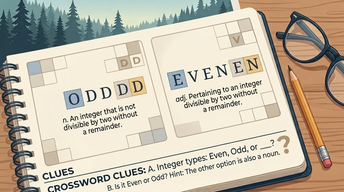
If you have searched for “even odd or neither”, you may be trying to solve a crossword clue, understand a math question, or learn how functions are classified. The phrase appears often in algebra and precalculus, where students must decide whether a function is even, odd, or neither. (Khan Academy)
The phrase can also appear as a crossword-style clue. In that setting, the exact answer depends on the number of letters and the surrounding clues. There is not one universal crossword answer for every puzzle.
In mathematics, however, the meaning is clear. An even function satisfies f(−x)=f(x)f(-x)=f(x). An odd function satisfies f(−x)=−f(x)f(-x)=-f(x). If neither rule works for every value in the domain, the function is neither. (Khan Academy)
This guide explains the phrase, its meaning, common crossword possibilities, mathematical rules, examples, common mistakes, and the difference between American and British English usage.
Even Odd or Neither : Quick Answer
For a crossword clue, “even, odd, or neither” does not have one fixed answer. You need the crossword’s letter count and crossing letters.
For a math question, “even, odd, or neither” asks you to classify a function based on symmetry.
| Type | Rule | Graph symmetry |
| Even | f(−x)=f(x)f(-x)=f(x) | Y-axis |
| Odd | f(−x)=−f(x)f(-x)=-f(x) | Origin |
| Neither | Neither rule works | No required symmetry |
For example:
- f(x)=x2f(x)=x^2 is even.
- f(x)=x3f(x)=x^3 is odd.
- f(x)=x2+xf(x)=x^2+x is neither.
A simple way to test a function is to replace every xx with −x-x, simplify, and compare the result with the original function. (Khan Academy)
The Origin of Even Odd or Neither
The phrase even or odd comes from the mathematical idea of parity. Parity describes whether an integer is divisible by 2.
The terms later became useful when mathematicians studied the symmetry of functions. An even function keeps the same output when xx changes to −x-x:
f(−x)=f(x)f(-x)=f(x)
An odd function changes the sign of its output:
f(−x)=−f(x)f(-x)=-f(x)
These definitions connect algebra with geometry. Even functions have graphs that mirror across the y-axis, while odd functions have graphs with rotational symmetry about the origin. (eCampusOntario Pressbooks)
The word neither simply means that the function meets neither condition.
For example:
f(x)=x2+xf(x)=x^2+x
gives:
f(−x)=x2−xf(-x)=x^2-x
That result is not equal to f(x)f(x) or −f(x)-f(x), so the function is neither even nor odd.
Is “Even Odd or Neither” a Spelling Question?
No. Unlike terms such as catalogue and catalog, even, odd, and neither do not represent British and American spelling alternatives.
The phrase has the same basic spelling in both forms of English. The main issue is its mathematical meaning or its use as a crossword clue.
British English vs American English Spelling
There is almost no spelling difference between British and American English in this phrase.
| Term | American English | British English | Difference |
| Even | even | even | None |
| Odd | odd | odd | None |
| Neither | neither | neither | None |
| Function | function | function | None |
| Symmetry | symmetry | symmetry | None |
| Parity | parity | parity | None |
Both American and British English use even, odd, and neither in mathematical writing.
For example:
“Determine whether the function is even, odd, or neither.”
This sentence works in both varieties of English.
The same applies to mathematical terms such as function, symmetry, and parity.
Why Does the Phrase Appear in Different Forms?
You may see:
- Even, odd, or neither
- Even, odd, neither
- Is the function even, odd, or neither?
- Determine whether f(x)f(x) is even, odd, or neither
These are variations in sentence structure, not spelling differences.
Which Spelling Should You Use?
There is no US-versus-UK spelling choice for even odd or neither.
Use the standard forms:
- even
- odd
- neither
For a math article aimed at US readers, you can write:
“Determine whether the function is even, odd, or neither.”
For UK or Commonwealth readers, the same wording works.
For global readers, this wording is also clear because mathematical notation remains the same.
If you are writing a crossword article, use the exact clue wording shown by the puzzle. Then explain that the answer depends on the puzzle’s letter count and crossing letters.
Common Mistakes with Even Odd or Neither
1. Thinking every function must be even or odd
Not every function fits one category.
Some functions are neither even nor odd. For example:
f(x)=x2+xf(x)=x^2+x
does not satisfy either rule.
2. Checking only one value
Testing one value does not prove that a function is even or odd.
The definition must hold for every value in the domain. (eCampusOntario Pressbooks)
3. Forgetting to change every x
When finding f(−x)f(-x), replace every xx with −x-x.
For example:
f(x)=x3+2xf(x)=x^3+2x
becomes:
f(−x)=(−x)3+2(−x)f(-x)=(-x)^3+2(-x)
which simplifies to:
−x3−2x=−f(x)-x^3-2x=-f(x)
Therefore, the function is odd. (OER UIN Syahada)
4. Confusing even numbers with even functions
An even number is an integer divisible by 2.
An even function follows the rule:
f(−x)=f(x)f(-x)=f(x)
These are related mathematical ideas, but they are not the same thing.
5. Assuming zero is neither
Zero is an even integer because it is divisible by 2:
0=2×00=2\times0
Some informal materials incorrectly describe zero as neither even nor odd, but standard integer parity treats zero as even. (Wikipedia)
Even Odd or Neither in Everyday Examples
The phrase mainly appears in math lessons, worksheets, textbooks, search queries, and educational content.
In an Email
“Please review the worksheet and determine whether each function is even, odd, or neither.”
In a Math Article
“To classify the function, calculate f(−x)f(-x) and compare it with f(x)f(x).”
In a Social Media Post
“Can you tell if this function is even, odd, or neither?”
In Formal Writing
“The function is classified as even because f(−x)=f(x)f(-x)=f(x) for every value in its domain.”
In a Crossword Search
Someone might search:
“Even odd or neither crossword clue answer”
In this case, the searcher usually wants the answer to a particular puzzle clue. The number of spaces and crossing letters are essential because crossword clues can have multiple possible answers.
Even Odd or Neither : Google Trends & Usage Data
Search interest around “even odd or neither” is closely connected to mathematics education. Online educational resources use the phrase for exercises involving function symmetry, graphs, and algebraic tests. Khan Academy, for example, uses “even, odd, or neither” in lessons and practice problems. (Khan Academy)
Searches also appear in homework and study contexts. Educational pages commonly present problems asking students to determine whether a function belongs to the even, odd, or neither category. (Vaia)
However, exact Google Trends numbers can change over time and vary by country, language, and search period. Without a specific Trends dataset or date range, it would be misleading to give precise popularity figures.
For SEO purposes, related searches can include:
- even odd or neither
- even odd or neither functions
- even odd or neither calculator
- even odd or neither graph
- how to tell if a function is even or odd
- even odd or neither crossword clue
- even odd or neither answer
Even Odd or Neither: Comparison Table
| Variation | Meaning | Common use |
| Even | f(−x)=f(x)f(-x)=f(x) | Mathematics |
| Odd | f(−x)=−f(x)f(-x)=-f(x) | Mathematics |
| Neither | Meets neither rule | Mathematics |
| Even or odd | Asks which category applies | Math exercises |
| Even, odd, or neither | Gives all three possible categories | Worksheets and textbooks |
| Even odd or neither crossword | Search for a crossword answer | Crossword solving |
| Even odd or neither function | Classification of a function | Algebra and precalculus |
How to Determine if a Function Is Even, Odd, or Neither
Use these three steps.
Step 1: Find f(−x)f(-x)
Replace every xx with −x-x.
Step 2: Check for an even function
If:
f(−x)=f(x)f(-x)=f(x)
The function is even.
Its graph has symmetry about the y-axis. (eCampusOntario Pressbooks)
Step 3: Check for an odd function
If:
f(−x)=−f(x)f(-x)=-f(x)
The function is odd.
Its graph has symmetry about the origin. (eCampusOntario Pressbooks)
If neither equation works, the function is neither.
Example
Consider:
f(x)=x3+2xf(x)=x^3+2x
Find f(−x)f(-x):
f(−x)=(−x)3+2(−x)f(-x)=(-x)^3+2(-x) f(−x)=−x3−2xf(-x)=-x^3-2x
Therefore:
f(−x)=−f(x)f(-x)=-f(x)
So the function is odd. (OER UIN Syahada)
FAQs About Even Odd or Neither
1. What does “even odd or neither” mean?
It usually asks you to classify a mathematical function. An even function satisfies f(−x)=f(x)f(-x)=f(x), an odd function satisfies f(−x)=−f(x)f(-x)=-f(x), and a neither function satisfies neither rule.
2. What is the answer to “even, odd, or neither” in a crossword?
There is no single answer for every crossword. The correct answer depends on the puzzle, number of letters, and crossing letters.
3. How do you know if a function is even?
Replace xx with −x-x. If the result equals the original function, the function is even. (eCampusOntario Pressbooks)
4. How do you know if a function is odd?
Replace xx with −x-x. If the result equals the negative of the original function, the function is odd. (Khan Academy)
5. Can a function be neither even nor odd?
Yes. Many functions have neither type of symmetry. For example, f(x)=2xf(x)=2^x is neither even nor odd. (eCampusOntario Pressbooks)
6. Can a function be both even and odd?
Yes, but under the usual definitions, the zero function is the only function that is both even and odd. (eCampusOntario Pressbooks)
7. Is “even odd or neither” different in British English?
No. The spelling of these terms does not change between American and British English.
Conclusion
The phrase “even odd or neither” can have two main search meanings. In mathematics, it asks you to classify a function by checking its symmetry. An even function satisfies f(−x)=f(x)f(-x)=f(x), while an odd function satisfies f(−x)=−f(x)f(-x)=-f(x). If neither relationship works for every value in the domain, the function is neither. (eCampusOntario Pressbooks)
The phrase also appears in searches for crossword clues. In that context, there is no universal answer. You need the puzzle’s letter count and crossing letters to identify the intended word.
There is also no British-versus-American spelling issue here. Even, odd, neither, function, symmetry, and parity keep the same spelling in both forms of English.
For students, the easiest method is to replace xx with −x-x, simplify, and compare the result with f(x)f(x) and −f(x)-f(x). For crossword solvers, use the clue, letter count, and crossing answers together.

I am Arshman Ali a professional English writer and English professor with a passion for language and a commitment to excellence. I bring precision and clarity to my writing, and the same high standards into my classroom. For me, language is not just a profession it is a purpose.