You’re sending a text message to a friend about your bus trip, but you stop midway through the text. Is it “the bus fair” or “the bus fare“? Your fingers hover over the keyboard, and actually a word you’ve heard a thousand times feels like a trap.
You’re not alone. Fair and fare are classic homophones – that is, words that sound the same, but have different meanings. This little difference in spelling confuses native speakers and language learners, and it can be a problem when typing quickly or composing informal texts, when autocorrect may fail.
This isn’t a life or death mistake, but it can make a text, email or essay look sloppy. This guide will tell you the precise definition of each word, when to employ it, and how to never again mistake them. We will include real examples, tips on common mistakes, memory tricks and answers to the questions that people actually type into the search engines.
At the end, “fair” and “fare” will be as clearly distinguishable as “cat” and “dog”.
Fair vs Fare – Quick Answer.
In short, if you’re in a rush, you can just read the summary:
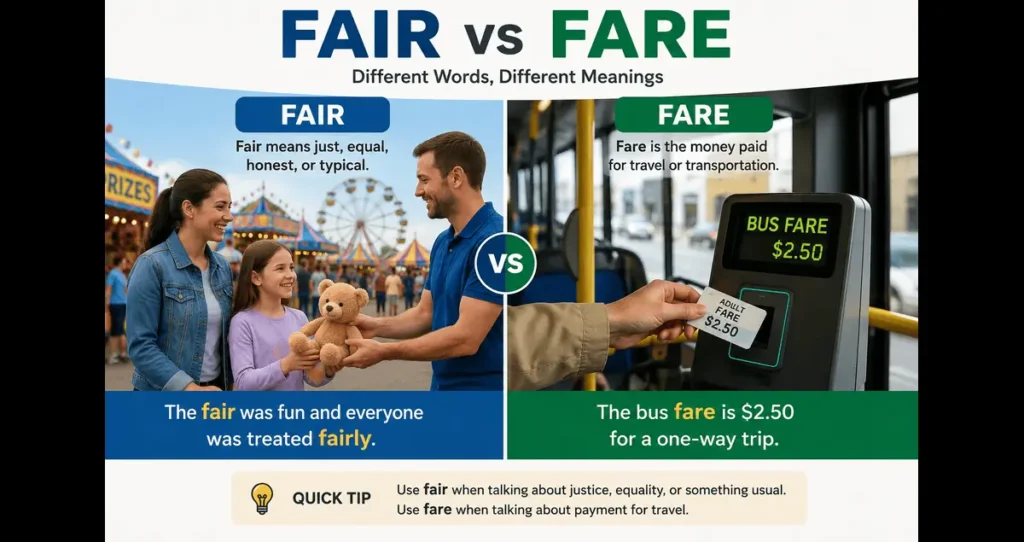
- Fair:If the word fair is used as an adjective it means just, honest or reasonable in most cases. It can also mean lightcolored (fair skin) or refer to an event (a county fair).
- Fare: typically refers to the fee charged for a journey by transport, e.g., taxi fare, but also has the meaning to get along or to come out as, e.g., how did you fare on the test.
Quick example:
- The fare is unfair for her to pay because she is on the same line except for her.
Takeaway: When you’re referring to justice, honesty, or a carnival, use fair. Use fare for travel costs or when referring to the proceedings of travel.
Read more:Complement vs Compliment: What’s the Difference?
Each Word means;
Fair
Adjective: Not biased, dishonest or unfair; treating everyone equally.
Pronunciation:The word “fer” sounds like “hair” and “care.The word ‘fer’ is pronounced /fɛr/, which is the same as ‘hair’ and ‘care’.
Part of speech: Mostly adjective, sometimes a noun.
Using it for;: Talking about fairness, equal treatment, reasonable judgment, light skin or hair color, clear and pleasant weather, or public event that has rides and exhibits.
Common contexts: Sports (a fair call), workplaces (fair pay), relationships (that’s not fair), events (the state fair).
Memory trick: Fair = short, simple, doing right by people and Just = short, simple, doing right by people. The word “fairness” also has the same first three letters as “fair.
Read more:What’s the Difference? Aloud and Allowed
Examples:
- The judge did a fair decision.
- Fair weather was enjoyed throughout the weekend.
- My little brother has fair skin which burns easily.
- We visited the county fair, and rode the Ferris wheel.
Fare
Definition: The price charged for a journey on public transport, or how someone performs or experiences something.
Spelling: FER.The spelling instruction for this word is the same as “fair.
Part of speech: noun, usually (most common) and verb.
How and when to use it: Use ‘fare’ when talking about fare prices of a bus, train, taxi or flight, and to talk about how well someone did or how something turned out.
Common context: Travel and transit – (“bus fare,” “airfare”), outcomes – (“How did you fare in the interview?”), older or formal writing – (“simple fare” for food).
Memory trick: “Fare” sounds like “fee” as in travel money think of a taxi meter counting your fare. It also has a homophone with “fare” which means to travel far.
Examples:
- This year’s train ticket prices increased once more.
- How did you fare on your final exams?
- We divide up the taxi charge among the three of us.
- The restaurant offered basic yet substantial food and beverages.
Key Differences
| Feature | Fair | Fare |
| Meaning | Just, honest, reasonable or public event | Travel expenses, how someone did |
| Part of Speech | Adjective (mainly), noun | Noun (mainly), verb |
| Common Usage | Fairness, weather, complexion, carnivals | Bus/train/taxi cost, outcomes |
| Example | That referee is quite fair. | I left my bus ticket at home. |
| Easy Memory Trick | “Fair” = fairness | “Fare” = fee for travel |
Word Origin (Etymology)
The word fair is from the Old English fæger, which means beautiful or pleasant. Centuries later it came to mean more than just good looks; “fairness” was considered pleasing and right, and so its meaning grew to mean “just” and “evenhanded”. The word “fair” has a different origin: Latin feria = holiday/holiday season, through Old French as feire.
The origin of fare is the Old English word faran, which meant “to travel” or “to get along. This is why the verb “fare” retains the multiple meanings of: “go” and “behave”: both refer to a trip or a trial.
English borrowed both words and they have merged in the same pronunciation over the centuries, so that both are now homophones. It’s the same sound coupled with totally different definitions that makes them so easy to confuse now.
English.British English vs American English.
Thankfully, there is no significant difference between the British and American versions of these two words. There is no difference between the word fair and fare in either dialect; the same spelling and meaning.
| Feature | British English | American English |
| Spelling | fair / fare | fair / fare |
| Pronunciation | /fɛə/ | /fɛr/ |
| Preference | Same usage | Same usage |
| Example | The train fare to London is expensive. | You will have to pay a lot for a train ticket to Boston. |
There is a very slight difference in pronunciation that is, British English tends to have slightly less “r” sound in it, whereas American English has a more distinct “r”. Spelling and meaning remain the same all over the world.
Which one do you think you should use?
In American English :use the word ‘fair’ to mean ‘just,’ ‘weather,’ or ‘event’ and ‘fare’ for the cost of transportation. There was no need for a twists on the regional theme.
British readers: same rules apply. The word “fare” is often used in expressions such as “taxi fare” and “how did it fare?”.
International readers/learners: Pay attention to context! When money or transportation is involved, almost always “fare.” When judgment, honesty or event is used, its “fair.”
Academic writing: Both words are found in the formal mode of writing, with fare (verb) being used in expressions such as, “the economy fared poorly” in essays and reports.
Business writing: “fair” can be used in phrases, such as “fair market value” and “fair trade.” The word “fare” is used on travel expense reports and in transit policy.
Everyday communication: An opinion is expressed as “fair” (that’s fair) and commuting costs are expressed as “fare” (Uber fare was $12).
Common Mistakes
1.X That’s not fare, you got a bigger slice. ✅ That’s not fair, you got a bigger slice. Why: it is based on Justice, not travel cost.
2.❌ I don’t have enough money for the fair. ✅ I don’t have enough money for the fare. Why: The bus/train fare is not “fair.
3.❌ This weekend we will be at the state fair. ✅ This weekend we will be at state fair. Why: Carnival style event is a “fair.
4.❌ What was the team’s performance in the championship? ✅ What did the team do in the championship? Because ‘fare’ is a verb, which refers to how something fared.
5.She has very light, fair skin. (Remove the “X” to indicate that this statement is correct.) Why: “fair” is the term used to describe skin tone.
6.❌ The airfare increased by 30% prior to the holidays. ✅ The airfare rose by 30% before the holidays. Why: “Airfare” is a word that has the word “fare” in it.
7.❌ I am given a fair price for the fair ride. ✅ I am given a fair price for the fare ride. (when talking about a paid ride) How: It is “fair” to charge the person the “fare,” which is the cost of the ride.
8.❌ It is only fair we split the bill. ✅ It’s only fare that we split the bill. Why: This is about fairness and NOT about cost.
9.❌ The restaurant is giving traditional food.✅ The restaurant is offering traditional menu. Why: “Fare” is a word that refers to food, not an event here.
10.❌ We paid a fair for the ferry crossing. ✅ We paid the fare for the ferry crossing. Why: There is always a “fare” used in travel payment.
Everyday Examples
Email: “Please remember to note the new train ticket price for your commute reimbursement.
School writing: The essay presents an argument that the defendant had a fair trial.
Business Communication: “No hidden fees on your fare due to our fair pricing policy.
The headline reads: News: “City officials voted to raise subway fares by 15 cents starting next month.
Books: “He wondered how he would do in the cold winter days that lay ahead.
Social media: “There’s a discount on Uber today $6 a fare!
Everyday comments: “That’s so not fair, you got to leave early!
Grammar Tips
Position of the word fair: Usually used before a noun (fair deal) or after a linking verb (the trial was fair). The noun form of fare is usually preceded by the article (the fare, a fare) and the verb form of fare is usually preceded by the subject (they fared well).
Collocations: “Fair” is associated with the following words: fair play, fair share, fair warning, fair trade. The word “fare” can be used with words such as bus fare, taxi fare, airfare, fare well, fare poorly.
Punctuation: There are no special punctuation rules, but be careful of compound words such as airfare, and farewell.
Example: “Fare” is a regular verb and conjugates as fare, fares, fared, faring (e.g., How are you fareing?). The word “fair” is usually not used as a verb in the present tense of English.
Easy Memory Tricks
- Fair = Justice. The two words have the same beginning sound in your head: “fair” and “fairness” share the same ‘fair’ beginning.
- Fare = Fee. Imagine a taxi meter – the more miles the larger the charge. “fare” and “fee” both require payment of money.
- Farewell tip: Remember “fare” and “farewell” is a goodbye when travelling.
Google Trends & Usage
The search term “fair vs fare” is more prevalent when students are learning new homophones or when learners of English are searching from outside the country, and when commuters search fast on a travel app.
Since they sound the same, it is easy to mix them up when writing emails, social media captions and text messages, especially if spelling isn’t checked for.
The miscue is more common with English learners who live in areas where English is not their first language, because one of the most difficult aspects of English spelling is homophones. The search intent for “fair vs fare” is virtually always to find a quick and clear answer that they can use right away; definitions, examples and comparison tables tend to be very effective for this type of search.
Related Words
Other pairs of words that are often confused are:
Affect vs Effect: Affect is generally the verb (to influence) and Effect is generally a noun (a result).
Accept vs Except: Accept means receive or agree to something, except means excluding something.
Principal vs Principle: Principal is a person in charge or the total sum of money; principle is a basic rule or principle.
Bare vs Bear: Bare is unclad, naked or simple; Bear is an animal, or to carry/endure.
Frequently Asked Questions
1.Is it “fair share” or “fare share”? It’s “fair share.” The meaning of the phrase is an equal portion or dividing a responsibility equally.
2.Should it be “fair enough” or “fare enough”? It’s “fair enough,” a casual expression used when you agree to or accept someone’s opinion, though you may not fully agree.
3.What is the meaning of “fare well”? To do well, or be successful, especially when wishing someone good luck on a trip or undertaking; “fare well” is used when wishing someone good luck in a new job, for example.
4.Is “welfare” related to “fare”? Yes. The use of “wellfare” comes from the combination of the words “well” and “fare,” which both mean “to travel well” or “to live well. Today the term is used for overall welfare or Government help schemes.
5.Why is it that the words fair and fare sound the same? Though they belong to completely different word origins (fair from Old English fæger, fare from Old English faran), they are homophones because their pronunciation merged over the course of many centuries of the evolution of the English language.
6.Does the term “fair” work as a verb? Very uncommon in modern English. It is now rarely used and mainly regional/old fashioned in phrases such as “to fair up” (when the weather clears up).
7.What is the plural of ‘fare’? The plural form of the word is “fares”, as in “Several fares were gathered on the journey. Noun “fair” also pluralizes normally to “fairs”.
8.Is it possible to have a “fare” as in food? Yes. In the more formal or older use, and in slightly more abstract contexts, “fare” can refer to food or provisions, as in “the inn provided simple fare.
Key Takeaways
- Fair means just, honest, lightskinned or public.
- Fare relates to travel costs or how something turned out.
- They sound the same when spoken, so it’s easy to get them confused when writing.
- They are used in the same way in British and American English.
- Be aware of compound words such as airfare and farewell, where fare is always used.
- Common phrases to remember: fair share, fair enough (with “fair”) and fare well, bus fare (with “fare”).
Conclusion
The words “fair” and “fare” sound the same, but they mean vastly different things. Fair means justice, honesty, looks or a carnival day. Fare is related to money and/or to the outcome of a journey.
It’s easiest to remember the difference by linking each word to its main meaning: fairness for “fair” and travel fees for “fare. Beware of compound words such as airfare and farewell and doublecheck your work when texting quickly or in emails where typos get through.
The examples, tables and memory tricks in this guide will help you use “fair” and “fare” correctly, every time. The next time you’re looking at which one to type, you will not have to think twice.

I am Bahadar Ali, a professional content writer and the author behind GrammarDrive.com. I am passionate about making grammar simple and accessible for everyone. Through my writing, I aim to help learners and professionals communicate with clarity and confidence.