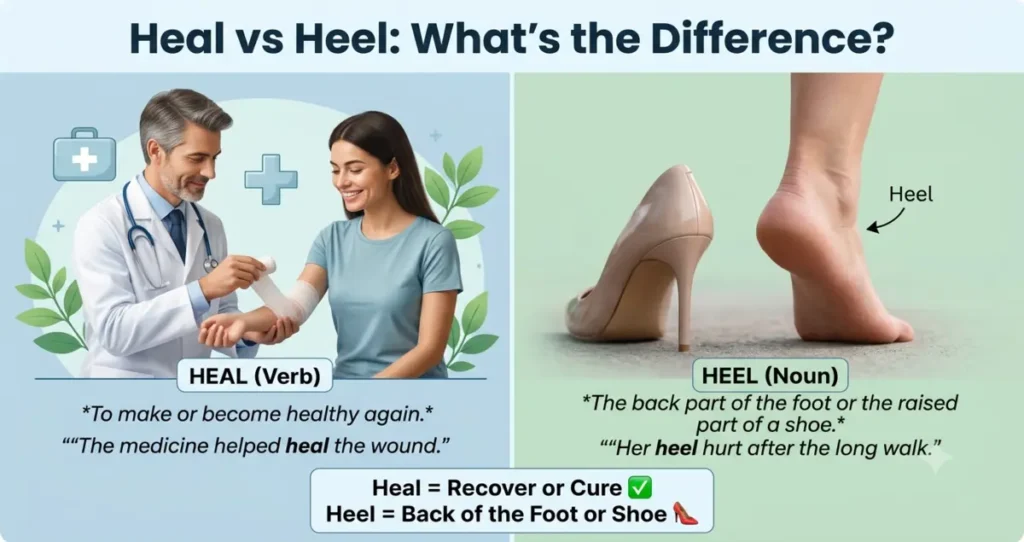
Ever came across a situation while writing where you didn’t know whether to use heal or heel? You’re not alone. The two words sound the same, so they are examples of the two words that have the same sound but different meanings and spellings called homophones.
The wrong word could alter the meaning of your sentence. Think of writing, “The doctor healed my foot heel,” or “The dog healed. Readers might understand what you’re trying to say, but these errors might make your work less refined.
You’ll discover how to distinguish between heal and heal, when to use each one and how to remember, plus the most frequent error people make. There are also comparison tables, real life examples, grammar tips, frequently asked questions and simple memory tricks to help you select the right word every time.This guide will clear up this issue for students, writers, professionals, and English learners alike.
Heal or Heel – Quick Answer
| Word | Meaning |
| Heal | To restore health or to recover from a wound, sickness, or hurt. |
| Heel | The heel or bottom of a shoe or a command to a dog to walk by his or her side. |
Simple Examples
- ✅ The cut will heal in a few days.
- ✅ My shoe’s heel broke while I was walking.
- ✅ The trainer told the dog to heel.
Read more:What’s the Difference? Aloud and Allowed
Quick Takeaway
- Heal = Recover or make healthy
- Heel = Foot, shoe, or dog command.
Meaning of each word
What does Heal mean?
Pronunciation: /hiːl/
Word: To write, to draw.Part of Speech: verb.
Definition
To heal: become healthy, or heal a person physically, emotionally, or spiritually.
Read more:Complement vs Compliment: What’s the Difference?
When to Use Heal
When discussing: use heal:
- Physical injuries
- Illnesses
- Emotional recovery
- Relationships
- Personal growth
Memory Trick
Consider “heal” and “health. Both of them start with hea-.
Examples
- The wound will heal quickly.
- Emotional wounds can heal with time.
- After surgery, doctors helped him to get better.
- The community was united in its efforts to recover from the disaster.
- A good night’s sleep promotes healing.
What’s Heel?
Pronunciation: /hiːl/
Part of Speech: Noun and Verb
Definition
As a noun, heel is the back part of your foot or the raised part of a shoe.
Heel is a command that when used as a verb instructs a dog to walk heel in rhythm with their handler.
Common Contexts
- Shoes
- Feet
- Walking
- Dog training
- Fashion
Memory Trick
Imagine that the heel strikes the ground at the end of the foot.
Examples
- After running my foot hurts in my heel.
- Her shoes were high heels that looked good on her.
- Weeks took to master the dog’s heel.
- The heel of the shoe is in need of repair.
- I accidentally stepped on my heel.
Key Differences
| Feature | Heal | Heel |
| Meaning | Recover or make healthy – is the main objective of the treatment. | The back of the foot is where the shoe part is located, and where you give a dog command. |
| Part of Speech | Verb | Noun and Verb |
| Common Usage | Medicine, emotions, recovery | Anatomy, footwear, pets |
| Example | The wound will heal up. | My heel is sore. |
| Easy Memory Trick | Heal → Health | Heel → Foot |
Word Origin (Etymology)
Heal
The name Heal is derived from the Old English word hǣlan, which means “to make whole, cure, or save. It is connected to words that relate to health, wholeness and wellness.
Heel
The word heel is derived from the Old English hēla meaning the back of the foot.
Why They’re Confused
The words had different origins in Old English but over time came to be sounded exactly alike. They are today pronounced alike, but mean entirely different things.
British English vs American English
No difference in spelling between British and American English.
Both varieties use:
- heal
- Heel
The pronunciation is, quite similarly, virtually unchanged.
| Feature | American English | British English |
| Heal | Same spelling | Same spelling |
| Heel | Same spelling | Same spelling |
| Pronunciation | Nearly identical | Nearly identical |
| Preferred Usage | No difference | No difference |
Examples
- In the United States, the injury will heal in no time.
- UK: It will heal in no time.UK: Soon it will be better.
- US: Her heel hurts.
- UK: Her heel hurts.
Which one should you use?
American Readers
Recover with heal and feet, shoes, or dog commands with heel.
British Readers
The rules are the same:
International Readers
No regional difference, therefore these words are easy to use internationally.
Academic Writing
Select word according to its exact meaning.
Business Writing
Heal should be used in medical reports and heel should be used for footwear descriptions.
Everyday Communication
Just remember:
- Heal = Recovery
- Heel = Foot or shoe
Common Mistakes
1
❓ The wound will heal shortly.
✅ The wound will heal soon.
Text Format: Text will be in a different format.
2
❌ My heal hurts.
✅ My heel hurts.
Why: Part of the body = heel.
3
× She wore high heels.
✅ She wore high heels.
The reason: Shoes have heels.
4
❌ The trainer taught the dog to heal.
✅ The trainer taught the dog to heel.
Why: Dog command = heel.
5
❌ Emotional wounds can heel.
✅ Emotional wounds can heal.
6
X My shoe heel started to crack.
✅ I have broken my shoe heel.
7
Exercise promotes a bone to heal.
✅ Exercise helps bones heal.
8
❌ My heel on my left foot is hurting.
✅ My left heel is sore.
9
The doctor was not stating that it was not a broken bone, but that it will heal by itself.
The doctor said that it will heal on its own.
10
The puppy trained by me to heal.
✅ The puppy is taught to walk at my side.
Everyday Examples
Emails
- Please give the injury some time to heal.
- The heel of this shoe needs replacing.
School Writing
- Fractures heal over time.
- Heel is a component of a human foot.
Business Communication
- Staff should be allowed to recover from injuries.
- These boots have a reinforced heel.
News
- The athlete will be expected to fully recover.
- During his pursuit, the suspect injured his heel.
Books
- Love is healing her.
- She quickly spun around and left.
Social Media
- Christy’s message for the world: Take time to heal. ❤️
- After today’s hike, my heel is killing me!
Daily Conversation
- Hope you get better soon!
- I get aching heels that make walking or standing a problem.
Grammar Tips
- The word heal is mostly used as a verb.
- In dog training, the word heel is a verb, but primarily it’s a noun in other contexts.
- Common collocations:
- heal naturally
- heal completely
- emotional healing
- high heel
- sore heel
- heel pain
- heel strike
- Don’t use these two interchangeably because they sound the same.
Easy Memory Tricks
- Heal = Health
- Heal = Hospital
- Heel = Foot
- Heel = High heels
- Now think about a doctor who’s helping a person heal, and a person on heels walks in the room.
Google Trends & Usage
Often people look for heal or heel as they sound the same. Students, English Learners, and writers proofreading their work cause search interest.
Typical search purpose is:
- Which of these is spelt correctly?
- Is it heal or heel?
- The following is a list of Heal vs heel examples.
- Heal meaning
- Heel meaning
The confusion is not uncommon in countries in which English is spoken such as the United States, the United Kingdom, Canada, and the commonwealth of Australia and among those who are learning the language internationally.
Related Words
Other confusing pairs of words that may be useful:
- Affect vs Effect: Action versus effect.
- Accept vs Except: Take in vs exclude.
- Principal/Principle: Person/Rule.
- There vs Their: They’re Location, Possession, Contraction.
- Bare vs Bear: Uncovered versus the animal or to carry.
- Lead vs Led; Present tense vs. Past tense.
- Compliment vs Compliment; Complete versus praise.
Frequently Asked Questions
1. Is it heal or heel a wound?
Heal, as wounds heal over time.
2. Is heel a verb?
Yes. Heel in Dog Training refers to walking close to the person training the dog.
3.Can heal, be used to denote feelings?
Yes. Emotional wounds, relationships and memories can all mend.
4. What is the half of the foot of your shoe called?
The back part of the shoe, which is raised, is called the heel.
5. What’s the reason heal and heel are different?
They are ‘homophones’, which means that they sound the same, but have different meanings and spellings.
6. Does British English have different spellings?
No, the same spellings are used in British English and American English.
7.If you can’t remember the difference, what could be the reason?
Remember:
- Heal = Health
- Heel = Foot
8. What word is the most common in medical writing?
Heal is much more likely to appear in the areas of healthcare, medicine, and recovery-related writing.
9. Which word is used in fashion?
Heel is a common term used in relation to shoes, footwear and style.
Key Takeaways
- Heal: to become healthy or to make healthy.
- The back of the foot or the back raised up part of a shoe is called heel.
- Heel is another dog training command.
- There are no phonetic differences between both the words.
- No difference between British/American spelling.
- Remember Heal = Health.
- Remember Heel = Foot.
- Be sure to read and proofread carefully, not to mix them up.
Conclusion
Once you match up the words with their meanings, it will be easier to know the difference between heal and heel. Heal is always about healing, health, getting well again. The heel is the back of your foot, the raised back of a shoe or the command given in dog training.
These words sound exactly the same and therefore are easy to mix up in spoken and written language. Good news: You can learn an easy-to-remember rhyme, heal equals health and heel equals foot, to spell correctly every time.
If it’s not clear, consider the context. Do you mean recovery or treatment? Use heal. Is it shoes, body or a trained dog? Use heel.
With practice and the help of the examples provided here, you’ll be confident and won’t make one of English’s most frequent spelling errors.

I am Bahadar Ali, a professional content writer and the author behind GrammarDrive.com. I am passionate about making grammar simple and accessible for everyone. Through my writing, I aim to help learners and professionals communicate with clarity and confidence.