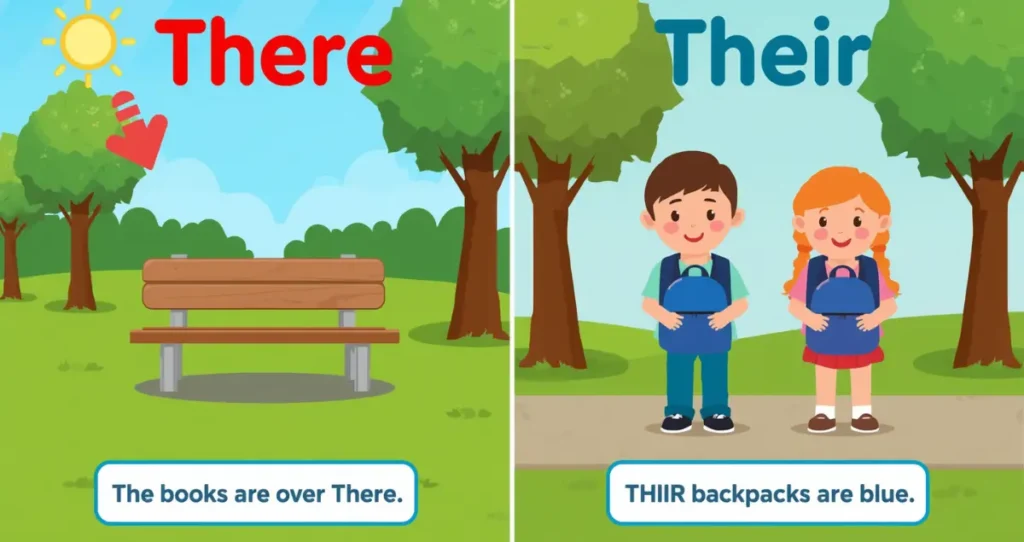
Many people confuse there and their because the words sound the same. They are called homophones. Even fluent English speakers mix them up in emails, social media posts, school work, and business writing.
People search for “there or their” because they want a quick answer. They want to know which spelling is correct and when to use each word. A small spelling mistake can change the meaning of a sentence and make writing look less professional.
The good news is that the difference is simple once you learn the basic rule. There usually talk about a place or introduce a sentence. Their show ownership. Learning this rule helps you avoid common grammar mistakes and write with confidence.
In this guide, you will learn the meaning, origin, spelling differences, examples, common mistakes, and the best way to remember “there” and “their.”
There or Their – Quick Answer
There
Use there when talking about a place, position, or existence.
Examples:
- The keys are over there.
- There is a cat outside.
- We went there yesterday.
Their
Use their to show ownership.
Examples:
- It is their house.
- The students forgot their books.
- Dogs wag their tails.
Quick Memory Trick
- There = place
- Their = belongs to them
- Read more:Centre or Center: What’s the Difference?
The Origin of There or Their
The words there and their come from Old English. Over time, their spellings changed, but their pronunciation stayed very similar.
Origin of “There”
“There” comes from the Old English word þaær, which meant “in that place.”
It has always been connected to location or existence.
Origin of “Their”
“Their” comes from Old Norse influence during the Viking period. It replaced older English possessive words over time.
“Their” became the standard possessive form meaning “belonging to them.”
Why the Spellings Are Different
English developed from many languages, including Germanic and Norse languages. Because of this, some words sound the same but have different meanings and spellings.
That is why:
- There relates to place
- Their relates to ownership
- Read more:Theatre or Theater: Which Spelling Is Correct ?
British English vs American English Spelling
Good news: both British English and American English use there and their the same way. There is no spelling difference between the two forms.
The confusion comes from pronunciation, not regional spelling.
Comparison Table
| Word | Meaning | British English | American English | Example |
| There | Place or existence | There | There | There is a book on the table. |
| Their | Ownership | Their | Their | Their car is new. |
Examples in UK and US Writing
| Region | Sentence |
| UK English | Their football team played well there. |
| US English | Their soccer team played well there. |
The grammar stays the same. Only vocabulary choices may differ.
Which Spelling Should You Use?
The correct spelling depends on your meaning, not your country.
Use “There” When:
- Talking about a place
- Showing existence
- Pointing to something
Examples:
- Put the bag over there.
- There are many people here.
Use “Their” When:
- Talking about ownership
- Referring to something that belongs to people or things
Examples:
- Their office is downtown.
- The children cleaned their room.
Audience-Based Advice
| Audience | Best Choice |
| US readers | Use standard grammar rules |
| UK readers | Use standard grammar rules |
| Global audience | Keep sentences simple and clear |
No matter where your audience lives, the rule stays the same.
Common Mistakes with There or Their
Many writers confuse these words because they sound alike.
Mistake 1
❌ Their is a problem here.
✅ There is a problem here.
Mistake 2
❌ The kids lost there toys.
✅ The kids lost their toys.
Mistake 3
❌ We went to their yesterday.
✅ We went there yesterday.
Mistake 4
❌ There dog is barking.
✅ Their dog is barking.
Easy Tip
Ask yourself:
- Is it a place? → There
- Does it belong to someone? → Their
There or Their in Everyday Examples
In Emails
- Please leave the package over there.
- Their report was very helpful.
In News Writing
- There were long delays at the airport.
- Their company announced new prices.
On Social Media
- We had fun there today!
- Their new video is amazing.
In Formal Writing
- There are several reasons for the change.
- Their research improved the project.
There or Their – Google Trends & Usage Data
Search data shows that many people look up “there or their” because it is one of the most common English grammar mistakes.
Popular Countries Searching This Keyword
- United States
- United Kingdom
- Canada
- Australia
- India
- Pakistan
Why People Search It
People often want help with:
- School assignments
- Professional writing
- Social media posts
- English learning
- Grammar correction tools
Usage Context
| Word | Common Usage |
| There | Location, existence |
| Their | Possession, ownership |
“There” appears more often in everyday English because it is used in many sentence structures.
Comparison Table: There vs Their
| Feature | There | Their |
| Part of Speech | Adverb/Pronoun | Possessive Determiner |
| Main Meaning | Place or existence | Ownership |
| Talks About | Location | Belonging |
| Example | The car is there. | Their car is red. |
| Common Error | Used instead of “their” | Used instead of “there” |
FAQs About There or Their
1. What is the difference between there and their?
“There” refers to place or existence. “Their” shows ownership.
2. Is “their” possessive?
Yes. “Their” means something belongs to them.
3. Can “there” show ownership?
No. “There” never shows possession.
4. Why do people confuse there and their?
They sound the same but have different meanings and spellings.
5. Is there a British or American spelling difference?
No. Both countries use the same spelling.
6. How can I remember the difference?
Remember:
- “There” contains “here,” which relates to place.
- “Their” contains “heir,” someone who owns things.
7. Which word is more common?
“There” is more common because it is used in many sentence types.
Conclusion
Understanding the difference between there and their is important for clear writing. Even though the words sound the same, they have very different meanings. “There” is used for place, direction, or existence. “Their” is used to show ownership.
This mistake is common in emails, school assignments, business communication, and social media. Luckily, the rule is simple. If you are talking about location, use “there.” If something belongs to someone, use “their.”
Both British English and American English follow the same spelling rules, so you do not need to change your writing based on region. The best way to avoid mistakes is to pause and check the meaning before writing the word.
With practice, choosing between “there” and “their” becomes easy. Clear grammar improves your confidence, makes your writing more professional, and helps readers understand your message faster.

I am Bahadar Ali, a professional content writer and the author behind GrammarDrive.com. I am passionate about making grammar simple and accessible for everyone. Through my writing, I aim to help learners and professionals communicate with clarity and confidence.