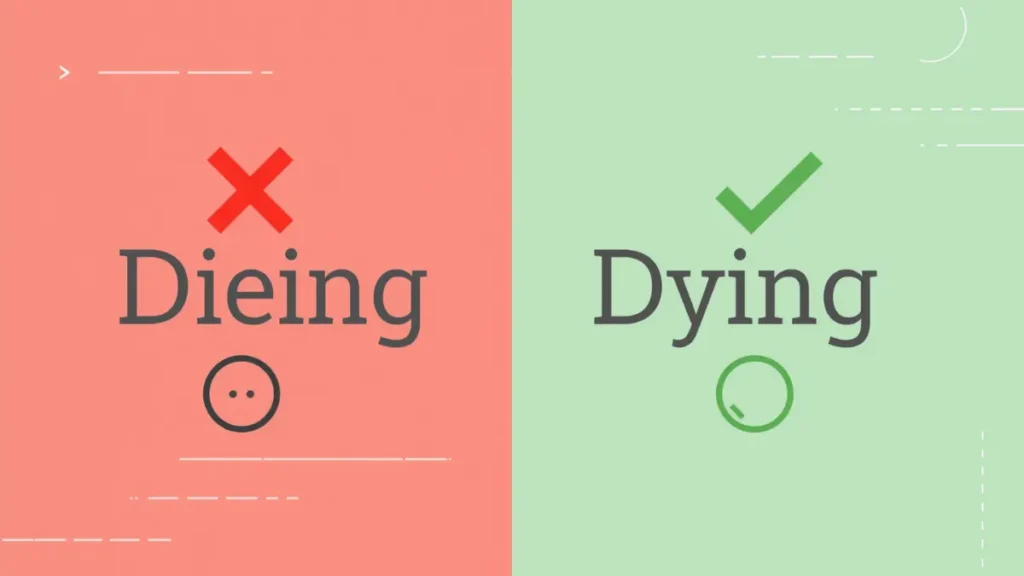
Many English learners get confused between “dieing” and “dying.” At first glance, both look similar, but only one is correct in most situations. This confusion often appears in writing emails, social media posts, school assignments, and even professional content.
People search for this keyword because they want a quick, clear answer without grammar jargon. They simply want to know: Which spelling is right?
The confusion usually comes from English spelling rules. In English, when a verb ends in “e,” it often drops the “e” before adding “-ing.” However, there are exceptions that make learners unsure. Another reason is that “dieing” does exist in rare technical contexts, which makes the mistake even more common.
In this article, you will learn the correct usage of dieing vs dying, their origin, grammar rules, regional spelling differences, and real-life examples. By the end, you will clearly understand when to use dying and why dieing is almost always incorrect in everyday English writing.
Dieing or Dying – Quick Answer
The correct spelling in most cases is dying.
- Dying → Present participle of die (to stop living)
- Example: The plant is dying.
- Dieing → Rare and mostly incorrect in modern English
- Sometimes used in engineering (cutting threads in metal), but not for life or death meaning.
👉 In simple English: Use “dying” for life, health, emotions, or decline.
The Origin of Dieing or Dying
The word die comes from Old Norse “deyja”, meaning “to die” or “to pass away.” Over time, English simplified many verb forms.
When adding -ing to verbs:
- Silent “e” is usually dropped → make → making, write → writing
- So, die → dying
The form “dieing” appears only in technical language, such as metalwork, where “die” is a tool used to shape materials. In that case, dieing means using a die tool—not related to death.
Setup or Set Up: What’s the Difference and Which One Should?
British English vs American English Spelling
Good news: both British and American English use dying as the correct spelling.
| Meaning Type | Correct Spelling | Example |
| Life/death context | dying | The man is dying. |
| Emotional decline | dying | Interest is dying out. |
| Metalwork tool | dieing (rare) | The worker is dieing threads. |
Which Spelling Should You Use?
- US English: Use dying in all general cases
- UK English: Use dying in all general cases
- Global English: Always use dying
👉 Only use dieing if you are writing about industrial machining or engineering.
To Much or Too Much: Which One Is Correct?
Common Mistakes with Dieing or Dying
- ❌ She is dieing in hospital
✔ She is dying in hospital - ❌ The flower is dieing
✔ The flower is dying - ❌ People are dieing in the accident
✔ People are dying in the accident
Most mistakes happen because learners apply the “keep the e” rule incorrectly.
Dieing or Dying in Everyday Examples
- Email:
We are sorry to hear that your plant is dying. - News report:
The animal population is dying due to habitat loss. - Social media:
My phone is dying again 😭 - Formal writing:
The company’s interest in the project is slowly dying.
Dieing or Dying – Google Trends & Usage Data
Search trends show that “dying” is overwhelmingly more common worldwide. It appears in medical, emotional, and general English usage.
“Dieing” appears rarely and mostly in:
- Engineering documents
- Technical machining contexts
- Misspellings in casual writing
Overall, “dying” dominates search results, grammar tools, and academic writing.
Comparison Table: Dieing vs Dying
| Feature | Dying (Correct) | Dieing (Rare/Incorrect) |
| Grammar use | Yes | Rare |
| Meaning | Life/death, decline | Industrial tool use |
| Common usage | Very high | Very low |
| Recommended | Yes | No (except technical) |
FAQs
1. Is “dieing” ever correct?
Yes, but only in technical engineering contexts involving tools called “dies.”
2. What is the correct spelling of dying?
The correct spelling is dying.
3. Why is “dieing” wrong in English?
Because the verb “die” drops the silent “e” before adding “-ing.”
4. Can I use “dieing” in essays?
No, always use dying unless writing about machinery.
5. Is “dying” British or American English?
Both use dying as the standard spelling.
6. What does “dying out” mean?
It means something is disappearing or becoming less common.
7. How can I remember the correct spelling?
Think: drop the “e” → die → dying.
Conclusion
Understanding the difference between dieing and dying is simple once you know the rule. In almost all cases, dying is the correct spelling used in both British and American English. It applies to life, health, emotions, trends, and decline. The incorrect form dieing only appears in rare technical fields like metalworking, so it should not be used in everyday writing.
Most confusion comes from applying general “-ing” rules without considering exceptions. By remembering that the silent “e” is dropped, you can avoid this common mistake. If you are writing an email, essay, or social media post, using the correct spelling improves clarity and professionalism. English learners often struggle with small spelling differences, but this rule is easy to master with practice.
Now you can confidently choose the correct form and avoid one of the most common English spelling errors in writing.

I am Bahadar Ali, a professional content writer and the author behind GrammarDrive.com. I am passionate about making grammar simple and accessible for everyone. Through my writing, I aim to help learners and professionals communicate with clarity and confidence.