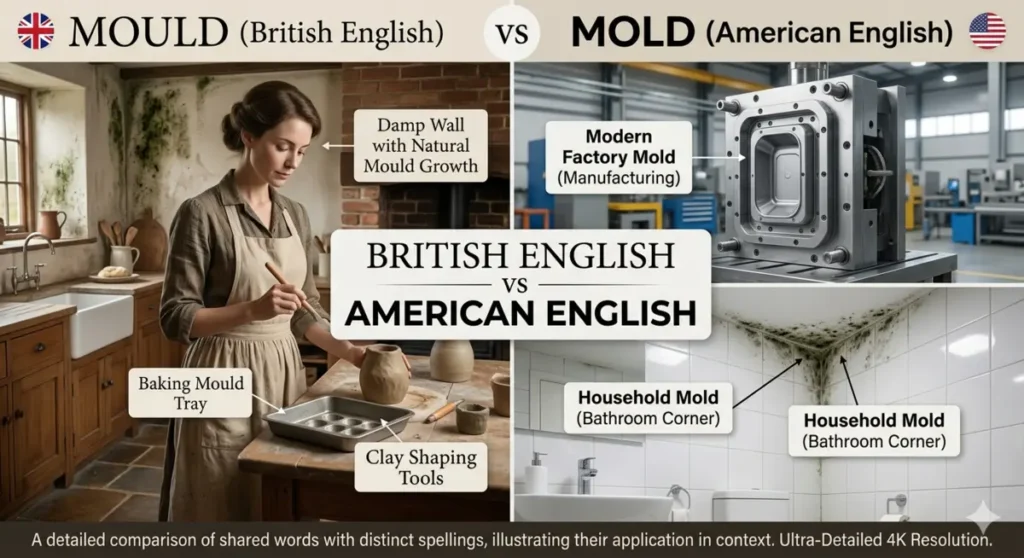
Have you ever seen black spots on old bread or a damp wall and wondered whether to write mould or mold? Many English learners and writers search for mould or mold because both spellings look correct.
The confusion happens because British English and American English use different spelling rules. In the UK and many Commonwealth countries, people usually write mould. In the United States, the preferred spelling is mold.
The keyword mould or mold is also confusing because the words have more than one meaning. They can describe a fungus growing in wet places, or a hollow shape used to form materials like plastic or clay.
Knowing the correct spelling helps in school writing, business communication, news articles, and social media posts. This guide explains the meaning, spelling differences, examples, common mistakes, and professional advice about mould or mold in simple and clear language.
Mould or Mold – Quick Answer
The quick answer is simple:
- Mould = British English spelling
- Mold = American English spelling
Both words have the same meaning.
Examples
- UK: There is mould on the bathroom wall.
- US: There is mold on the bathroom wall.
- UK: The artist used a mould for the statue.
- US: The artist used a mold for the statue.
Theatre or Theater: Which Spelling Is Correct ?
The Origin of Mould or Mold
The words mould and mold come from the Old English word molde, meaning earth or soil. Over time, the meaning expanded to include fungus growth and shaping materials.
The spelling difference developed later:
- British English kept the “ou” spelling as mould.
- American English simplified it to mold.
This pattern is common in many English words:
- Colour → Color
- Favourite → Favorite
- Mould → Mold
The meanings stayed the same, but spelling styles changed by region.
British English vs American English Spelling
British English prefers mould, while American English uses mold.
| British English | American English | Meaning |
| Mould | Mold | Fungus growth |
| Mould | Mold | Shaping form/container |
Examples
Fungus Meaning
- UK: The bread has mould on it.
- US: The bread has mold on it.
Shape/Form Meaning
- UK: The cake mixture went into a mould.
- US: The cake mixture went into a mold.
Defence or Defense: Key Differences and Usage Guide ?
Which Spelling Should You Use?
Choose the spelling based on your audience.
Use “Mold” If:
- Your audience is in the United States
- You write for American companies
- Your website targets US readers
Use “Mould” If:
- Your audience is in the UK
- You write for Australia, New Zealand, or Canada
- Your readers follow British English
Global Advice
If your audience is international, pick one style and stay consistent throughout your writing.
Common Mistakes with Mould or Mold
1. Mixing British and American Spellings
❌ Wrong: The mold on the wall spread because of damp mould.
✅ Correct: The mold on the wall spread because of damp mold.
✅ Correct: The mould on the wall spread because of damp mould.
2. Thinking They Have Different Meanings
❌ Wrong: Mould and mold mean different things.
✅ Correct: Both spellings have the same meaning.
3. Using the Wrong Audience Style
❌ Wrong: UK school report using “mold” everywhere.
✅ Correct: UK school report using “mould.”
4. Confusing It with “Mold” as a Verb
❌ Wrong: She moulded the clay in American English writing.
✅ Correct: She molded the clay in American English writing.
5. Incorrect Formal Usage
❌ Wrong: The article switches between mould and mold randomly.
✅ Correct: Use one spelling style consistently.
Mould or Mold in Everyday Examples
In Emails
- “Please check the basement for mould before repairs begin.”
- “The inspector found mold near the kitchen sink.”
In News
- “Heavy rain caused mold to grow in old buildings.”
- “Health experts warned families about black mold exposure.”
On Social Media
- “I cleaned all the mold from my bathroom today!”
- “This old bread has mould already.”
In Formal Writing
- “Mould exposure may affect indoor air quality.”
- “The factory uses a metal mold for production.”
Mould or Mold – Google Trends & Usage Data
Search data shows:
- Mold is more popular in the United States.
- Mould is more common in the United Kingdom, Australia, and New Zealand.
People search for these words mostly in:
- Home cleaning topics
- Health discussions
- Construction and manufacturing
- Cooking and baking
- English grammar searches
The spelling often depends on where the user lives and which English system they learned.
Comparison Table: Mould vs Mold
| Feature | Mould | Mold |
| English Style | British English | American English |
| Meaning | Fungus or shape form | Fungus or shape form |
| Common Regions | UK, Australia | USA |
| Pronunciation | Same | Same |
| Formal Use | British writing | American writing |
| Verb Form | Moulded | Molded |
FAQs About Mould or Mold
1. Is mould correct spelling?
Yes. It is correct in British English.
2. Is mold correct spelling?
Yes. It is correct in American English.
3. Do mould and mold mean the same thing?
Yes. Both words have identical meanings.
4. Which spelling is more common worldwide?
“Mold” is more common online because of American English influence.
5. How do Canadians spell it?
Canada often uses British spelling, so “mould” is common.
6. Is black mold dangerous?
Some types can affect health and indoor air quality.
7. Can mould refer to a shape?
Yes. It can also mean a hollow form used for shaping objects.
Conclusion
Understanding mould or mold is easy once you know the regional spelling rules. The word mould is mainly used in British English, while mold is standard in American English. Both spellings have the same pronunciation and meaning. They can describe fungus growth or a shape used for forming materials.
Choosing the right spelling depends on your audience and writing style. If you write for British readers, use mould. If your audience is American, use mold. The most important thing is consistency. Avoid switching between both spellings in the same article or document.
Whether you are writing emails, school assignments, news reports, or website content, understanding mould or mold helps your writing look professional and clear. Once you learn the difference, using the correct spelling becomes simple and natural.