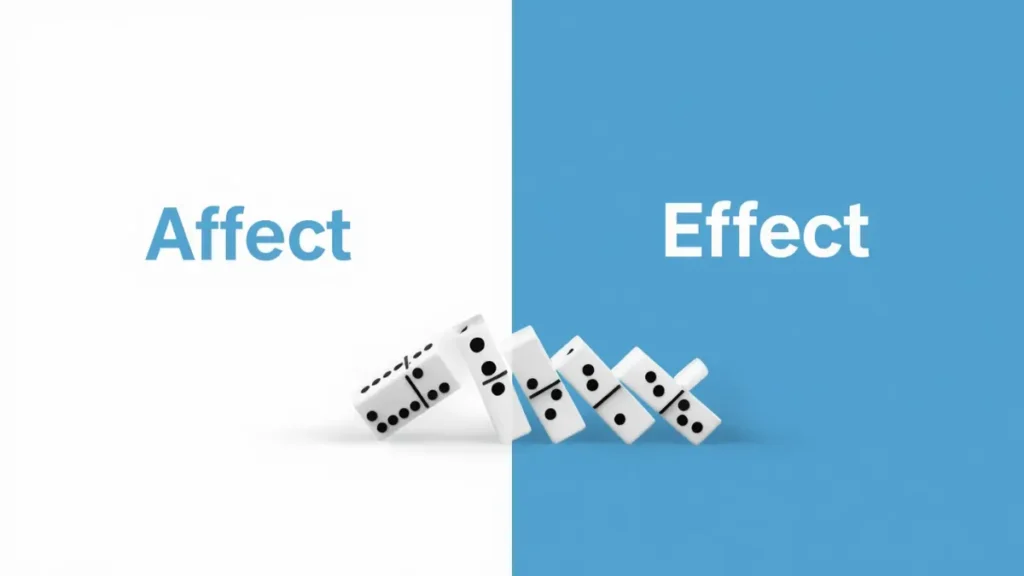
Many writers stop and think when they see the words affect and effect. They look similar, sound alike, and often appear in the same topics. This makes them one of the most confusing word pairs in English.
People search for affect or effect because they want to know which word is correct in emails, essays, reports, social media posts, and everyday conversations. Using the wrong word can change the meaning of a sentence and make writing look less professional.
The good news is that the difference is simple once you learn the basic rule. In most cases, affect is a verb (an action word), while effect is a noun (a thing or result). Understanding this rule will help you choose the correct word every time.
This guide explains the meaning, origin, usage, common mistakes, examples, and trends behind affect or effect in clear and simple language.
Affect or Effect – Quick Answer
The easiest way to remember the difference is:
- Affect = usually a verb (to influence or change something)
- Effect = usually a noun (the result of a change)
Examples
✅ The weather can affect your mood.
✅ The effect of the weather was noticeable.
✅ Lack of sleep can affect performance.
✅ One effect of lack of sleep is poor concentration.
Quick Memory Trick
- Affect = Action
- Effect = End Result
Read more: Between or Among: What’s the Difference
The Origin of Affect or Effect
Both words come from Latin and entered English centuries ago.
Affect
The word affect comes from the Latin word afficere, meaning “to influence,” “to act upon,” or “to do something to.”
Effect
The word effect comes from the Latin word effectus, meaning “result,” “outcome,” or “completion.”
Because both words share similar roots related to change and influence, they developed closely connected meanings. This is why many English learners and native speakers still confuse them today.
Unlike many spelling differences, affect and effect are not British and American spelling variations. They are two different words with different meanings.
Read more: Further or Farther: Simple Guide to Spelling and Correct Usage
British English vs American English Spelling
Unlike words such as colour/color or organise/organize, affect and effect are spelled the same in both British and American English.
Comparison Table
| Meaning | British English | American English |
| To influence | Affect | Affect |
| Result or outcome | Effect | Effect |
| Affect a decision | Affect | Affect |
| Effect of a decision | Effect | Effect |
Examples
British English
- The new policy may affect workers.
- The effect of the policy is still unknown.
American English
- The new policy may affect workers.
- The effect of the policy is still unknown.
There is no spelling difference between the two forms.
Which Spelling Should You Use?
The answer depends on what you mean.
Use Affect When:
- You mean “to influence.”
- The word is acting as a verb.
- Something is causing change.
Examples
- Stress can affect health.
- Rain may affect travel plans.
- High prices affect consumers.
Use Effect When:
- You mean “result” or “outcome.”
- The word is acting as a noun.
- You are talking about what happened because of something.
Examples
- The effect was immediate.
- One effect of exercise is better health.
- The policy had a positive effect.
Audience-Based Advice
| Audience | Recommended Usage |
| United States | Affect = influence, Effect = result |
| United Kingdom | Affect = influence, Effect = result |
| Australia | Affect = influence, Effect = result |
| Canada | Affect = influence, Effect = result |
| Global Audience | Follow the standard rule |
The same rule works everywhere English is spoken.
Common Mistakes with Affect or Effect
Many writers mix these words because they are closely related.
Mistake #1
❌ The weather had a bad affect on crops.
✅ The weather had a bad effect on crops.
Mistake #2
❌ Pollution can effect your health.
✅ Pollution can affect your health.
Mistake #3
❌ The new law will have a positive affect.
✅ The new law will have a positive effect.
Mistake #4
❌ Social media effects young people.
✅ Social media affects young people.
Common Correction Rule
Ask yourself:
Is the word an action or a result?
- Action → Affect
- Result → Effect
Affect or Effect in Everyday Examples
In Emails
- The delay may affect project timelines.
- The effect of the delay could be significant.
In News Articles
- Rising fuel prices affect millions of drivers.
- The economic effect is still being measured.
On Social Media
- Lack of sleep can affect your mood.
- What effect does coffee have on productivity?
In Business Writing
- Market changes can affect profits.
- The long-term effect remains unclear.
In Academic Writing
- Researchers studied how noise affects learning.
- The study measured the effect of noise on students.
Affect or Effect – Google Trends & Usage Data
Search data shows that affect or effect remains one of the most searched grammar questions online.
Popular Countries
The keyword receives strong interest from:
- United States
- United Kingdom
- Canada
- Australia
- India
Why People Search It
Most users want to know:
- Which word is correct
- How to remember the difference
- Which word to use in professional writing
- Whether affect and effect are interchangeable
Usage Context
| Context | Common Choice |
| Influence or change | Affect |
| Result or outcome | Effect |
| Academic writing | Both |
| Business communication | Both |
| News reporting | Both |
Because both words appear often in formal writing, confusion continues to generate high search interest worldwide.
Affect vs Effect Comparison Table
| Feature | Affect | Effect |
| Part of Speech | Usually Verb | Usually Noun |
| Meaning | To influence | Result or outcome |
| Memory Trick | Action | End Result |
| Example | Weather affects travel | Effect of weather |
| Common Usage | Action | Result |
| British English | Affect | Effect |
| American English | Affect | Effect |
Frequently Asked Questions (FAQs)
1. Is it affect or effect on someone?
Use effect when talking about the result.
Example:
“The effect on customers was positive.”
2. Is affect a verb or noun?
Most of the time, affect is a verb meaning “to influence.”
Example:
“Stress affects sleep.”
3. Is effect a noun or verb?
Most of the time, effect is a noun meaning “result.”
Example:
“The effect was immediate.”
4. How do I remember affect vs effect?
Use this simple trick:
- Affect = Action
- Effect = End Result
5. Can affect and effect be used interchangeably?
No. They usually have different meanings and different grammatical roles.
6. Which is more common, affect or effect?
Both are common, but effect often appears more frequently in formal writing because people discuss results and outcomes.
7. Do British and American English use different spellings?
No. Both countries use affect and effect with the same spelling and meaning.
Conclusion
The difference between affect or effect becomes easy once you understand their basic roles. In most situations, affect is a verb that means “to influence,” while effect is a noun that means “the result of a change.” This simple rule solves the majority of writing situations.
Whether you are writing emails, school assignments, business reports, social media posts, or news articles, choosing the correct word helps make your message clear and professional. A useful memory trick is to remember that affect starts with “A” for Action, while effect starts with “E” for End Result.
Both British and American English follow the same spelling and usage rules, so writers around the world can use the same guideline. When you are unsure, ask yourself a simple question: “Am I talking about an action or a result?” If it is an action, use affect. If it is a result, use effect.
Mastering this common grammar challenge will improve your confidence and make your writing stronger, clearer, and more accurate.

I am Bahadar Ali, a professional content writer and the author behind GrammarDrive.com. I am passionate about making grammar simple and accessible for everyone. Through my writing, I aim to help learners and professionals communicate with clarity and confidence.