Many English learners struggle with between and among. These two words seem similar because both describe relationships involving people, objects, or groups. Yet choosing the wrong one can make a sentence sound awkward or incorrect.
People often search for between or among because they are unsure whether to use between two things only or among three or more things. While that simple rule helps, modern English usage is slightly more flexible than many grammar books suggest.
Understanding the difference can improve your writing in emails, business reports, academic papers, and everyday conversations. It also helps you communicate ideas more clearly.
In this guide, you will learn the meanings of between and among, their origins, common mistakes, practical examples, and usage trends. By the end, you will know exactly which word to choose and when to use it.
Between or Among – Quick Answer
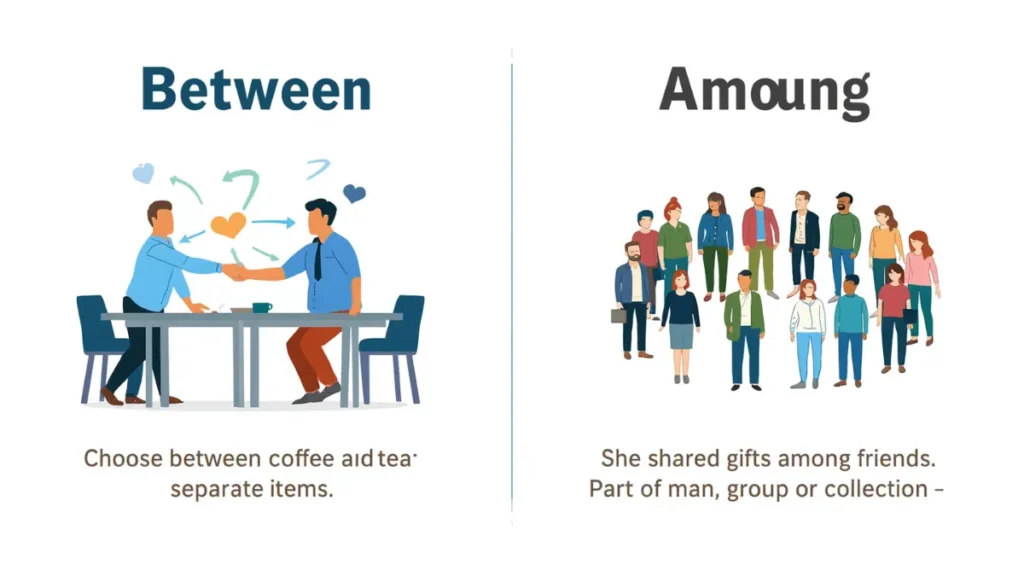
Between
Use between when talking about a relationship involving distinct or separate people, places, or things.
Examples:
- The agreement was made between the two companies.
- Choose between coffee and tea.
- The negotiations took place between the three countries.
Among
Use among when talking about a group as a whole rather than individual members.
Examples:
- She shared the candies among her friends.
- The secret spread among the students.
- Happiness was common among the team.
Simple Rule
- Between = separate individuals or items
- Among = a group or collection
Read more: Your or You’re: What’s the Difference
The Origin of Between or Among
Both words come from Old English.
Between
The word between comes from the Old English betweonum, meaning “in the middle of two things.”
For centuries, it referred mainly to relationships involving two separate items.
Among
The word “among” comes from the Old English gemang, meaning “in a group” or “mixed together.”
It developed to describe things existing within a collection or crowd.
Why the Confusion Exists
The confusion comes from the traditional rule:
- Between = two
- Among = three or more
However, modern English often uses between with more than two items when each item is considered separately.
Example:
“The treaty was signed between France, Germany, and Italy.”
Read more: Imply or Infer: What’s the Difference and How to Use
British English vs American English Spelling
Unlike many English word pairs, between and among have the same spelling in both British and American English.
Comparison Table
| Meaning | British English | American English |
| Relationship involving separate items | Between | Between |
| Relationship within a group | Among | Among |
Examples
| British English | American English |
| Divide the work among the team. | Divide the work among the team. |
| Choose between the options. | Choose between the options. |
There are no spelling differences.
Which Spelling Should You Use?
Since there is no spelling variation, your choice depends entirely on meaning.
For US Audiences
Use:
- Between for distinct items.
- Among groups.
For UK Audiences
The same rules apply.
For Commonwealth Countries
Australia, Canada, New Zealand, and other English-speaking countries follow the same usage.
For Global Audiences
Focus on meaning rather than location.
Remember:
- Separate individuals → Between
- Group or collection → Among
Common Mistakes with Between or Among
Mistake 1
❌ Divide the money between five children.
✅ Divide the money among five children.
Mistake 2
❌ The agreement was among the three companies.
✅ The agreement was between the three companies.
Mistake 3
❌ Choose among tea and coffee.
✅ Choose between tea and coffee.
Mistake 4
❌ The secret was kept between the class.
✅ The secret was kept among the class.
Quick Correction Table
| Incorrect | Correct |
| Shared between ten students | Shared among ten students |
| Agreement among three countries | Agreement between three countries |
| Choose among two options | Choose between two options |
| Popular between students | Popular among students |
Between or Among in Everyday Examples
Emails
Between
“The discussion remained between the managers.”
Among
“The information was shared among employees.”
News Writing
“The trade deal was signed between the nations.”
“The idea gained support among voters.”
Social Media
“A debate started between users.”
“The trend became popular among teenagers.”
Formal Writing
“The differences between the methods were significant.”
“The results were consistent among participants.”
Between or Among – Google Trends & Usage Data
Both words remain highly searched because they are common grammar questions.
Between
Most commonly used when discussing:
- Choices
- Comparisons
- Agreements
- Relationships
Among
Most commonly used when discussing:
- Groups
- Communities
- Distribution
- Social trends
Popular Countries
| Country | Between Usage | Among Usage |
| United States | Very High | High |
| United Kingdom | Very High | High |
| Canada | High | High |
| Australia | High | High |
| New Zealand | High | High |
Search interest remains strong because students, writers, and professionals frequently encounter these words.
Between vs Among Comparison Table
| Feature | Between | Among |
| Main Meaning | Relationship between separate items | Relationship within a group |
| Traditional Rule | Usually two items | Usually three or more items |
| Modern Usage | Two or more distinct items | Groups and collections |
| Example | Between John, Sarah, and Tom | Among the students |
| Formal Writing | Very common | Very common |
| British English | Same spelling | Same spelling |
| American English | Same spelling | Same spelling |
FAQs
1. What is the difference between between and among?
Between focuses on distinct individuals or items. Among focuses on a group as a whole.
2. Can between be used for more than two things?
Yes. Modern English allows between when the items are separate and distinct.
3. Is among only used for three or more things?
Usually, yes. It is mainly used when discussing groups or collections.
4. Which is correct: between three countries or among three countries?
Between three countries is correct when discussing a relationship involving each country individually.
5. Is there a British and American spelling difference?
No. Both words have identical spelling in all major forms of English.
6. Which word is better for formal writing?
Both are acceptable. The correct choice depends on the meaning.
7. How can I remember the difference?
Think:
- Individual relationships = Between
- Group relationships = Among
Conclusion
Understanding the difference between between and among can make your writing clearer and more professional. Although many people learn the rule that between is for two and among is for three or more, modern English focuses more on the relationship being described.
Use between when discussing distinct individuals, objects, countries, or choices. Even if there are more than two items, between is often correct when each one is considered separately. Use among when discussing a group, collection, or crowd as a whole.
There are no spelling differences between British English and American English, which makes the decision easier. The key is understanding whether you are talking about separate items or a group.
By remembering this simple distinction, you can avoid common grammar mistakes and write with greater confidence in emails, reports, articles, social media posts, and professional communication.

I am Bahadar Ali, a professional content writer and the author behind GrammarDrive.com. I am passionate about making grammar simple and accessible for everyone. Through my writing, I aim to help learners and professionals communicate with clarity and confidence.