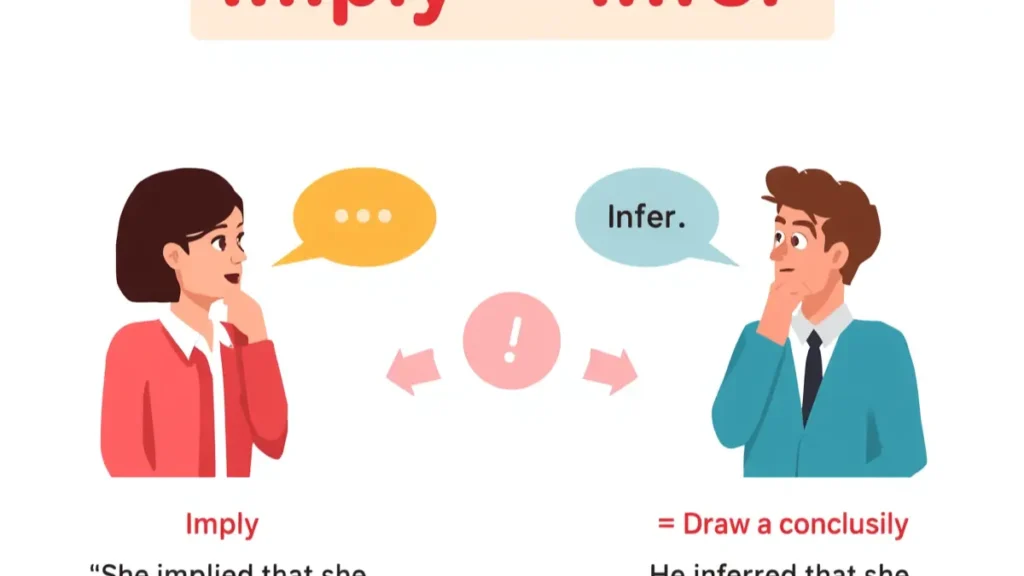
Many English learners mix up imply or infer when reading or writing sentences. You may hear someone say, “He implied that I was wrong,” or “I inferred that she was upset,” and feel unsure about which word to use. This confusion is very common, which is why thousands of people search for imply or infer every month.
The problem happens because both words are connected to hidden meanings. One person gives a message indirectly, and another person understands it. But the roles are different. Using the wrong word can change the meaning of your sentence completely.
Understanding, imply or infer helps you communicate clearly in writing, speaking, exams, and professional communication. For example, saying “I inferred you are angry” is correct, while “I implied you are angry” may be incorrect depending on who is speaking.
In this guide, you will learn the difference between imply or infer, their origin, grammar rules, examples, common mistakes, FAQs, and practical usage tips. By the end, you will confidently know who implies and who infers.
Imply or Infer – Quick Answer
Simple Rule
- Imply = to suggest something indirectly (speaker/writer does this)
- Infer = to understand or guess meaning (listener/reader does this)
Examples
✅ She implied that she was unhappy.
✅ He implied the meeting was canceled.
✅ I inferred that she was upset.
✅ They inferred the answer from the clues.
Easy Memory Trick
- Imply = Send the message
- Infer = Receive the message
Read more: Learnt or Learned: Which Spelling Is Correct ?
The Origin of Imply or Infer
Both words come from Latin roots and entered English through Old French.
Origin of “Imply”
The word imply comes from Latin implicitus, meaning “to involve or fold in.” It later evolved to mean “suggest indirectly.”
Origin of “Infer”
The word infer comes from Latin inferre, meaning “to bring in” or “to conclude.”
Why Confusion Exists
The confusion happens because:
- Both deal with hidden meaning
- Both appear in conversations and writing
- People often use them interchangeably in casual speech
- The actions are closely connected
However, grammar separates them clearly:
- One person implies
- Another person infers
British English vs American English Spelling
There is no spelling difference between British and American English for imply or infer. The words are spelled the same in both forms of English.
Read more: Adviser or Advisor: Which Spelling Is Correct ?
Comparison Table
| Usage | British English | American English |
| Imply | imply | imply |
| Infer | infer | infer |
| Meaning rules | Same grammar rule | Same grammar rule |
| Formal writing | Strict usage | Strict usage |
Examples
British English
- The teacher implied the answer.
- I inferred the meaning.
American English
- The manager implied a delay.
- She inferred the conclusion.
Which Spelling Should You Use?
Since spelling is the same, focus on correct usage and context.
Use “Imply” When:
- You are speaking or writing a message indirectly
- You are suggesting something without saying it clearly
Examples
- He implied that I was late.
- The message implied a warning.
- She implied disagreement.
Use “Infer” When:
- You are interpreting a message
- You are understanding hidden meaning
Examples
- I inferred he was angry.
- They inferred the truth from clues.
- She inferred the meaning quickly.
Global Advice
For all English users:
- Speaker = imply
- Listener = infer
Common Mistakes with Imply or Infer
Mistake 1
❌ I implied from his words that he was sad.
✅ I inferred from his words that he was sad.
Mistake 2
❌ He inferred that I was lying. (if he is speaking indirectly)
✅ He implied that I was lying.
Mistake 3
❌ The text inferred a warning.
✅ The text implied a warning.
Mistake 4
❌ She implied the meaning correctly.
✅ She inferred the meaning correctly.
Imply or Infer in Everyday Examples
In Emails
- The manager implied changes in the schedule.
- I inferred the deadline had been extended.
In News Writing
- The report implied economic growth.
- Analysts inferred future trends.
On Social Media
- His post implied he was unhappy.
- I inferred a deeper meaning.
In Formal Writing
- The data implied a strong correlation.
- Researchers inferred results from the study.
Imply or Infer – Google Trends & Usage Data
Search interest for imply or infer remains high because learners struggle to separate speaker vs listener roles.
Popular Countries
| Country | Search Interest |
| United States | Very High |
| United Kingdom | High |
| India | Very High |
| Pakistan | High |
| Canada | High |
Why People Search It
People often search this keyword when:
- Writing essays
- Preparing exams
- Learning English grammar
- Improving writing clarity
- Studying communication skills
Common Contexts
| Context | Common Word |
| Speaker meaning | Imply |
| Listener meaning | Infer |
| Academic writing | Both |
| Casual speech | Often mixed |
Comparison Table: Imply vs Infer
| Feature | Imply | Infer |
| Role | Speaker | Listener |
| Action | Suggests indirectly | Understands meaning |
| Direction | Outgoing message | Incoming message |
| Example | He implied anger | I inferred anger |
| Grammar Use | Active communication | Interpretation |
FAQs About Imply or Infer
What is the main difference between imply and infer?
Imply is used when someone suggests something. Infer is used when someone understands it.
Who implies and who infers?
The speaker implies, and the listener infers.
Can imply and infer be used interchangeably?
No. They have different grammatical roles.
Is “infer” more formal than “imply”?
Both are equally formal in writing.
Why do people confuse imply and infer?
Because both relate to hidden meanings and indirect communication.
Are imply and infer used differently in UK and US English?
No. Both follow the same rules in all English forms.
How can I remember the difference easily?
Remember: Imply = I speak, Infer = I understand.
Conclusion
Understanding imply or infer is essential for clear communication in English. These two words are closely related but have very different roles. “Imply” is used when someone suggests something indirectly, while “infer” is used when someone understands or interprets that suggestion.
Many learners confuse these words because both deal with hidden meanings. However, the key difference is simple: the speaker implies, and the listener infers. Once you remember this rule, your writing and speaking become much clearer and more accurate.
There is no spelling difference between British and American English, so the same grammar rules apply worldwide. Whether you are writing essays, emails, or professional reports, using imply and infer correctly helps you sound more confident and intelligent.
With practice, this distinction becomes natural, and you will no longer mix these two important English words.

I am Bahadar Ali, a professional content writer and the author behind GrammarDrive.com. I am passionate about making grammar simple and accessible for everyone. Through my writing, I aim to help learners and professionals communicate with clarity and confidence.