Many English learners and even native speakers get confused between “further” or “farther.” Both words look similar, and both seem to talk about distance or progress. Because of this, people often search online to find a clear and simple rule.
The confusion usually happens when someone is writing an essay, email, or formal document and suddenly stops to ask: Which one is correct?
This article solves that problem in a very simple way. You will learn the exact difference between further and farther, when to use each word, and why both exist in modern English. We will also explore British and American spelling habits, common mistakes, and real-life examples.
By the end, you will never feel unsure again. You will know when to use farther for physical distance and further for abstract ideas or additional information. This guide is written in very easy English so anyone can understand it quickly and use it with confidence.
Further or Farther – Quick Answer
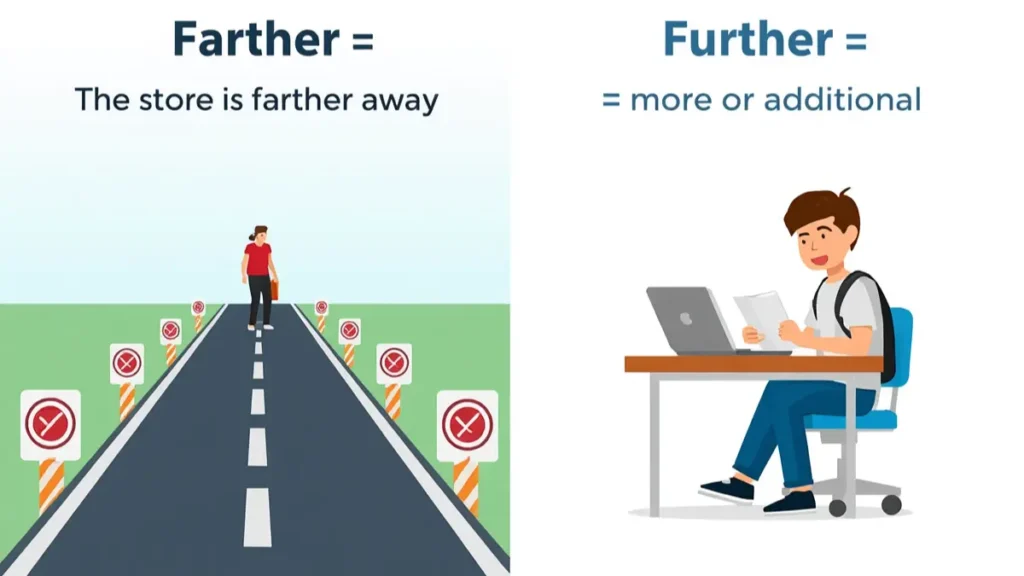
The simple rule is:
- Farther = physical distance
- Further = additional or abstract meaning
Examples:
- I ran farther than you. (distance)
- We need to discuss this further. (more discussion)
- The shop is farther down the road. (distance)
- Do you have any further questions? (extra)
👉 Quick trick:
If you can measure it in meters or miles, use farther.
If it means “more” or “additional,” use further.
Read more: Affect or Effect: What’s the Difference ?
The Origin of Further or Farther
Both words come from Old English.
- “Further” comes from furþor, meaning “more forward” or “additional.”
- “Farther” developed later from “far,” meaning “distant.”
Originally, both words were used more freely. Over time, English speakers started separating them:
- Farther → physical distance
- Further → abstract or figurative meaning
Today, grammar rules try to keep this difference clear, but in real life, people sometimes still mix them.
British English vs American English Spelling
Both British and American English use further and farther, but usage habits differ slightly.
- British English: prefers further in most cases
- American English: clearly separates farther (distance) and further (abstract)
Comparison Table
| Meaning Type | British English Usage | American English Usage |
| Physical distance | further / farther | farther |
| Additional meaning | further | further |
| Formal writing | further | further |
| Informal speech | both | both |
👉 Key point: Americans are stricter about the rule than British English.
Read more: Burnt or Burned: Which Spelling Is Correct?
Which Spelling Should You Use?
Your choice depends on your audience:
- 🇺🇸 US audience → Use strict rule: farther (distance), further (extra meaning)
- 🇬🇧 UK / Commonwealth → Both are fine, but “further” is more common
- 🌍 Global writing (blogs, SEO, academic) → Follow American rule for clarity
👉 Best practice:
If you are unsure, use:
- Farther for distance
- Further for everything else
Common Mistakes with Further or Farther
Here are common errors:
❌ Wrong: I need to walk further to the shop (distance)
✔ Correct: I need to walk farther to the shop
❌ Wrong: We need to go farther in this topic (discussion)
✔ Correct: We need to go further in this topic
❌ Wrong: Any farther questions?
✔ Correct: Any further questions?
👉 Tip: Most mistakes happen when people ignore the “distance vs idea” rule.
Further or Farther in Everyday Examples
Emails
- Please contact us if you have further questions.
- We are located farther from the city center.
News Writing
- The investigation will continue further next week.
- The earthquake was felt farther than expected.
Social Media
- “I can’t run any farther 😅”
- “Let’s talk about this further later.”
Formal Writing
- The study requires further analysis.
- The village lies farther north.
Further or Farther – Google Trends & Usage Data
Search behavior shows:
- “further or farther” is searched most in:
- United States 🇺🇸
- India 🇮🇳
- Pakistan 🇵🇰
- United Kingdom 🇬🇧
- People mainly search it for:
- Essay writing
- Grammar checks
- IELTS / TOEFL preparation
- SEO content writing
👉 Insight:
Most confusion comes from learners mixing British and American grammar styles.
Comparison Table: Further vs Farther
| Word | Meaning Type | Example Sentence |
| Further | Additional / extra | Do you need further help? |
| Further | Abstract progress | Let’s discuss this further. |
| Farther | Physical distance | He ran farther than me. |
| Farther | Measurable space | The store is farther away. |
FAQs – Further or Farther
1. What is the main difference between further and farther?
Farther is for distance. Further is for extra or abstract meaning.
2. Can I use “further” for distance?
Yes, especially in British English, but “farther” is more precise.
3. Is “farther” correct in American English?
Yes, it is the correct form for physical distance.
4. Which is more common in writing?
“Further” is more common overall in formal writing.
5. Is “further” more formal than “farther”?
Yes, “further” is often used in academic and formal contexts.
6. Can they be used interchangeably?
Not ideally. Modern grammar separates them by meaning.
7. Which one should I learn first?
Learn the rule: farther = distance, further = extra meaning.
Conclusion
Understanding further or farther is simple once you know the basic rule. The confusion exists because both words come from the idea of “more distance or progress,” but modern English separates their meanings. Farther is used when you talk about physical distance you can measure. Further is used when you talk about extra information, ideas, or progress.
In real life, both words are common in writing, speaking, emails, and academic work. If you are learning English or writing content, following the simple rule will keep your writing clear and professional. American English prefers a strict separation, while British English is more flexible, but both understand the difference.
Now you can confidently use further or farther without hesitation. Just remember: distance = farther, everything else = further. This small rule will instantly improve your grammar accuracy and writing clarity in exams, blogs, and professional communication.

I am Arshman Ali a professional English writer and English professor with a passion for language and a commitment to excellence. I bring precision and clarity to my writing, and the same high standards into my classroom. For me, language is not just a profession it is a purpose.