Have you ever paused while speaking or writing and wondered whether you should use bring or take? You are not alone. Many English learners and even native speakers sometimes confuse these two common verbs.
At first, they seem similar because both involve moving an object from one place to another. However, the direction of movement makes all the difference.
People search for bring or take because using the wrong word can make a sentence sound unnatural or confusing. For example, should you say, “Bring your laptop to my office” or “Take your laptop to my office”? The answer depends on where the speaker is in relation to the movement.
Understanding bring or take is important for clear communication in conversations, emails, school assignments, and professional writing. Once you learn the simple rule, choosing the correct word becomes easy.
This guide explains the meanings, origins, examples, common mistakes, and practical usage of bring or take so you can use them confidently in everyday English.
Bring or Take – Quick Answer
Simple Rule
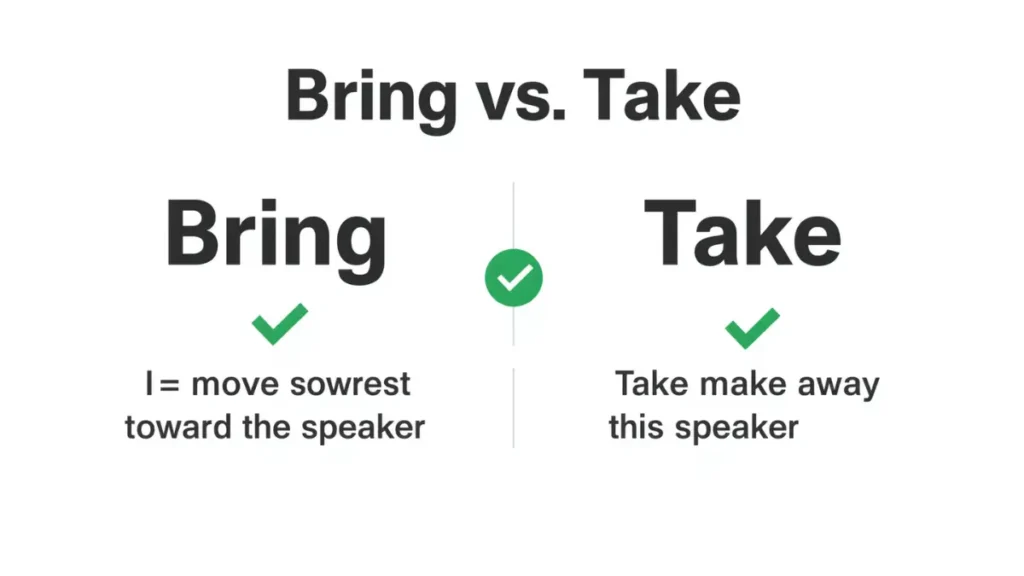
- Bring = Move something toward the speaker or destination.
- Take = Move something away from the speaker or starting point.
Examples
✅ Please bring your notes to my office.
✅ Please take these documents to the manager.
❌ Please bring these documents away from here.
❌ Please take your notes to me. (Usually incorrect when the speaker is the destination.)
Easy Memory Trick
- Bring = Come Here
- Take = Go There
Read more: Affect or Effect: What’s the Difference
The Origin of Bring or Take
Origin of “Bring”
The word bring comes from Old English bringan, meaning “to carry or convey to a place.” It has always referred to movement toward a person or location.
Origin of “Take”
The word take comes from Old Norse taka, meaning “to grasp, seize, or carry away.” It developed into the modern meaning of moving something from one place to another.
Why Confusion Exists
People confuse these words because:
- Both involve movement.
- Both can describe carrying objects.
- The difference depends on perspective.
- Some languages use a single word for both actions.
British English vs American English Spelling
There is no spelling difference between British and American English.
Comparison Table
| Word | British English | American English |
| Bring | Bring | Bring |
| Take | Take | Take |
| Meaning | Same | Same |
| Usage | Same | Same |
Examples
British English
- Please bring the report to the meeting.
- Take this package to reception.
American English
- Bring your ID to the event.
- Take the documents to the office.
Which Spelling Should You Use?
The spelling is identical worldwide. Focus on the meaning.
Use “Bring” When:
- Something moves toward you.
- Someone comes to your location.
- The destination is where the speaker is.
Examples
- Bring your passport to me.
- Can you bring some snacks?
Use “Take” When:
- Something moves away from you.
- Someone goes to another location.
- The destination is elsewhere.
Examples
- Take this letter to Sarah.
- Please take your umbrella home.
Global Advice
No matter where your audience is located, the rule remains:
Bring = toward. Take = away.
Common Mistakes with Bring or Take
Mistake 1
❌ Take your homework to me tomorrow.
✅ Bring your homework to me tomorrow.
Mistake 2
❌ Bring this package to the post office.
✅ Take this package to the post office.
Mistake 3
❌ Can you take some drinks to the party? (when speaking from the party location)
✅ Can you bring some drinks to the party?
Mistake 4
❌ Bring these books back home.
✅ Take these books back home.
Bring or Take in Everyday Examples
In Emails
- Please bring your identification to the meeting.
- Take the signed contract to the legal department.
In News Writing
- Volunteers brought supplies to affected families.
- Rescue teams took injured people to hospitals.
On Social Media
- Don’t forget to bring snacks!
- Take your camera on the trip.
In Formal Writing
- Participants should bring proof of registration.
- Staff will take documents to the archives.
Bring or Take – Google Trends & Usage Data
The keyword bring or take is commonly searched by English learners worldwide.
Popular Countries
| Country | Search Interest |
| India | Very High |
| Pakistan | Very High |
| United States | High |
| United Kingdom | High |
| Philippines | High |
Why People Search This Keyword
People search it when:
- Learning English grammar.
- Preparing for exams.
- Writing professional emails.
- Improving speaking skills.
- Translating from another language.
Common Contexts
| Context | Common Usage |
| Conversations | Bring or Take |
| Education | Grammar lessons |
| Business | Emails and instructions |
| Travel | Directions and planning |
Comparison Table: Bring vs Take
| Feature | Bring | Take |
| Direction | Toward speaker | Away from speaker |
| Focus | Destination | Starting point |
| Example | Bring it here | Take it there |
| Movement | Coming | Going |
| Memory Tip | Come Here | Go There |
FAQs About Bring or Take
What is the main difference between bring and take?
Bring means moving something toward a person or place, while take means moving it away.
Is it “bring to” or “take to”?
Both are correct depending on direction.
Can I use bring and take interchangeably?
Not usually. They express different directions of movement.
Why do learners confuse bring and take?
Because both involve carrying or moving objects.
Which is correct: bring it to me or take it to me?
Usually, “bring it to me” is correct because the movement is toward the speaker.
Is there a British and American difference?
No. Both varieties follow the same rule.
How can I remember the difference?
Think: Bring = Come Here and Take = Go There.
Conclusion
Understanding bring or take is one of the easiest ways to improve your English communication. Although both words describe moving something, their meanings depend on direction. Bring means moving something toward a person or place, while take means moving something away from a person or place.
This distinction helps make your speech and writing more precise. If you are sending emails, giving instructions, writing reports, or speaking with friends, choosing the correct word improves clarity and professionalism.
Fortunately, there is no spelling difference between British and American English, so the same rule works everywhere. Remember the simple trick: Bring equals come here, and take equals go there.
With regular practice and attention to context, you will quickly master bring or take and avoid one of the most common English grammar mistakes.

I am Bahadar Ali, a professional content writer and the author behind GrammarDrive.com. I am passionate about making grammar simple and accessible for everyone. Through my writing, I aim to help learners and professionals communicate with clarity and confidence.