You are composing an email message. You type in, “we past the deadline,” and it’s not quite right. Or perhaps you type “in the passed” and your spell-check doesn’t catch it, but it just sounds bad. You’re not alone. Two of the words that are most confused in English, and it’s no wonder, are passed and past.
They are pronounced precisely the same. Both have to do with the concept of time. And they have the same basic word: pass. However, these two are radically different in a sentence. One is a verb. The other is all but the first mentioned – an adjective, a noun, a preposition, or an adverb.
The rules, a few examples and a memory trick will make it easy to know when to use passed and when to use past, and this will come to you quickly. At the end of it all you won’t have to guess.
Did You Pass or Did You Fail – that is the question.
The short form is:
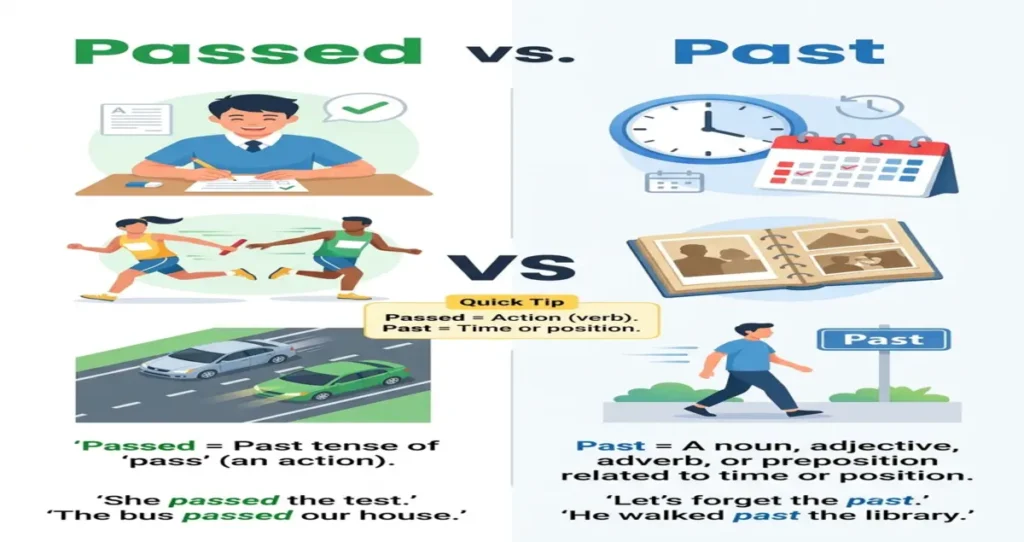
- The word passed is always a verb. The past-tense form of the word “pass. Use it when someone did something – moved by, handed over, or succeeded at. Example: She took an exam and got through it.
- The definition of the past is NEVER a verb. It refers to past time, place, or an event that has occurred. It may modify an adjective, noun, preposition or adverb. Sample: We went through the shop.
Rewrite it in a way that it can be changed to another verb such as “moved” or “handed,” then use passed. If not, use past.
Read more:Advice vs Advise: What’s the Difference? (+ Easy Examples
Explain the meaning of each word.
Passed
Part of Speech: verb. Definition: to move, go by, hand over, or succeed at, something, as in the past.
Part of speech: Verb (past tense/past participle)
Use: Use anytime you are telling about something that has already happened, in conjunction with the verb “pass.”
Common contexts: exams, time passing, giving objects, driving past an object, death (a mild form of death).
Memory trick: The word “pass” is hidden inside the word “passed” and it’s an action.
Examples:
- He offered to pass the salt across the table.
- She had no problem passing the driving test on the first attempt.
- The doctor came after two hours had passed.
- My grandfather died this past spring.
Read more:Sung or Sang which word you use from these
Past
Noun: A word that refers to something that has occurred, a time in the past, or a change from one place to another.
Part of speech: Adjective, noun, preposition or adverb (not a verb)
Use it: when talking about a period of time, a place (beyond or by), or history in general.
Common contexts: History, describing time (in the past week), directions (go past the bank).
Trick: Past is a place in time, not an action, to remember this.
Examples:
- People used to write letters rather than text. (noun)
- She has had her share of problems. (noun)
- The past few days have been stressful. (adjective)
- Cross the traffic lights and turn left. (preposition)
- He shot by without a word. (adverb)
Key Differences
| Feature | Passed | Past |
| Meaning | Moving, giving or taking over action. | A point in time or place that has already occurred/been passed |
| Part of Speech | Verb only | The words that describe nouns and pronouns are called adverbs, adjectives and prepositions. |
Common Usage | Tell about someone’s action | Making a comparison of time or place with respect to the present |
| Example | She successfully completed the test. | That’s in the past now. |
| Easy Memory Trick | Always includes the action “pass”.Always has the action “pass. | It’s not a movement, it’s a fixed point. |
Word Origin (Etymology)
Both of these words come from the same root, Old French word passer, which has the meaning of “to pass” or “to go by”. The word means “a step” or “a pace” and was derived from the Latin word passus.
Though the English-speaking people gradually wanted a verb form (to pass) and a way to describe something (time or place) that had already been “passed” — that is, a description rather than an action. That division resulted in a splitting of the verb split, but also of everything else.
It is natural that they are confused even now, as they share a common origin and pronunciation. There are many examples of these close cousins in English, and this is one of the more difficult ones.
Difference between British English and American English.
Fortunately, it’s not that there’s a significant difference in the way passed and past are used in British English versus American English. Both dialects use the same rule: “passed” is the word for the verb, “past” is for the rest.
| FeatureSpelling | British EnglishSame | American EnglishSame |
| Pronunciation | Same | Same |
| Preferred Usage | Verb vs. non-verb rule | There is a rule for verbs and non-verb. |
| Example | He passed by the store. | He went past the shop. |
It’s a grammar problem, and not one that is limited to any specific region — it’s a problem that native speakers and other speakers of English have found themselves in every once in a while.
Which one should you use?
American English readers: Just follow the general rule of the game — there are no American exceptions to this rule.
British readers: This is the same rule. No British spelling variant to be concerned about.
International readers: For those whose native language is not English, they should consider one question: “Can the word be changed to an action verb such as ‘moved’ or ‘went by’? If yes, use passed.
Academic writing: when it comes to precision, this is the key. Always remember to double check each occurrence, particularly phrases such as “in the past” (which is a noun phrase, not a verb form, so therefore it has to be past, not “passed”)
Business writing: Common trouble spot is deadlines — “we passed the deadline” (verb, correct) vs. “the deadline is in the past” (noun, correct).
Common Mistakes
1.❌ The deadline has past. ✅ The deadline has passed. Why: This needs a verb to show the action of the deadline going by.
2.❌ We must let bygones be bygones. ✅ We must let bygones be bygones! Why: This is a fixed expression and past is an adjective, not an action.
3.❌ In the passed, this wasn’t a problem. ✅ In the past, this wasn’t a problem. Why: “In the past” is a noun phrase, not a verb.
4.❌ She walked passed me without saying hi. ✅ She walked past me without saying hi. Why: “Walked past” is used to indicate location, not to indicate passing something.
5.❌ He past the ball to his teammate. ✅ He passed the ball to his teammate. Why: This is a verb action statement that is clear — passing a ball.
6.Past is correct, but passed is not correct here either: I’ve been sick (for) the past week. / I’ve been sick (for) this past week. / This is another way to write it, so check word order. Why: The past is the right adjective, but be sure the sentence flows.
7.❌ This year, time has gone quickly. ✅ Time went quickly this year. Why: “Has passed” is a verb phrase (present perfect tense).
8.❌ This is all in the past now. ✅ This is all in the past now. Why: The noun form of the past is always “in the past”.
9.❌ We past through three cities on our trip. ✅ We passed through three cities on our trip. Why: Passed through means that passed on way through.
10.❌ My past experiences passed down to my children. ✅ My past experiences were passed down to my children. Why: Past describes the experiences (adjective); passed down is the verb action.
Everyday Examples
CfOs: “I wanted to make sure to follow up because we have now passed the deadline for the original email.
School writing: “Students would be required to write by hand when it came to school writing.
Business communication: “We had better sales in the last quarter than we thought we would have.
News: “The bill was debated for months before it was passed by lawmakers.
The books were always in his mind: “He would often think about his past, wondering how things might have been different.
Social media: “I can’t believe that this summer has already slipped by so quickly!
Dinner conversations: “Don’t stop at the gas station”Everyday conversations: “Just drive past the gas station”
Grammar Tips
Sentence position: Passed usually follows a subject and comes before an object (“She passed the test”). Past is often used with a preposition or is a noun (walk past, in the past).
Phrases: “Passed away,” “passed down,” “passed out,” “passed the time” (verb phrases) vs. “in the past”, “past experiences”, “past due” (past as adjective/noun).
Punctuation: There are no special rules for punctuation, but be careful with commas in sentences with time clauses (e.g., “In the past, we did things differently.
The simple past form of the verb is “passed” and the past participle form is “passed.” Past has no verb forms because it isn’t a verb.
Easy Memory Tricks
- The “action test”: If you can replace the word with “moved”, “handed”, etc., then it is OK.
- The double-S trick: Passed has two S’s, movement is in the word action – the S’s are movement lines.
- The “was” trick: Past is used for something that is already occurring, such as a photograph, that doesn’t move; that is not a verb.
- The phrase check:If the sentence contains ‘in the’, ‘for the’ or ‘over the’ immediately before the word, this is almost always past (as in ‘in the past’ ‘for the past week’).
Google Trends & Usage
Passed vs. past is frequently used and tends to be more frequent throughout the year, especially near exam time, near the end of the year, and grammar check periods in workplace writing.
This pair is commonly looked for when dealing with proofreading emails, essays or reports because the spell checker will not highlight it as an error: both words are spelled correctly but used incorrectly.
This kind of confusion is widespread throughout the world, particularly among students and non-native speakers of English, since words that are phonetically similar but have different meanings are referred to as homophones, which are more difficult to tell apart in written text than in spoken. Most of the time the searcher is motivated by what they want to do with the results. In other words, the searcher wants an easily understood, quick rule that they can use right away.
Related Words
Here are other word pairs that are often confused that you may want to review:
- Affect vs Effect – Affect is typically a verb (to affect, influence) and effect is a noun (a result).
- Accept vs. Except – Accept – to receive or agree to something, Except – “excluding.”
- Principal vs. Principle – Principal (relational) is someone leading or a principal part and principle (relational) is a collection of ideas, values, or beliefs.
Frequently Asked Questions
1. What is the correct spelling of the word “passed away” or “past away”? It’s always passed away. This is a verb phrase that has the verb form (passed), and is used to describe somebody who dies.
2. Which is it, “the past few days” or “the passed few days”? It’s been the last couple of days. In this instance, ‘past’ is used as an adjective to modify ‘days’ and not as an action.
3. Is there ever a situation where the word ‘past’ can be used as a verb? No. 2: In the present tense, the word “past” is never a verb. The only time passed is used as a verb is to describe its passage in time.
4. Passed by” or “past by” is correct? Is passed is correct. An action word phrase that means something moved by or went by.
5. What’s an easy way to remember the difference? If you can, ask yourself if the word is a verb. If yes, use passed. Use past if it refers to a time, place or state.
6. Is it half past 2 or half passed 2? It’s half past two. It’s a time expression that is fixed in the past, and not the verb passed.
7.Explain why spell-checkers will not catch this error.? Both are correct spelling words that are passed and passed. A misspell checker will only be able to identify misspelled words, not the misused homophones such as this one.
8. Do you think the statement “past due” or “passed due” is the correct one? The answer is “Past due. It is a phrase that modifies a bill or payment, rather than an action.
9. Is the rule adapted in formal or academic writing? No, it does not change anywhere. When it comes to formal writing, proofreading will become more important because the mistake might be easy to overlook.
10. Do you say “10” differently when you say ‘passed’ or ‘past’? No, they’re pronounced exactly the same. They cannot be distinguished unless they serve different functions in a sentence.
Key Takeaways
- Passed is always a verb — it is a word that tells about an action that has occurred.
- The past is not a verb: it is a time, a place or a state that is already in existence.
- A tip: try substituting the word with “moved” or “handed. If it does, use “passed”.
- The word past is always used for common words and expressions such as “in the past,” “half past two,” and “past due.
- Passed is always used in common phrases such as, “passed away,” “passed down,” and “passed the test.
There’s no difference in usage between British and American English.
Conclusion
Now the question is which word is an action or which word is a point in time or place? Use passed if it is an action – something was given, moved by, or achieved by someone. When the sentence is referring to a past event, a place or a general reference to time, use past.
Keep in mind the rapid test: substitute the word with “moved” or “handed. If that is the case, you have been passed. If it sounds unnatural, then you need past.
Be aware of common pitfalls such as “in the past,” “half past two,” and “passed away,” as those set expressions can stumble even the seasoned writer.
The rules, examples and memory tricks taught in this guide will help you use these words correctly the next time you use them. Next time you type one of these words, you won’t need to take a guess — you’ll know it.

I am Bahadar Ali, a professional content writer and the author behind GrammarDrive.com. I am passionate about making grammar simple and accessible for everyone. Through my writing, I aim to help learners and professionals communicate with clarity and confidence.