You’re composing an email. You wish to ask your boss for assistance. Should you or “advise“? Do you say “thank you for your advise” or “thank you for your advice”?
As soon as they stop you for a second, you’re not alone. Every day, millions of people confuse the terms advice and advise. They’re nearly identical in sound. Both are derived from the same basic word. The rules of English spelling do not help us to distinguish which one is a noun and which one is a verb.
This error isn’t a simple typographical error. Even though you have excellent ideas, if you use the wrong word in a resume, business letter or school essay, you will come across as careless.
In this guide, you’ll learn a simple, permanent way to remember the difference. Real-life examples from e-mails, discussions, and normal writing. Don’t hesitate, it will be obvious at the end.
Advice vs Advise – Quick Answer:
Here’s the short version.
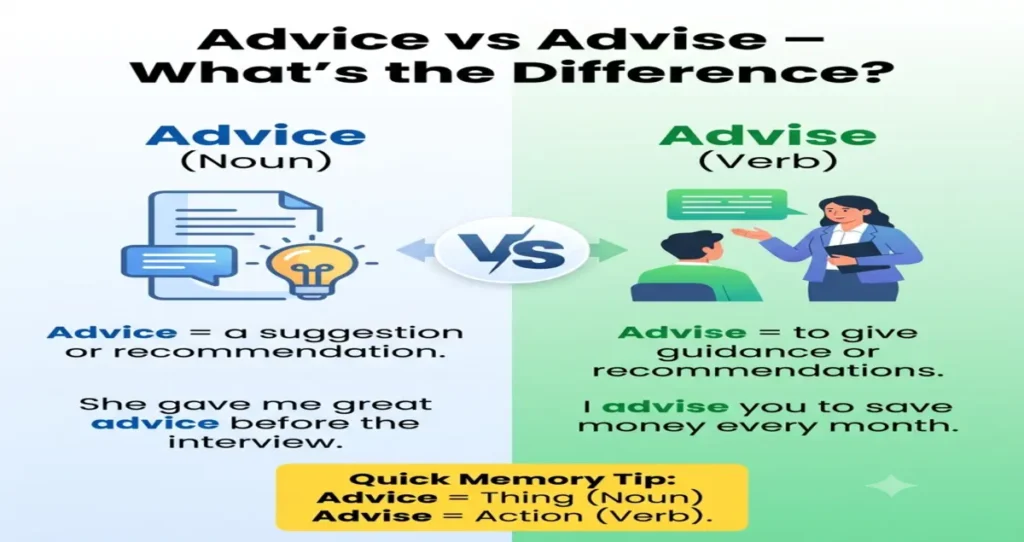
- Advice is a noun. A recommendation or proposition. “She provided me with lots of good advice.”
- Advise is a verb. It means to give a suggestion or recommendation. “She will would guide me in my career.
Tip: Use advice instead of the word if you can get rid of the word “suggestion” or “recommendation”. When it’s possible to use “suggest” or “recommend” instead of “advise,”
you should.
Example: “Can you advise me?” → “Can you recommend something to me?” ✅ Example: “I need your advice.
Read more:Difference between Swam and Swum and which is correct
Meaning of Each word
Advice (noun)
Definition: A recommendation or suggestion about what someone should do.
The word is pronounced almost as if it were a single syllable.The pronunciation of the word advice is like it is only one syllable in length.
The part of speech: a noun, which does not have a count form (so, you do not say, for example, “an advice” or “advices”)
Use it when: You refer to guidance or opinion that someone gives, not the giving of the guidance.
Typical contexts: Career advice, tips on relationships, medical advice, financial advice, life tips, etc.
Memory aid: The word for advice is “C” and the word for “recommendation” is “C. So, the term advice is a noun and it means a thing you receive, such as a gift with a ‘C’ ribbon on it.
Read more:Hanged or Hung: What’s Difference and Which You Use
Examples:
- I have always remembered my grandmother’s words.
- He asked for advice before signing the contract.
- This is the best thing I’ve ever heard.
Advise (verb)
Definition: To give a recommendation or suggestion to someone; to counsel or inform.
Origin: Latin, from “avidare,” meaning “to desire to eat.There are several variations of this
word.The word is spelt in a variety of different ways.
Part of speech: Verb (action word)
Use it when: somebody is recommending.
Typical scenarios: Career counseling, law work, financial counseling, teaching, mentoring.
Memory trick: tell your students that “Advise” has an “S” and “verb” backwards-ish (but just as an aside, “verb” backwards is also “verb”). Or, simply: “S” is a sound that is like a buzzing action like a verb doing something.
Examples:
- I recommend you to check that the contract is well read.
- The lawyer will give us counsel as to our legal remedies.
- She counsels small business on marketing strategy.
Key Differences
| Feature | Advice | Advise |
| Meaning | A proposal or recommendation that is offered. | To make a suggestion/recommendation |
| Part of Speech | Noun | Verb |
| Common Usage | Advice needed / good advice | Please give me your advice / I recommend you |
| Example | Take my advice. | I advise caution. |
| Easy Memory Trick | “C” = noun, such as a gift that you receive | “S” = verb – is an action you take |
Word Origin (Etymology)
Both are derived from the same origin, the Old French word avis, “opinion” or “view”, which in turn is from the Latin phrase ad visum, which means something like “according to what is seen” or “in view of”.
English speakers over the years had to have a noun (the opinion) and a verb (the act of giving the opinion). In the case of the English language, it can do this by changing a c to an s: practise (verb) vs practice (noun), mostly used in British English; or license (noun) vs license/practise patterns in general.
It is this common source that is also responsible for the similarity of the words in use today. These are in fact two renditions of the same concept, divided to perform two separate tasks within the sentence.
British vs American English
Fortunately, British and American English spell and use advice and advise the same way. As with other rarely spelt pairs like practice/practise and licence/licence, there is no regional difference in spelling for this pair.
| Feature | British English | American English |
| Advice (noun) spelling | advice | advice |
| Advise (verb) spelling | advise | advise |
| Pronunciation | ad-VYCE / ad-VYZE | ad-VYCE / ad-VYZE |
| Preference | Same rule applies | Same rule applies |
Wherever your readers may be, the noun-vs-verb rule for advice and advise remains unchanged.
Which one do you use?
American English: advising, advise. No regional turn around to be concerned with.
British readers: The rule applies to you as well. To avoid confusion with practice/practise, this pair does not change spelling in British English.
International readers (ESL): Pay attention to the sound. The word has an ‘s’ sound at the end, such as in the word “ice. The word “advise” has a “z” sound at the end of it, as in the word “wise. When you can hear the difference, it’s usually obvious what it’s spelled.
Academic writing: Double check this pair. This is one of the most frequent mistakes in student essays and is a favorite of the professors.Recruiters and managers will catch your eye with this old school word when you write business. The verb was always used in business as an imperative, as in “Please advise.”
Casual communication: If you’re communicating via text or informally, then little mistakes are acceptable, but it’s important to make it a habit early on.
Common Errors
1 ✅ Can you give me some advice? ❌ Can you give me some advise? Why: Again, “Advise” is a verb and requires a noun (a thing to give) — hence, “advice.
2. I will give you my advice tomorrow. ❌ I will advice you tomorrow. ✅ I will advise you tomorrow. Why: The word after “will” must be a verb, in this case, “advise” (the action).
3. NOT: She gave great advise at the meeting. ✅: She gave great advice at the meeting. Why: The noun (s. object) that follows “gave” is the thing given, which is advice.
4. ❌ He advices his clients on taxes. ✅ He advises his clients on taxes. Why: Verbs ending in ‘he/she/it’ normally add an ‘s’ to the end of the word, but the word ends in ‘e’ and therefore an ‘s’ is added to the end.
5. ❌ Please send your advises. ✅ Please send your advice. Why? The term is uncountable and doesn’t have a plural form such as “advices”.
6. ❌ My advise is to wait. ✅ My advice is to wait. Why: “My” is used to show possession of a thing, which means the word has to be a noun; it must be “advice.
7. ❌ I need to advice my team about the change. ✅ I need to advise my team about the change. Why: “To” + base verb means “advise.
8. ❌ That was a helpful advice. ✅ That was helpful advice. Because: Advice is an uncountable noun and does not agree with the singular definite article ‘a’ or ‘an’.
9. ❌ The doctor prescribes for rest a week. ✅ The doctor prescribes a week of rest. Why: The verb form “advises” should be used for the subject “the doctor” (third person singular).
10. ❌ Thank you for the advise. ✅ Thank you for the advice. Why: The + noun structure requires the word for the thing that is being thanked.
Everyday Examples
Telephone calls: “Let me know what to do by Friday.
School writing: “My teacher told me to look at my thesis statement and make some changes before I got more advice from my peers to change my mind.”
Business communication: “During downturns, our financial advisor gives people the advice to diversify, and many have saved their portfolios as a result.
Air quality plunged, and News: “Health officials recommend that residents stay indoors.
The old sailor’s saying came to him in his mind, “Never trust a calm sea.
Social Media: Individuals are asking on social media platforms if they should accept a job offer.People are asking on social media “Should I take this job offer? 🤔”.
Everyday exchanges: “Can I ask you for some advice? “Well what do you know, “What’s up?
Grammar Tips
Sentence position: Advice is normally placed after verbs such as give, take, get, need, offer, follow, ignore. Typically, subjects follow advise, or modal verbs such as will, can, should, must.
Collocations with the word advice: good advice, bad advice, sound advice, legal advice, expert advice, piece of advice, take advice, seek advice.
Common collocations with advise: strongly advise, kindly advise, advise against, advise on, please advise, advise accordingly.
The verb form of advise: advise, advised (past), advising (present participle), advises (third person singular).
Punctuation note: ‘advice’ is uncountable so use ‘a piece of advice’, rather than ‘an advice’, when you need to talk about one piece of advice.
Easy Memory Tricks
- “C” is for a Concept (noun), “S” is for a Step (verb, an action).
- Consider a prACtiCe/adviCe pattern: nouns frequently have the “c.
- Read the word aloud: adviCe rhymes with a noun like a thing (Ice). Seeking advice is like seeking wisdom, adviSe rhymes with wiSe.
- Think of a wise owl giving advice to a student, and giving the student a scroll, and the scroll is the noun, the owl is the verb.
Google Trends & Usage
As a standalone word, gets searched much more often than “advise,” likely because people do search for advice on so many topics, such as relationship advice, career advice, legal advice, financial advice, etc.
The word “advise” is used more often in formulaic or professional settings, like business words such as “please advise” or questions about proper grammar usage.
There is much confusion between these two as many other languages have the same word in both noun and verb form, particularly for English learners. The search intent for ‘advice vs advise’ is nearly always seeking clarity on correct usage, whether it be about a particular sentence, email or a general understanding of grammar.
Related Words
Affect vs Effect: Affect is typically a verb meaning to impact and effect is typically a noun meaning result.
Accept vs Except: Accept – to agree to receive something; Except – to exclude something.
Principal and Principle :is Principal is defined as someone having authority over something or one of the most important elements while Principle is defined as a basic rule or belief.
Practice vs Practise: Same noun-verb combination, but different spelling in British English (practice = noun, practise = verb).
FAQs
Should it be ‘please advise’ or ‘please advice’? It’s “please advise.” It is a business word that is requesting someone to offer advice or directions. It is asking for some action (advice) so it should have the verb form “advise.
Is a word that can also be used as a verb? In standard English, is always a noun. When you’re talking about providing advice, you need the verb form, “advise.
Is “advices” a real word? Not in a normal modern English. The word is uncountable, meaning that it does not have a plural form. If you have to use several tips, use “pieces of advice”.
What is the trick for identifying which is the verb? Be aware that advise is similar to many action words in ending, ending with an “s” sound, as in revise and supervise. Those two are also verbs.
Spell “advisor” with an “s” or a “c”? The word is spelt with an ‘s’ – but this can be spelt as ‘advisor’ or ‘adviser’, both are correct spellings. It is a form of the verb “advise,” not a noun “advice.
Are these words different in British English vs American English? No. There is no difference in spelling or usage between British English and American for the words advice and advise, unlike some other pairs of noun/verb.
What is the difference between and “opinion”? Advice is a suggestion for action based on experience or knowledge, to make a course of action seem the most advisable. An opinion is a personal view or belief, it can be with or without a recommended action.
Why do so many people mix up these two words up? They appear to be very similar, come from similar roots, and have a spelling system that most people find unusual: nouns tend to end in “c,” verbs in “s.
When do you say ‘advise’ and when do you say ‘advice’? Yes. The “s” sound in the word is soft (as in “ice”) and the “z” sound is hard (as in “wise”) in the word “advise”. Hearing for this difference will assist you in spelling.
Is it OK to use both and “advise” in a sentence? Yes. For instance: “Follow your doctor’s recommendations. In this sentence, advise is the verb (the action of giving advice) and advice is the noun (the thing you are advising).
Key Takeaways
- Advice is a noun — what you get or give (a suggestion).
- Advise is a verb (the action of giving advice).
- Remember the “c” for noun and “s” for verb, this is a quick way of remembering it.
- Advice is uncountable, so never use an advice or advices.
- Businesses use the correct word, “Please advise,” not “Please advice.
- British and American English agree in the usage of both words.
- Pronounce the words: rhymes with “ice”, “advise” rhymes with “wise”.
Conclusion
Even seasoned writers stumble over this, but when it comes to the rule, it’s easy to grasp once you do. The noun is advice — the tip, the suggestion, or the thing that someone gives you. Advise is a verb (action word) — the action of giving that tip.
Have a look at the little but very important clue: “c” for the concept you get, “s” for the step someone takes to give it. Be careful of common pitfalls, such as please advice (which is wrong) and please advise (which is correct), and of course, do not make the word advice plural.
Now you have an easy, lasting solution to selecting the correct word, in emails, essays, and in everyday speaking. Next time you need to write one of these words, stop and do the trick, and write confidently.

I am Arshman Ali a professional English writer and English professor with a passion for language and a commitment to excellence. I bring precision and clarity to my writing, and the same high standards into my classroom. For me, language is not just a profession it is a purpose.