This confusion happens because English verbs change form depending on tense. Some verbs are simple, but irregular verbs like “wear” can be tricky. Using the wrong form may make your writing sound incorrect in emails, school work, business writing, or social media posts.
The good news is that the difference between wore and worn is easy to understand once you learn the grammar rule. In this guide, you will learn the quick answer, the history of the words, spelling and grammar differences, common mistakes, and real-life examples. You will also see comparison tables, FAQs, and practical advice to help you choose the right word every time.
Wore or Worn – Quick Answer
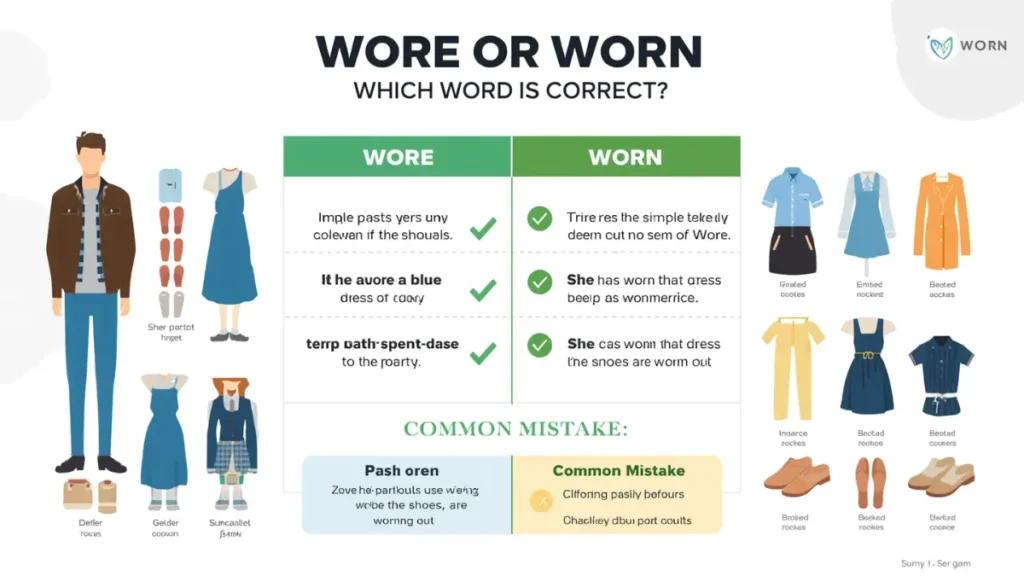
“Wore” is the simple past tense of “wear.”
“Worn” is the past participle of “wear.”
Examples
- I wore a blue jacket yesterday.
- She has worn that dress many times.
- They wore boots in the rain.
- He had worn the same hat for years.
Read more: Laying or Lying: What’s the Difference ?
Simple Rule
- Use wore for past actions.
- Use worn with helping verbs like:
- has
- have
- had
- was
- were
The Origin of Wore or Worn
The words wore and worn come from the Old English verb “werian,” which meant “to clothe” or “to protect.”
Over time, English changed and developed different verb forms. Like many irregular verbs, “wear” does not follow the normal “-ed” ending rule.
Read more; Bring or Take: What’s the Difference
Verb Evolution
| Form | Example |
| Base Verb | wear |
| Past Tense | wore |
| Past Participle | worn |
English kept these different forms because of historical language patterns from Germanic roots.
This is why:
- “I wear”
- “I wore”
- “I have worn”
all exist together today.
British English vs American English Spelling
There is no spelling difference between British English and American English for wore and worn. Both countries use the same forms.
The difference is mainly in grammar use and style preferences.
Comparison Table
| English Type | Past Tense | Past Participle | Example |
| British English | wore | worn | She has worn it before. |
| American English | wore | worn | He wore a suit yesterday. |
Important Note
Both American and British English follow the same grammar rule:
- Simple past → wore
- Perfect tense → worn
Which Spelling Should You Use?
You should choose the word based on grammar, not location.
Use “Wore” When:
- Talking about a finished past action
- No helping verb is used
Examples
- I wore sneakers yesterday.
- She wore red at the party.
Use “Worn” When:
- Using has, have, or had
- Talking about completed experiences
Examples
- I have worn this coat before.
- They had worn uniforms at school.
Audience-Based Advice
| Audience | Best Choice |
| US readers | Follow standard grammar |
| UK readers | Follow standard grammar |
| Global audience | Use simple and clear tense rules |
The grammar stays the same everywhere.
Common Mistakes with Wore or Worn
Many people mix these words because both refer to past actions.
Mistake 1
❌ I have wore this before.
✅ I have worn this before.
Mistake 2
❌ She worn a black dress yesterday.
✅ She wore a black dress yesterday.
Mistake 3
❌ They had wore boots.
✅ They had worn boots.
Easy Trick
If you see:
- has
- have
- had
then use worn.
If there is no helping verb, use wore.
Wore or Worn in Everyday Examples
In Emails
- I wore the company badge yesterday.
- I have worn the new uniform already.
In News Writing
- The actor wore a designer suit.
- The athlete had worn protective gear.
On Social Media
- I wore this outfit last weekend!
- She has worn this style for years.
In Formal Writing
- The witness wore a dark coat.
- The employee had worn safety equipment properly.
Wore or Worn – Google Trends & Usage Data
Searches for “wore or worn” are common in:
- United States
- United Kingdom
- India
- Pakistan
- Philippines
Most users search this keyword because they want:
- grammar help
- correct sentence structure
- English learning support
Usage Contexts
| Word | Common Use |
| wore | Daily conversation |
| worn | Formal grammar and perfect tense |
Popular Search Questions
- Is it wore or worn?
- Have wore or have worn?
- Wore in a sentence
- Worn meaning
Comparison Table: Wore vs Worn
| Feature | Wore | Worn |
| Verb Type | Past tense | Past participle |
| Used Alone | Yes | No |
| Needs Helping Verb | No | Yes |
| Example | I wore shoes. | I have worn shoes. |
| Grammar Role | Simple past | Perfect tense |
FAQs About Wore or Worn
1. Is it “have wore” or “have worn”?
Correct: have worn
Example:
- I have worn this jacket before.
2. Can I say “I worn a coat”?
No. Correct sentence:
- I wore a coat.
3. Why is “worn” used with “have”?
Because “worn” is a past participle. Past participles need helping verbs.
4. Is “wore” present tense?
No. “Wore” is past tense.
Present tense is:
- wear
5. What is the past participle of wear?
The past participle is:
- worn
6. Is “worn” correct in formal writing?
Yes. It is common in business, academic, and professional English.
7. Do British and American English use different forms?
No. Both use:
- wore
- worn
Conclusion
Understanding the difference between wore and worn is important for correct English grammar. While both words come from the verb “wear,” they serve different purposes in a sentence. Wore is the simple past tense, while worn is the past participle used with helping verbs like “has,” “have,” and “had.”
This mistake is very common among English learners because irregular verbs do not follow standard grammar patterns. However, the rule becomes simple when you remember one key point: if there is a helping verb, use worn. If there is no helping verb, use wore.
These forms are the same in both British and American English, so you can use them confidently anywhere in the world. Whether you are writing emails, school assignments, articles, or social media posts, choosing the correct form will make your English sound more natural and professional.
By practicing the examples and rules in this guide, you can avoid common mistakes and use both words correctly every time.

I am Bahadar Ali, a professional content writer and the author behind GrammarDrive.com. I am passionate about making grammar simple and accessible for everyone. Through my writing, I aim to help learners and professionals communicate with clarity and confidence.