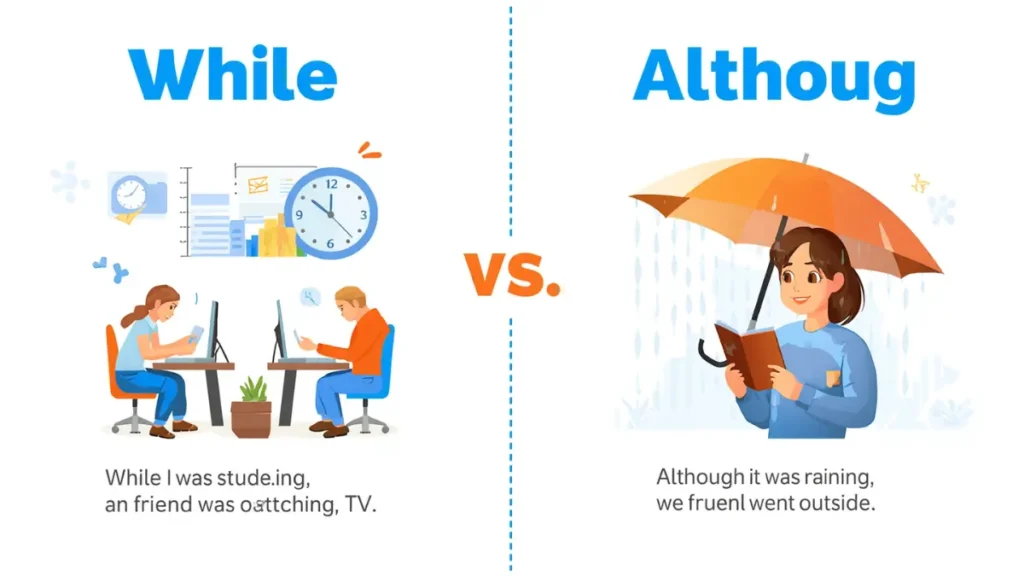
Many English learners struggle with while and although because both words connect ideas and show contrast. At first glance, they seem interchangeable. You may see sentences like, “While I like coffee, I prefer tea” and “Although I like coffee, I prefer tea.” Both sound correct, which makes the choice confusing.
People often search for while or although because they want to improve their grammar, write more naturally, and avoid mistakes in school, business, or everyday communication. Understanding the difference helps you create clearer and more professional sentences.
The good news is that both words are easy to master once you understand their main functions. Although is mainly used to show contrast, while while can show either contrast or time. This small difference affects when each word should be used.
In this guide, you’ll learn the meanings, origins, usage rules, common mistakes, examples, and trends related to while and although. By the end, you’ll know exactly which word fits your sentence.
While or Although – Quick Answer
Although is used to show contrast between two ideas.
While can show contrast or indicate that two actions happen at the same time.
Examples
✅ Although it was raining, we went outside.
✅ While it was raining, we went outside.
Time Example
✅ While I was studying, my friend was watching TV.
❌ Although I was studying, my friend was watching TV.
Easy Rule
- Use although for contrast.
- Use while for time or contrast.
Read more: May or Might: What’s the Difference?
The Origin of While or Although
While
The word while comes from Old English hwil, meaning “a period of time.” Its original meaning referred to time. Later, it also developed a contrasting meaning.
Although
The word although comes from Middle English. It combines the words all and though. It has long been used to express concession or contrast.
Why the Confusion Exists
The confusion exists because while can also show contrast, making it similar to although in many sentences.
For example:
- While I enjoy football, I prefer cricket.
- Although I enjoy football, I prefer cricket.
Both sentences are correct.
Read more: Can or May: What’s the Difference ?
British English vs American English Spelling
There is no spelling difference between while and although in British and American English.
Both varieties use the same spellings and grammar rules.
Comparison Table
| Meaning | British English | American English |
| Contrast | Although | Although |
| Time or Contrast | While | While |
Examples
| British English | American English |
| Although it was late, he stayed. | Although it was late, he stayed. |
| While it was late, he stayed. | While it was late, he stayed. |
Which Spelling Should You Use?
There is no spelling choice to make because both words have the same spelling worldwide.
The real decision is based on meaning.
For US Audiences
Use:
- Although for contrast.
- While for time or contrast.
For UK Audiences
The same rule applies.
For Global Audiences
Choose the word that best expresses your meaning.
If you only want to show contrast, although is often clearer.
Common Mistakes with While or Although
Mistake 1
Using although to describe time.
❌ Although I was sleeping, my phone rang.
✅ While I was sleeping, my phone rang.
Mistake 2
Using while when only contrast is intended and clarity matters.
Less Clear:
⚠️ While the product is expensive, it is reliable.
Clearer:
✅ Although the product is expensive, it is reliable.
Mistake 3
Using both words together.
❌ While although it was cold, we went out.
✅ Although it was cold, we went out.
✅ While it was cold, we went out.
While or Although in Everyday Examples
Emails
“Although the project faced delays, it was completed successfully.”
News Writing
“While inflation remains high, economic growth continues.”
Social Media
“Although I’m tired, I’m still excited for tonight.”
Formal Writing
“Although the sample size was small, the results were significant.”
Daily Conversation
“While I was cooking, my brother cleaned the kitchen.”
While or Although – Google Trends & Usage Data
Both words are among the most common conjunctions in English.
While
- Extremely common in conversation.
- Frequently used for time-related actions.
- Popular in journalism and business writing.
Although
- Common in academic and formal writing.
- Preferred when expressing contrast clearly.
- Often used in essays and reports.
Usage by Country
| Country | While Usage | Although Usage |
| United States | Very High | High |
| United Kingdom | Very High | High |
| Canada | High | High |
| Australia | High | High |
| New Zealand | High | High |
Overall, while appears more frequently because it serves two purposes: time and contrast.
While vs Although Comparison Table
| Feature | While | Although |
| Shows Time | Yes | No |
| Shows Contrast | Yes | Yes |
| Common in Conversation | Very Common | Common |
| Formal Writing | Common | Very Common |
| British English | Same Spelling | Same Spelling |
| American English | Same Spelling | Same Spelling |
FAQs
1. What is the difference between while and although?
While can show time or contrast. Although only shows contrast.
2. Can while and although be used interchangeably?
Sometimes. They can both show contrast, but only while can indicate time.
3. Which is more formal, while or although?
Although is generally considered slightly more formal.
4. Can I start a sentence with although?
Yes.
Example:
“Although it was raining, we went outside.”
5. Can I start a sentence with while?
Yes.
Example:
“While I was studying, my phone rang.”
6. Is although used in business writing?
Yes. It is very common in reports, emails, and professional documents.
7. Which word is more common in everyday speech?
While is usually more common because it has multiple uses.
Conclusion
Understanding the difference between while and although helps you communicate more clearly and accurately. Although both words can show contrast, they are not always interchangeable. Although focuses only on contrast, while while can express either contrast or time.
A simple rule can help you remember the difference. If you are describing two actions happening at the same time, use while. If you are highlighting a surprising contrast between two ideas, use although. In many cases, both words may be grammatically correct, but one may sound clearer depending on the context.
There are no spelling differences between British and American English, so your choice depends entirely on meaning. Professional writers often choose although when they want a clear contrast and while when discussing simultaneous actions.
By understanding these small differences, you can improve your writing, avoid common mistakes, and sound more natural in both formal and informal English. Whether you’re writing emails, reports, essays, or social media posts, choosing the right word will make your message stronger and easier to understand.

I am Arshman Ali a professional English writer and English professor with a passion for language and a commitment to excellence. I bring precision and clarity to my writing, and the same high standards into my classroom. For me, language is not just a profession it is a purpose.