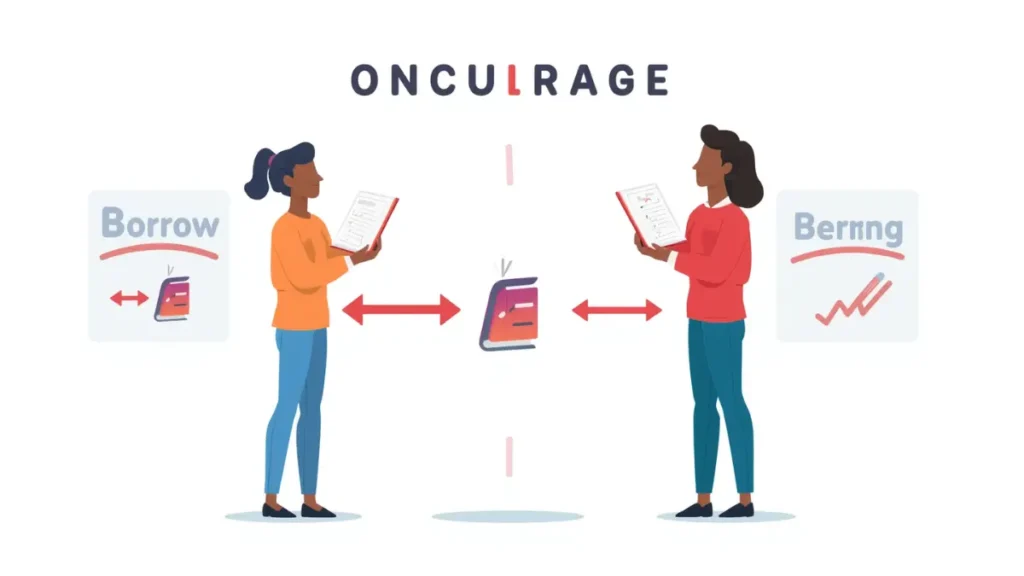
Do you ever stop and wonder If you should say borrow or lend? You are not alone. These two words are among the most commonly confused verbs in English. Many learners and even native speakers mix them up because both words involve giving and receiving something temporarily.
For example, should you say, “Can I lend your book?” or “Can I borrow your book?” The answer depends on who is giving and who is receiving. Using the wrong word can make your sentence sound unnatural or confusing.
The good news is that the difference between borrow and lend is simple once you understand the basic rule. In this guide, you will learn the meaning of each word, their history, how they are used in British and American English, common mistakes to avoid, and real-life examples.
By the end, you will know exactly when to use borrow and when to use lend in everyday conversations, emails, social media posts, and professional writing.
Borrow or Lend – Quick Answer
The difference is simple:
- Borrow means to take something from someone temporarily.
- Lend means to give something to someone temporarily.
Examples
✅ Can I borrow your pen?
✅ She borrowed a book from the library.
✅ I will lend you my pen.
✅ He lent his car to his brother.
A simple rule to remember:
Borrow = Receive
Lend = Give
Read more: While or Although: What’s the Difference
The Origin of Borrow or Lend
The words borrow and lend have different origins but have worked together in English for centuries.
Borrow
The word borrow comes from Old English borgian, meaning “to take something on security” or “to obtain temporarily.”
Lend
The word lend comes from Old English lǣnan, meaning “to grant” or “to allow someone to use something.”
Over time, both words became essential parts of English communication because people frequently exchange items, money, and services.
Unlike spelling-confusion pairs such as color and colour, borrow and lend are not different spellings of the same word. They are two different verbs with opposite perspectives.
British English vs American English Spelling
There is no spelling difference between British English and American English.
Both countries use:
- Borrow
- Lend
Read more: Between or Among: What’s the Difference
Comparison Table
| Meaning | British English | American English |
| Receive temporarily | Borrow | Borrow |
| Give temporarily | Lend | Lend |
| Correct spelling | Borrow / Lend | Borrow / Lend |
| Alternative spelling | None | None |
Examples
British English:
- May I borrow your umbrella?
American English:
- Can I borrow your phone charger?
The words remain the same across both versions of English.
Which Spelling Should You Use?
Since there is no spelling variation, your choice depends on meaning rather than location.
For US Audiences
Use borrow when receiving something.
Use lend when giving something.
For UK Audiences
The same rule applies.
For Commonwealth Countries
Australia, Canada, New Zealand, and South Africa also follow the same usage.
For Global Audiences
Use the standard distinction:
- Borrow = receive
- Lend = give
This usage is understood worldwide.
Common Mistakes with Borrow or Lend
Many English learners reverse these words.
Mistake 1
❌ Can you borrow me your book?
✅ Can you lend me your book?
Mistake 2
❌ Can I lend your book?
✅ Can I borrow your book?
Mistake 3
❌ He borrowed me some money.
✅ He lent me some money.
Mistake 4
❌ I lent a laptop from my friend.
✅ I borrowed a laptop from my friend.
Quick Memory Trick
If the item is coming to you, use borrow.
If the item is going from you, use lend.
Borrow or Lend in Everyday Examples
“Could I borrow the meeting notes from yesterday?”
Business Communication
“I can lend you a copy of the report.”
News
“The bank agreed to lend money to small businesses.”
Social Media
“Can anyone lend me a camera for the weekend?”
Formal Writing
“The organization lent resources to support the project.”
Everyday Conversation
“May I borrow your charger?”
“Sure, I can lend it to you.”
Borrow or Lend – Google Trends & Usage Data
Both words are widely searched because many English learners struggle with the difference.
Popular Contexts
| Context | Common Word |
| Asking for an item | Borrow |
| Giving an item | Lend |
| Financial services | Lend |
| Libraries | Borrow |
| Education | Both |
| Daily conversation | Both |
Usage by Country
| Country | Borrow Usage | Lend Usage |
| United States | Very High | Very High |
| United Kingdom | Very High | Very High |
| Canada | High | High |
| Australia | High | High |
| New Zealand | High | High |
Search interest often increases among students, English learners, and professionals improving their writing skills.
Borrow vs Lend Comparison Table
| Feature | Borrow | Lend |
| Meaning | Receive temporarily | Give temporarily |
| Direction | Toward you | Away from you |
| Verb Type | Action of receiver | Action of giver |
| Example | Borrow a book | Lend a book |
| Common Use | Requests | Offers |
| Formal Writing | Yes | Yes |
| Everyday Speech | Yes | Yes |
Frequently Asked Questions (FAQs)
1. What is the difference between borrow and lend?
Borrow means receiving something temporarily. Lend means giving something temporarily.
2. Is it “borrow me” or “lend me”?
The correct phrase is lend me.
Example:
✅ Lend me your pen.
❌ Borrow me your pen.
3. Can I say “Can I lend your book?”
No.
The correct sentence is:
✅ Can I borrow your book?
4. Which word is used in libraries?
Libraries lend books.
Readers borrow books.
5. Are borrow and lend interchangeable?
No. They describe opposite sides of the same action.
6. Do British and American English use these words differently?
No. Both varieties use the same meanings and spellings.
7. How can I remember the difference?
Remember:
Borrow = Take
Lend = Give
Conclusion
Understanding the difference between borrow and lend can instantly improve your English. Although these words are closely related, they describe opposite actions. When you receive something temporarily, you borrow it. When you give something temporarily, you lend it.
There is no British or American spelling difference, making the rule easy to apply everywhere. If you are writing an email, speaking with friends, preparing a business document, or studying English, using the correct word helps make your communication clear and professional.
A simple way to remember the difference is to think about direction. If something comes toward you, you borrow it. If something goes from you to another person, you lend it. This small distinction can prevent common mistakes and help you sound more natural in English.
By practicing real-life examples and remembering the basic rules, you can confidently use borrow and lend in any situation.

I am Arshman Ali a professional English writer and English professor with a passion for language and a commitment to excellence. I bring precision and clarity to my writing, and the same high standards into my classroom. For me, language is not just a profession it is a purpose.