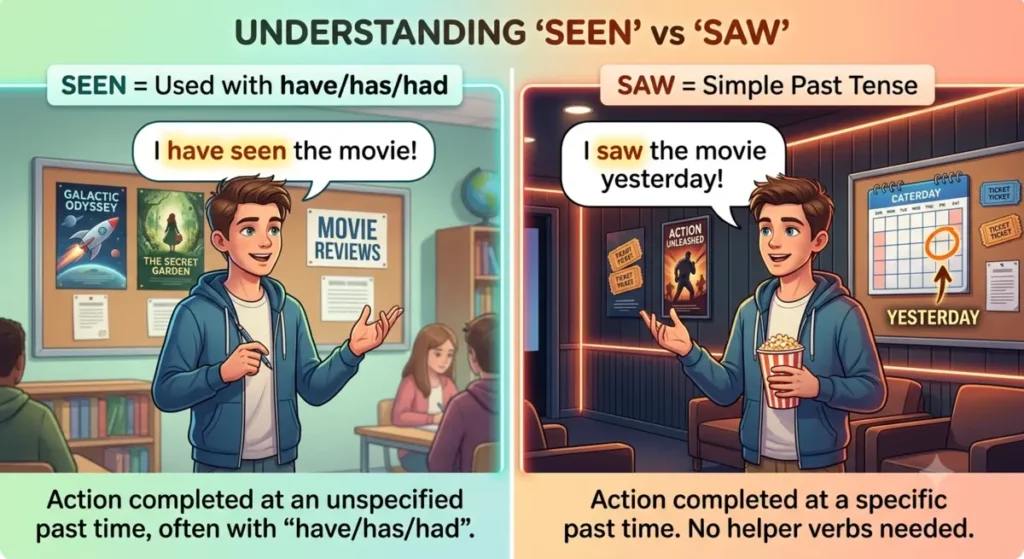
Many English learners and even native speakers get confused about “seen or saw.” Both words come from the verb “see,” but they are not used the same way. This small grammar mistake appears in emails, school work, social media posts, and even business writing.
People often search for “seen or saw” because they want a quick and simple answer. They may ask questions like: “Is it I seen or I saw?” or “When should I use seen?” The confusion happens because both words talk about the past, but each follows a different grammar rule.
The good news is that the difference is easy to understand. Once you learn one simple rule, you can avoid this common mistake forever. In this guide, you will learn the meaning of “seen” and “saw,” their history, spelling rules, common errors, and real-life examples. You will also discover which form works best in formal and casual writing.
Seen or Saw – Quick Answer
The main difference is simple:
- Saw is the simple past tense of “see.”
- Seen is the past participle and needs a helping verb like have, has, had, was, or been.
Correct Examples
- I saw a movie yesterday.
- I have seen that movie before.
- She saw the accident.
- They had seen the news already.
Read more: Alternately or Alternatively: Meaning, Difference and Correct Usage
Incorrect Examples
- I seen him yesterday. ❌
- She has saw that show. ❌
Easy Rule
- Use saw alone.
- Use seen with a helping verb.
The Origin of Seen or Saw
Both “seen” and “saw” come from the Old English verb “seon,” which meant “to see” or “to observe.”
Over time, English changed and created different verb forms:
Read more: Laying or Lying: What’s the Difference ?
| Verb Form | Word |
| Base Verb | See |
| Past Tense | Saw |
| Past Participle | Seen |
English keeps many old irregular verbs. That is why we say:
- go → went → gone
- see → saw → seen
The spelling differences exist because English developed from Germanic languages. These older language patterns stayed in modern English grammar.
British English vs American English Spelling
The words “seen” and “saw” are spelled the same in both British and American English. There is no spelling difference between the two versions of English.
The difference is only about grammar and usage.
Comparison Table
| Usage | British English | American English |
| Past tense | I saw him. | I saw him. |
| Past participle | I have seen him. | I have seen him. |
| Informal mistakes | I seen him. ❌ | I seen him. ❌ |
Key Point
Both countries follow the same grammar rules for “seen” and “saw.”
Which Spelling Should You Use?
You should choose the correct form based on grammar, not location.
Use “Saw” When:
- Talking about a completed action in the past
- No helping verb is present
Examples
- I saw the match last night.
- We saw your message.
Use “Seen” When:
- A helping verb is included
- The sentence uses perfect tense
Examples
- I have seen this before.
- She had seen the email earlier.
Audience-Based Advice
| Audience | Best Usage |
| US readers | Follow standard grammar |
| UK readers | Follow standard grammar |
| Global audience | Use simple grammar rules |
Correct grammar improves trust and professionalism everywhere.
Common Mistakes with Seen or Saw
Many people mix these words in speech and writing.
Common Errors
| Incorrect | Correct |
| I seen it yesterday. | I saw it yesterday. |
| She has saw the film. | She has seen the film. |
| We seen your post. | We saw your post. |
| They had saw the car. | They had seen the car. |
Why These Mistakes Happen
- Informal speech habits
- Regional dialects
- Confusion about past tense forms
Simple Fix
Ask yourself:
- Is there a helping verb?
- Yes → use seen
- No → use saw
Seen or Saw in Everyday Examples
Emails
- I saw your email this morning.
- I have seen your request and will reply soon.
News Writing
- Witnesses saw smoke near the building.
- Officials have seen rising costs this year.
Social Media
- I saw that meme yesterday.
- Have you seen this video yet?
Formal Writing
- Researchers saw changes in the data.
- Scientists have seen similar results before.
Seen or Saw – Google Trends & Usage Data
Search data shows that many users look for “seen or saw” because grammar confusion is very common.
Countries with High Search Interest
- United States
- United Kingdom
- Canada
- Australia
- India
Common Search Queries
- seen vs saw
- when to use seen
- saw or seen grammar
- I seen or I saw
Usage Context
| Context | Common Form |
| Casual speech | Often incorrect |
| School writing | Usually corrected |
| Professional writing | Standard grammar required |
| Social media | Mixed usage |
Grammar tools and search engines often correct misuse automatically.
Seen or Saw Comparison Table
| Feature | Saw | Seen |
| Verb Type | Past tense | Past participle |
| Needs Helping Verb | No | Yes |
| Example | I saw it. | I have seen it. |
| Formal Usage | Correct | Correct |
| Common Mistake | Used with “have” | Used alone |
FAQs About Seen or Saw
1. Is it correct to say “I seen”?
No. “I seen” is incorrect in standard English. Say “I saw” or “I have seen.”
2. When should I use “saw”?
Use “saw” for a completed action in the past.
Example: I saw her yesterday.
3. When should I use “seen”?
Use “seen” with helping verbs like “have,” “has,” or “had.”
Example: I have seen that movie.
4. Is “seen” past tense?
No. “Seen” is the past participle form.
5. Why do people confuse seen and saw?
Because both words relate to past actions and sound similar in conversation.
6. Do British and American English use different rules?
No. Both use the same grammar rules for “seen” and “saw.”
7. Is “I have saw” correct?
No. The correct form is “I have seen.”
Conclusion
Understanding the difference between “seen or saw” is easier than many people think. The key rule is simple: use “saw” as the simple past tense and use “seen” only with a helping verb. Once you remember this pattern, your grammar becomes much clearer and more professional.
Many people make mistakes with these words because informal speech often ignores grammar rules. However, correct usage matters in school, business emails, academic writing, and professional communication. Using the right word helps your message sound polished and trustworthy.
You should also remember that British English and American English follow the same rules for these words. There is no spelling difference between them. The only thing that changes is sentence structure and grammar.
If you ever feel unsure, check for a helping verb. No helping verb means use “saw.” A helping verb means use “seen.” This quick check can help you avoid one of the most common English grammar mistakes.

I am Arshman Ali a professional English writer and English professor with a passion for language and a commitment to excellence. I bring precision and clarity to my writing, and the same high standards into my classroom. For me, language is not just a profession it is a purpose.